answer.
Ask question
Login Signup
Ask question
All categories
  • English
  • Mathematics
  • Social Studies
  • Business
  • History
  • Health
  • Geography
  • Biology
  • Physics
  • Chemistry
  • Computers and Technology
  • Arts
  • World Languages
  • Spanish
  • French
  • German
  • Advanced Placement (AP)
  • SAT
  • Medicine
  • Law
  • Engineering
Rzqust [24]
2 years ago
5

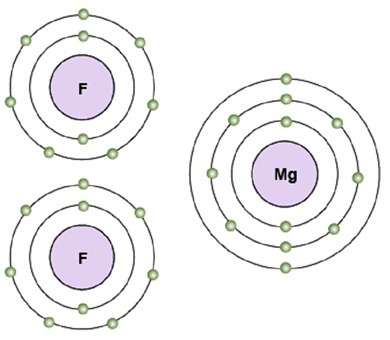
These diagrams show two atoms of fluorine and an atom of magnesium.

Physics
2 answers:
Morgarella [4.7K]2 years ago
8 0

The correct steps to the following question will be- A magnesium atom donates two electrons to the fluorine atoms → Each fluorine atom accepts one of the electrons → The magnesium atom becomes a +2 ion → Each fluorine atom becomes a -1 ion.

EXPLANATION:

The electronic configuration of fluorine atom is 1s^22s^22p^5.

The electronic configuration of magnesium is 1s^22s^22p^63s^2.

The valence shell of fluorine needs one electron to satisfy inert gas configuration to be stable. On other hand, the magnesium has two electrons in its valence shell. It needs six electrons more to be stable. As it is a electropositive metal, so it will lose two of its electrons to acquire the nearest inert gas configuration i.e neon.

Hence, magnesium will lose two of its valence electrons and becomes a  positively charged cation having +2 charge.

Each of the fluorine atoms will accept one electron from magnesium and becomes negatively charged anion having one unit negative charge.

Now both the cation and anion are attracted by the coulombic force of attraction and forms magnesium chloride.

Bezzdna [24]2 years ago
4 0

the answer is D. A magnesium atom donates two electrons to the fluorine atoms → Each fluorine atom accepts one of the electrons → The magnesium atom becomes a +2 ion → Each fluorine atom becomes a -1 ion

because magnesium only has 2 valence electrons, and it would be easier to lose electrons rather gain.

i just took the test, its right.


You might be interested in
A guitar string has a linear density of 8.30 ✕ 10−4 kg/m and a length of 0.660 m. the tension in the string is 56.7 n. when the
Sedbober [7]
Ans: Beat Frequency = 1.97Hz

Explanation:
The fundamental frequency on a vibrating string is 

f =   \sqrt{ \frac{T}{4mL} }<span>  -- (A)</span>

<span>here, T=Tension in the string=56.7N,
L=Length of the string=0.66m,
m= mass = 8.3x10^-4kg/m * 0.66m = 5.48x10^-4kg </span>


Plug in the values in Equation (A)

<span>so </span>f = \sqrt{ \frac{56.7}{4*5.48*10^{-4}*0.66} }<span> = 197.97Hz </span>

<span>the beat frequency is the difference between these two frequencies, therefore:
Beat frequency = 197.97 - 196.0 = 1.97Hz
-i</span>
3 0
2 years ago
Read 2 more answers
A 7.5 nC point charge and a - 2.9 nC point charge are 3.2 cm apart. What is the electric field strength at the midpoint between
Oduvanchick [21]

Answer:

Net electric field, E_{net}=91406.24\ N/C

Explanation:

Given that,

Charge 1, q_1=7.5\ nC=7.5\times 10^{-9}\ C

Charge 2, q_2=-2.9\ nC=-2.9\times 10^{-9}\ C

distance, d = 3.2 cm = 0.032 m

Electric field due to charge 1 is given by :

E_1=\dfrac{kq_1}{r^2}

E_1=\dfrac{9\times 10^9\times 7.5\times 10^{-9}}{(0.032)^2}

E_1=65917.96\ N/C

Electric field due to charge 2 is given by :

E_2=\dfrac{kq_2}{r^2}

E_2=\dfrac{9\times 10^9\times 2.9\times 10^{-9}}{(0.032)^2}

E_2=25488.28\ N/C

The point charges have opposite charge. So, the net electric field is given by the sum of electric field due to both charges as :

E_{net}=E_1+E_2

E_{net}=65917.96+25488.28

E_{net}=91406.24\ N/C

So, the electric field strength at the midpoint between the two charges is 91406.24 N/C. Hence, this is the required solution.

3 0
2 years ago
Suppose you are measuring the height of a small child. What will determine the number if significant digits you record?
slega [8]

The number of significant digits of any measurement is determined by the instrument used for such measurement. For example, in this case, we have the height of a small child being measured. We can use a simple ruler for this, and we see that a ruler has ten divisions for 1 cm. This means that the ruler cannot measure beyond the size of 0.1 cm or 1 mm. Hence, when we report the height of the small child, we report it to one significant digit after the decimal place. As an example, if we measure a child's height to be 90 full cm divisions and 8 smaller divisions, we report it as 90.8 cm but not 90.83 or 90.86 cm.

8 0
2 years ago
Which of the following statements accurately describes the atmospheric patterns that influence local weather?
timurjin [86]

Answer: A

Explanation:

Well the high and lows effect the humidity the more humidity the more hot it is so the high brings higher temperatures.

4 0
1 year ago
A circular loop of wire with a radius of 12.0 cm and oriented in the horizontal xy-plane is located in a region of uniform magne
Ulleksa [173]

(a) 34 V

The average emf induced in the loop is given by Faraday-Newmann-Lenz law:

\epsilon = -\frac{\Delta \Phi_B}{\Delta t} (1)

where

\Delta \Phi_B is the variation of magnetic flux through the coil

\Delta t = 2.0 ms = 0.002 s is the time interval

We need to find the magnetic flux before and after. The magnetic flux is given by:

\Phi_B = BA

where

B is the magnetic field intensity

A is the area of the coil

The radius of the coil is r = 12.0 cm = 0.12 m, so its area is

A=\pi r^2 = \pi (0.12 m)^2 = 0.045 m^2

At the beginning, the magnetic field is

B_i = 1.5 T

so the flux is

\Phi_i = B_i A = (1.5 T)(0.045 m^2)=0.068 Wb

while after the removal of the coil, the magnetic field is zero, so the flux is also zero:

\Phi_f = 0

so the variation of magnetic flux is

\Delta \Phi = 0-0.068 Wb=-0.068 Wb

And substituting into (1) we find the average emf in the coil

\epsilon=-\frac{-0.068 Wb}{0.002 s}=34 V

(b) Counterclockwise

In order to understand the direction of the induced current, we have to keep in mind the negative sign in Lenz's law (1), which tells that the direction of the induced current must be such that the magnetic field produced by this current opposes the variation of magnetic flux in the coil.

In this situation, the magnetic flux through the coil is decreasing, since the coil is removed from the field. So, the induced current must be such that it produces a magnetic field whose direction is the same as the direction of the external magnetic field, which is upward along the positive z-direction.

Looking down from above and using the right-hand rule on the loop (thumb: direction of the current, other fingers wrapped: direction of magnetic field), we see that in order to produce at the center of the coil a magnetic field which is along positive z-direction, the induced current must be counterclockwise.
4 0
2 years ago
Other questions:
  • What would be the weight of a 59.1-kg astronaut on a planet with the same density as Earth and having twice Earth's radius? . .
    6·2 answers
  • The picture below shows the position of Earth and two stars.
    11·2 answers
  • The forward movement of orbital waves classifies them as ____ waves.
    13·1 answer
  • An airplane traveling 245 m/s east experienced turbulence, so the pilot decided to slow down to 230 m/s. It took the pilot 7 sec
    6·2 answers
  • Anna Litical and Noah Formula are experimenting with the effect of mass and net force upon the acceleration of a lab cart. They
    11·1 answer
  • Given the indices of refraction n1 and n2 of material 1 and material 2, respectively, rank these scenarios on the basis of the p
    13·1 answer
  • Steam at 700 bar and 600 oC is withdrawn from a steam line and adiabatically expanded to 10 bar at a rate of 2 kg/min. What is t
    14·1 answer
  • Whennes
    15·1 answer
  • A bag is gently pushed off the top of a wall at A and swings in a vertical plane at the end of a rope of length l. Determine the
    12·1 answer
  • After an arrow is shot, is the force unbalanced or balanced? BRAINLY.
    6·1 answer
Add answer
Login
Not registered? Fast signup
Signup
Login Signup
Ask question!
