answer.
Ask question
Login Signup
Ask question
All categories
  • English
  • Mathematics
  • Social Studies
  • Business
  • History
  • Health
  • Geography
  • Biology
  • Physics
  • Chemistry
  • Computers and Technology
  • Arts
  • World Languages
  • Spanish
  • French
  • German
  • Advanced Placement (AP)
  • SAT
  • Medicine
  • Law
  • Engineering
Vsevolod [243]
2 years ago
4

Draw l-aspartic acid as it would occur at the ph of most body fluids.

Chemistry
1 answer:
Svet_ta [14]2 years ago
5 0
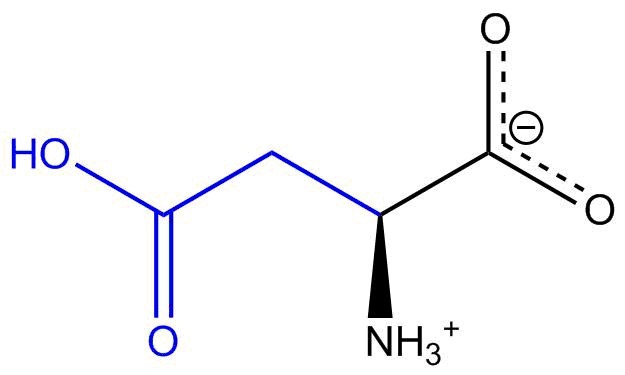
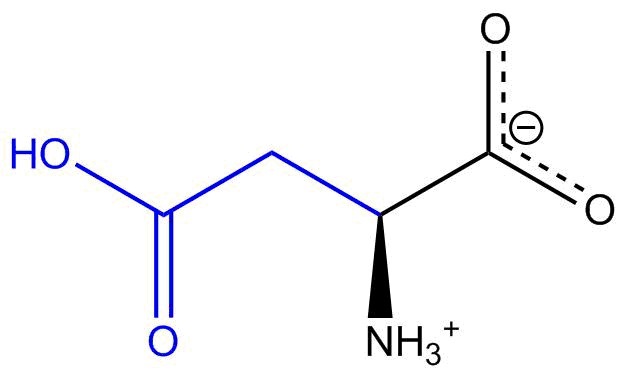
L-aspartic acid is an α-amino acid. Shown in the structure attached. The original structure of l-aspartic acid is the structure containing no charges. It contains an amine functionality and a carboxylic functionality like all amino acids and has an R-group, which in this case is another carboxylic acid group. Amino acids are amphoteric which means it can act as an acid as a base, since the -NH₂ group is basic, and the -COOH group is acidic.

The physiological pH, which is the pH of various body fluids such as blood, is generally around 7.4. This is a mostly neutral pH. A carboxylic acid has a pKa value of around 3-4. If the pH of a solution is higher than the pKa of the acid in that solution, then the acid will dissociate and give up it's protons. In this example, the carboxylic functional group has a pKa of 3.9, which is less than the pH of 7.4. Therefore, at physiologic pH, the carboxylic acid functionality will be deprotonated in the form -COO⁻.

We must also consider the basic amine, -NH₂, functional group. This basic group has the ability to be protonated under the right pH conditions. When an amine is protonated, it becomes an ammonium group of the form -NH₃⁺. This ammonium group has a pKa of around 9. If the pH is greater than 9, then this group will be deprotonated, but in our case, the physiological pH is 7.4 which is less than 9. Therefore, the amine group will be protonated at a physiological pH.

The correct structure to represent l-aspartic acid is shown in the image that has charges, with a deprotonated carboxylic acid group, -COO⁻, and a protonated amine group, -NH₃⁺.

This is true for the pure amino acid. However, when this amino acid is part of a protein chain and has formed peptide bonds using the amine and carboxylic groups, what is left is the free carboxylic acid chain. The same rules apply to this carboxylic acid, and therefore, at physiological pH, this carboxylic acid will be the one to be deprotonated, as the other carboxylic acid will have reacted to form a peptide bond.

You might be interested in
If a gas has a volume of 750 mL at 25oC, what would the volume of the gas be at 55oC?
blagie [28]

Answer:

The answer to your question is     V2 = 825.5 ml

Explanation:

Data

Volume 1 = 750 ml

Temperature 1 = 25°C

Volume 2= ?

Temperature 2 = 55°C

Process

Use the Charles' law to solve this problem

                V1/T1 = V2/T2

-Solve for V2

                V2 = V1T2 / T1

-Convert temperature to °K

T1 = 25 + 273 = 298°K

T2 = 55 + 273 = 328°K

-Substitution

                V2 = (750 x 328) / 298

-Simplification

                V2 = 246000 / 298

-Result

                V2 = 825.5 ml


7 0
2 years ago
(ii) When shale gas is burned, the hydrogen sulfide reacts with oxygen.
Elenna [48]

Answer:

See explanation

Explanation:

Now , we have the equation of the reaction as;

2H2S(g) + 302(g)------->2SO2(g) + 2H2O(g)

This equation shows that SO2 gas is produced in the process. Let us recall that this same SO2 gas is the anhydride of H2SO4. This means that it can dissolve in water to form H2SO4

So, when SO2 dissolve in rain droplets, then H2SO4 is formed thereby lowering the pH of rain water. This is acid rain.

4 0
2 years ago
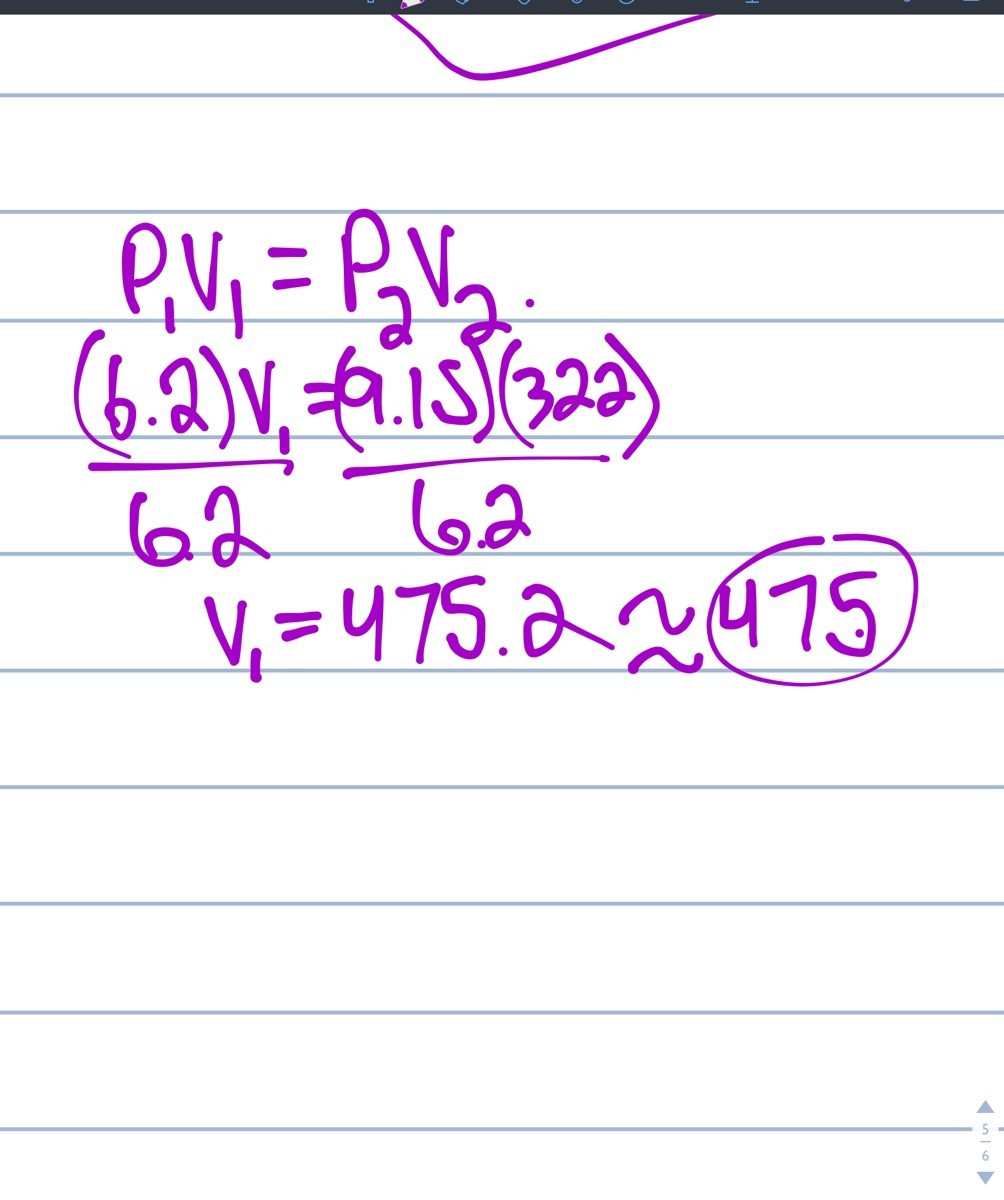
a gas that exerts a pressure of 6.20 atm in a container with a volume of ____ mL will exert a pressure of 9.150 atm when transfe
leonid [27]
The answer is 475 mL

7 0
2 years ago
Read 2 more answers
When C3H8 burns completely inn excess of oxygen, the products formed are
kolezko [41]

Answer:

C3H8 + 5O2 ====> 3CO2 + 4H20

4 0
2 years ago
determine whether each of the following causes an increase or decrease in the activity of the electron transport chain.
viktelen [127]
The following causes increase the activity of the electron transport chain:
1. High ADP concentration
2. Large differences in H+ concentration across the inner mitochondrial membrane
3. High phosphate concentration

The following causes decrease the activity of the electron transport chain:
1. Low oxygen concentration
2. Low NADH concentration
4 0
2 years ago
Other questions:
  • What scientific knowledge was necessary for Kroto, Smalley, and Curl to discover buckyballs? Check all that apply. All matter is
    7·2 answers
  • The average density of a carbon-fiber-epoxy composite is 1.615 g/cm3. the density of the epoxy resin is 1.21 g/cm3 and that of t
    12·1 answer
  • When one atom loses an electron and another atom accepts that electron a(n) bond between the two atoms results?
    14·1 answer
  • Write the formulas for the following ionic compounds: (a) copper bromide (containing the Cu+ ion), (b) manganese oxide (containi
    5·1 answer
  • Which letter indicates a subatomic particle with a mass of 5.489 x 10⁻⁴ amu
    5·2 answers
  • let 4 moles of methanol (liquid) combust in 3 moles of gaseous oxygen to form gaseous carbon dioxide and water vapor. Suppose th
    12·1 answer
  • A mixture of ethyl alcohol (molecular mass = 46.1 u) and water (molecular mass = 18.0 u) contains one mole of molecules. The mix
    11·1 answer
  • Determine whether the statement is true or false, and why? “Climate change could cause many habitats to be destroyed, leading to
    7·1 answer
  • Salt in crude oil must be removed before the oil undergoes processing in a refinery. The
    15·1 answer
  • Will is learning about a new kind of plastic used to make models. He learns that infrared light is absorbed by the plastic, X-ra
    7·2 answers
Add answer
Login
Not registered? Fast signup
Signup
Login Signup
Ask question!