answer.
Ask question
Login Signup
Ask question
All categories
  • English
  • Mathematics
  • Social Studies
  • Business
  • History
  • Health
  • Geography
  • Biology
  • Physics
  • Chemistry
  • Computers and Technology
  • Arts
  • World Languages
  • Spanish
  • French
  • German
  • Advanced Placement (AP)
  • SAT
  • Medicine
  • Law
  • Engineering
frozen [14]
2 years ago
14

A transverse wave on a rope is given by y(x,t)= (0.750cm)cos(π[(0.400cm−1)x+(250s−1)t]). find the period

Physics
2 answers:
Art [367]2 years ago
6 0

The time period of the transverse wave in a rope will be \boxed{{\text{0}}{\text{.025 s}}}.

Further Explanation:

The waves are the disturbance created in the medium particles. A transverse wave in a rope is the disturbance produced in the particles of the rope in the vertical direction.

A transverse wave is a wave in which the disturbance in the medium is perpendicular to the propagation of the wave. The time period of the wave is the time taken in completing one oscillation about the mean position.

The expression of the transverse wave in the rope is given.

y\left( {x,t} \right) = \left( {0.750\,{\text{cm}}} \right)\cos \left( {\pi \left[ {\left( {0.400\,{\text{cm}} - {\text{1}}} \right)x + \left( {250\,{{\text{s}}^{ - 1}}} \right)t} \right]} \right)  

The standard equation for a wave present in a rope is given as.

\boxed{y\left( {x,t} \right) = A\cos \left( {kx + \omega t} \right)}  

Here, A is the amplitude of the wave, y is the position of the wave, k is the wave number and \omega is the angular frequency of the wave.

From the above expression, the angular frequency of the wave is obtained as.

\omega  = 250\pi  

We know that the time period is obtained from the angular frequency as.

T = \dfrac{{2\pi }}{\omega }  

Substitute the value of \omega in above expression.

\begin{aligned}T &= \frac{{2\pi }}{{250\pi }} \\&= \frac{1}{{125}}\,{\text{s}} \\&\approx {\text{0}}{\text{.008}}\,{\text{s}} \\&\approx {\text{8}}\,{\text{ms}} \\\end{aligned}  

Thus, the time period of the transverse wave in the rope is \boxed{8\,{\text{ms}}}.

Learn More:

  1. Wavelength of electron brainly.com/question/1979815  
  2. Charles’ Law and its explanation brainly.com/question/7316997
  3. Magnitude of acceleration of crate while slipping brainly.com/question/10470406

Answer Details:

Grade: High School

Chapter: Waves

Subject: Physics

Keywords: Transverse, wave, amplitude, angular frequency, perpendicular, stationary wave, rope, velocity, position, propagation of wave, wave number.
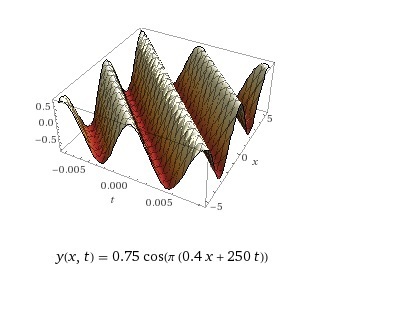
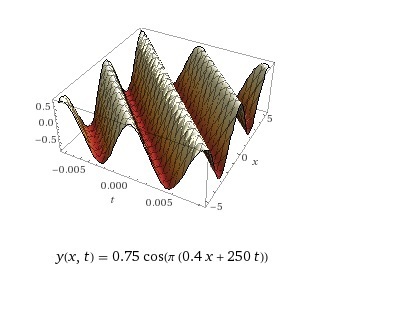
Angelina_Jolie [31]2 years ago
5 0
Using a graphical tool to obtain the form of the wave we can see that

It is periodic in X with period = 5 cm

It is periodic in t with period = 1/125 s = 8 ms

You might be interested in
a box weighing 155 N is pushed horizontally down the hall at constant velocity. the applied force is 83 n what is the coefficien
meriva

Answer:

μ = 0.535

Explanation:

On a level floor, normal force = weight.

N = W

Friction force = normal force × coefficient of friction.

F = Nμ

Substitute:

F = Wμ

83 = 155μ

μ = 0.535

Round as needed.

8 0
2 years ago
1. A 9.4×10²¹ kg moon orbits a distant planet in a circular orbit of radius 1.5×10⁸ m. It experiences a 1.1×10¹⁹ N gravitational
sattari [20]

Answer:

26 days

Explanation:

m = 9.4×10²¹ kg

r= 1.5×10⁸ m

F = 1.1×10^ 19 N

We know Fc = \frac{m v^{2} }{r}

==> 1.1 × 10^{19} = (9.4 × 10^{21} × v^{2} ) ÷ 1.5 × 10^{8}

==> 1.1 × 10^{19} = v^{2} × 6.26×10^{13}

==> v^{2} =  1.1 × 10^{19} ÷ 6.26×10^{13}

==> v^{2} = 0.17571885 × 10^{6}

==> v= 0.419188323 × 10^{3} m/sec

==> v= 419.188322834 m/s

Putting value of r and v from above in ;

T= 2πr ÷ v

==> T= 2×3.14×1.5×10^{8} ÷ 0.419188323 × 10^{3}

==> T = 22.472× 100000 = 2247200 sec

but

86400 sec = 1 day

==> 2247200 sec= 2247200 ÷ 86400 = 26 days

3 0
2 years ago
Read 2 more answers
An electric air heater consists of a horizontal array of thin metal strips that are each 10 mm long in the direction of an airst
sweet-ann [11.9K]

Answer:

see explanation below

Explanation:

Given that,

T_1 = 500°C

T_2 = 25°C

d = 0.2m

L = 10mm = 0.01m

U₀ = 2m/s

Calculate average temperature

\\T_{avg} = \frac{T_1 + T_2}{2} \\\\T_{avg} = \frac{500 + 25}{2} \\\\T_{avg} = 262.5

262.5 + 273

= 535.5K

From properties of air table A-4 corresponding to T_{avg} = 535.5K \approx 550K

k = 43.9 × 10⁻³W/m.k

v = 47.57 × 10⁻⁶ m²/s

P_r = 0.63

A)

Number for the first strips is equal to

R_e_x = \frac{u_o.L}{v}

R_e_x = \frac{2\times 0.01}{47.57 \times 10^-^6 }\\\\= 420.4

Calculating heat transfer coefficient from the first strip

h_1 = \frac{k}{L} \times 0.664 \times R_e_x^1^/^2 \times P_r^1^/^3

h_1 = \frac{43.9 \times 10^-^3}{0.01} \times 0.664\times420 \times 4^1^/^2 \times 0.683^1^/^3\\\\= 52.6W/km^2

The rate of convection heat transfer from the first strip is

q_1 = h_1\times(L\times d)\times(T_1 - T_2)\\\\q_1 = 52.6 \times (0.01\times0.2)\times(500-25)\\\\q_1 = 50W

The rate of convection heat transfer from the fifth trip is equal to

q_5 = (5 \times h_o_-_5-4\times h_o_-_4) \times(L\times d)\times (T_1 -T_2)

h_o_-_5 = \frac{k}{5L} \times 0.664 \times (\frac{u_o\times 5L}{v} )^1^/^2\times Pr^1^/^3\\\\= \frac{43.9\times10^-^3}{0.05} \times0.664\times (\frac{2 \times 0.05}{47.57 \times 10^-^6} )^1^/^2\times 0.683^1^/^3\\\\= 25.5W/Km^2

Calculating h_o_-_4

h_o_-_4 = \frac{k}{4L} \times 0.664 \times (\frac{u_o\times 4L}{v } )^1^/^2\times Pr^1^/^3\\\\= \frac{43.9\times10^-^3}{0.04} \times0.664\times (\frac{2 \times 0.04}{47.57 \times 10^-^6} )^1^/^2\times 0.683^1^/^3\\\\= 26.3W/Km^2

The rate of convection heat transfer from the tenth strip is

q_1_0 = (10 \times h_o_-_1_0-9\times h_o_-_9) \times(L\times d)\times (T_1 -T_2)

h_o_-_1_0 = \frac{k}{10L} \times 0.664 \times (\frac{u_o\times 10L}{v } )^1^/^2\times Pr^1^/^3\\\\= \frac{43.9\times10^-^3}{0.1} \times0.664\times (\frac{2 \times 0.1}{47.57 \times 10^-^6} )^1^/^2\times 0.683^1^/^3\\\\= 16.6W/Km^2

Calculating

h_o_-_9 = \frac{k}{9L} \times 0.664 \times (\frac{u_o\times 9L}{v } )^1^/^2\times Pr^1^/^3\\\\= \frac{43.9\times10^-^3}{0.09} \times0.664\times (\frac{2 \times 0.09}{47.57 \times 10^-^6} )^1^/^2\times 0.683^1^/^3\\\\= 17.5W/Km^2

Calculating the rate of convection heat transfer from the tenth strip

q_1_0 = (10 \times h_o_-_1_0-9\times h_o_-_9) \times(L\times d)\times (T_1 -T_2)\\\\q_1_0 = (10 \times 16.6 -9\times 17.5) \times(0.01\times 0.2)\times (500 -25)\\\\=8.1W

The rate of convection heat transfer from 25th strip is equal to

q_2_5 = (25 \times h_o_-_2_5-24\times h_o_-_2_4) \times(L\times d)\times (T_1 -T_2)

Calculating h_o_-_2_5

h_o_-_2_5 = \frac{k}{25L} \times 0.664 \times (\frac{u_o\times 25L}{v } )^1^/^2\times Pr^1^/^3\\\\= \frac{43.9\times10^-^3}{0.25} \times0.664\times (\frac{2 \times 0.25}{47.57 \times 10^-^6} )^1^/^2\times 0.683^1^/^3\\\\= 10.5W/Km^2

Calculating h_o_-_2_4

h_o_-_2_4 = \frac{k}{24L} \times 0.664 \times (\frac{u_o\times 24L}{v } )^1^/^2\times Pr^1^/^3\\\\= \frac{43.9\times10^-^3}{0.24} \times0.664\times (\frac{2 \times 0.24}{47.57 \times 10^-^6} )^1^/^2\times 0.683^1^/^3\\\\= 10.7W/Km^2

Calculating the rate of convection heat transfer from the tenth strip

q_2_5 = (25 \times h_o_-_2_5-24\times h_o_-_2_4) \times(L\times d)\times (T_1 -T_2)\\\\q_1_0 = (25 \times 10.5 -24\times 10.7) \times(0.01\times 0.2)\times (500 -25)\\\\=5.4W

6 0
2 years ago
Water waves in a small tank are .06 m long. They pass a given point at a rate of 14.8 waves every three seconds. What is the spe
snow_lady [41]

Answer:

Speed = 0.296m/2

Period = 0.203 s

Explanation:

If by 'long' you mean the wavelength of the waves, then the wavelength \lambda=0.06m.

The frequency f of the waves is 14.8 waves every 3 seconds or

f=14.8/3 =4.33Hz.

Now the relationship between wavelength \lambda, frequency f and speed v of the waves is:

v=\lambda f

We put in the values \lambda=0.06m and f=4.933Hz and get:

\boxed{v=0.06*4.922=0.296m/s}

Now the period T is just the inverse of the frequency, or

T=\frac{1}{f}

\boxed{T=\frac{1}{4.933}=0.203\:seconds }

4 0
2 years ago
Under the Big Top elephant, Ella (2500 kg), is attracted to Phant, the 3,000 kg
Vladimir [108]

Under the Big Top elephant, Ella (2500 kg), is attracted to Phant, the 3,000 kg elephant. They are separated by 8

4 0
2 years ago
Other questions:
  • A 5.8 × 10⁴-watt elevator motor can lift a total weight of 2.1 × 10⁴ newtons with a maximum constant speed of
    12·1 answer
  • A body A of mass 1.5kg, travelling along the positive x-axis with speed 4.5m/s, collides with another body B of mass 3.2kg which
    14·1 answer
  • Joe wanted to experiment with different factors that affect the freezing rate of water. He put two cups of water into each of tw
    9·2 answers
  • Astronauts often undergo special training in which they are subjected to extremely high centripetal accelerations. One device ha
    15·2 answers
  • In the sport of parasailing, a person is attached to a rope being pulled by a boat while hanging from a parachute-like sail. A r
    10·1 answer
  • (a) Aircraft sometimes acquire small static charges. Suppose a supersonic jet has a 0.500 - μC charge and flies due west at a sp
    6·1 answer
  • A basketball player grabbing a rebound jumps 76.0 cm vertically. How much total time (ascent and descent) does the player spend.
    7·1 answer
  • A sound wave travels twice as far in neon (Ne) as it does it krypton (Kr) in the same time interval. Both neon and krypton can b
    9·1 answer
  • Using energy considerations and assuming negligible air resistance, show that a rock thrown from a bridge 20.0 m above water wit
    8·1 answer
  • Emir is standing in a treehouse and looking down at a swingset in the yard next door. The angle of depression from Emir's eyelin
    10·2 answers
Add answer
Login
Not registered? Fast signup
Signup
Login Signup
Ask question!
