answer.
Ask question
Login Signup
Ask question
All categories
  • English
  • Mathematics
  • Social Studies
  • Business
  • History
  • Health
  • Geography
  • Biology
  • Physics
  • Chemistry
  • Computers and Technology
  • Arts
  • World Languages
  • Spanish
  • French
  • German
  • Advanced Placement (AP)
  • SAT
  • Medicine
  • Law
  • Engineering
ozzi
2 years ago
8

A glass tube is filled with hydrogen gas.  An electric current is passed through the tube, and the tube begins to glow a pinkish

/purple color (this is how fluorescent bulbs and neon signs produce light). If you were to pass this pink light through a prism to separate the individual light frequencies, you would see that this pink light is composed of four distinct colors: violet, green, blue, and red.  Notice the similarity between image (b) above and image (b) from question #3. Which is the best description of why this occurs?

Physics
2 answers:
IRISSAK [1]2 years ago
6 0
The first description is the correct one.
Firdavs [7]2 years ago
5 0

Answer:

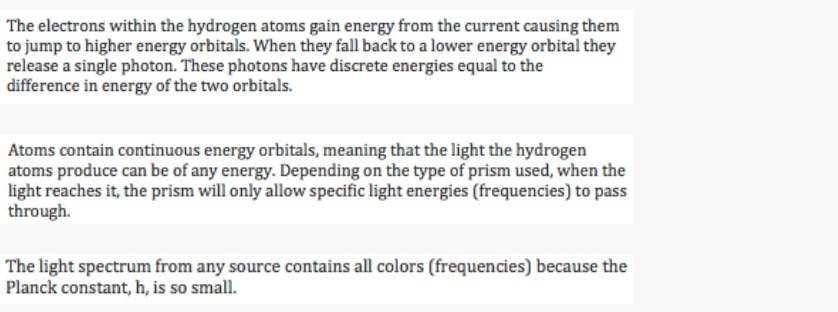
The electrons within the hydrogen atoms have gained energy from the current causing them to jump to higher orbitals. When they fall back to a lower energy orbital they release a single photon. These photons have discrete energies equal to the difference in energy of the two orbitals

Explanation:

The phenomenon described here is the photo electric effect.

When electricity is passed through the hydrogen gas an electron absorbs the energy of one photon and gains energy more than the work function of the hydrogen. Work function is the electron binding energy of a material. The above process causes the emission of an electron which is known as a photoelectron (photon).

You might be interested in
A box sits on a table. A short arrow labeled F subscript N points up. A short arrow labeled F subscript g points down. A long ar
Aloiza [94]

Answer:

unbalanced and right

Explanation:

7 0
2 years ago
Explain the theory Steven Reiss developed and tested.
NNADVOKAT [17]
<span>A theory of motivation by Steven Reiss, the 16 Basic Desires Theory talks about the sixteen fundamental needs, values and drives that motivate a person.</span>
6 0
2 years ago
Read 2 more answers
Takumi works in his yard for 45 minutes each Saturday. He works in the morning, and he wears sunscreen and a hat each time he wo
MrRa [10]

Explanation :

Takumi wears sunscreen and a hat each time he works in the yard. This is to protect himself with the strong radiation coming from the sun. UV rays that are coming from the sun are the main cause of skin cancer.

Stochastic effects are the effects that are caused by chance. Cancer is one of the main stochastic effects.

So, the correct option is (b) "the severity of stochastic effects, such as cancer".

7 0
3 years ago
Read 2 more answers
A cup of hot coffee initially at 95 degrees C cools to 80 degrees C in 5 min while sitting in a room of temperature 21 degrees C
Oksana_A [137]

Answer:

When the temperature of the coffee is 50 °C, the time will be 20.68 mins

Explanation:

Given;

The initial temperature of the coffee T₀ = 95 °C

The temperature of the room = 21°C

Let T be the temperature at time of cooling t in mins

According to Newton's law of cooling;

\frac{dT}{dt} \alpha (T-21)\\\\\frac{dT}{dt} = k (T-21)\\\\\frac{dT}{T-21} = kdt\\\\\int\limits {\frac{dT}{T-21}}  =  \int\limits kdt\\\\Log(T-21) =kt +  Logc \\\\Log (\frac{T-21}{c} ) = kt\\\\T -21 = ce^{kt}\\\\At \ t = 0, T = 95\\\\95-21 = ce^0\\\\74 = c\\\\New, equation: T -21 = 74e^{kt}\\\\Again; when \ t= 5\ min, T = 80\\\\80 -21 = 74e^{5k}\\\\59 = 74e^{5k}\\\\e^{5k} = \frac{59}{74}\\\\ 5k = ln(\frac{59}{74})\\\\5k = -0.2265\\\\k = -0.0453

When the temperature is 50 °C, the time t in min is calculated as;

T -21 = 74e^{-0.0453t}\\\\50 -21 = 74e^{-0.0453t}\\\\29 = 74e^{-0.0453t}\\\\\frac{29}{74} = e^{-0.0453t}\\\\0.39189 = e^{-0.0453t}\\\\ln(0.39189 ) = {-0.0453t}\\\\-0.93677 = {-0.0453t}\\\\t = \frac{-0.93677}{-0.0453}\\\\ t = 20.68 \ mins

Therefore, when the temperature of the coffee is 50 °C, the time will be 20.68 mins

4 0
2 years ago
A toy plane has a mass of 2.5 kg and is 18 m above the ground. It is moving at 4.5 m/s. How much mechanical energy does the toy
sleet_krkn [62]
Mechanical energy is the sum of kinetic energy and potential energy, or E=Ek+Ep. So Ek=(1/2)*m*v² where m is the mass of the object and v is it's velocity. Mp=m*g*h where m is the mass, g=9.81 m/s² and h is the height of the object. So after we input the numbers the total mechanical energy is
E=(1/2)*2.5*(4.5²) + 2.5*9.81*18 = 25.3125 J + 441.45 J = 466.7625 J. The correct answer is E= 466 J. 
4 0
2 years ago
Read 2 more answers
Other questions:
  • To avoid an accident, a driver steps on the brakes to stop a 1000-kg car traveling at 65km/h. if the braking distance is 35 m, h
    7·1 answer
  • At ground level g is 9.8m/s^2. Suppose the earth started to increase its angular velocity. How long would a day be when people o
    11·2 answers
  • Now assume that the boat is subject to a drag force fd due to water resistance. is the component of the total momentum of the sy
    15·2 answers
  • When you come within 100 ft of the uncontrolled railroad crossing and you cannot see the tracks for 400 ft in both directions, t
    8·1 answer
  • In order to get a tree stump out of the ground, chains are connected to two trucks. One truck pulls with a force of 600 N to the
    9·1 answer
  • you are sitting on a beach and a wave strikes the shore every 10 seconds. a surfer tells you that these waves travel at a speed
    6·1 answer
  • A uniform stationary ladder of length L = 4.5 m and mass M = 11 kg leans against a smooth vertical wall, while its bottom legs r
    12·1 answer
  • A 0.20 kg mass on a horizontal spring is pulled back 2.0 cm and released. If, instead, a 0.40 kg mass were used in this same exp
    12·1 answer
  • PLEASE HELP John is rollerblading down a long, straight path. At time zero, there is a mailbox about 1 m in front of him. In the
    5·1 answer
  • if a net horizontal force of 175 N is applied to a bike whos mass is 43 kg what acceleration is produced
    15·1 answer
Add answer
Login
Not registered? Fast signup
Signup
Login Signup
Ask question!
