answer.
Ask question
Login Signup
Ask question
All categories
  • English
  • Mathematics
  • Social Studies
  • Business
  • History
  • Health
  • Geography
  • Biology
  • Physics
  • Chemistry
  • Computers and Technology
  • Arts
  • World Languages
  • Spanish
  • French
  • German
  • Advanced Placement (AP)
  • SAT
  • Medicine
  • Law
  • Engineering
Goshia [24]
2 years ago
11

1. What mass of H2O will be produced if 9.5 g of H2 reacts with 1.2 g of O2?

Chemistry
2 answers:
docker41 [41]2 years ago
8 0

1) The answer is: mass of water is 1.35 grams.

Balanced chemical reaction: 2H₂ + O₂ → 2H₂O.

m(O₂) = 1.2 g; mass of oxygen.

M(O₂) = 2 · 16 g/mol.

M = 32 g/mol, molar mass of oxygen.

n(O₂) = m(O₂) ÷ M(O₂).

n(O₂) = 1.2 g ÷ 32 g/mol.

n(O₂) = 0.0375 mol; amount of oxygen, limiting reactant.

m(H₂) = 9.5 g; mass of hydrogen.

M(H₂) = 2 g/mol, molar mass of hydrogen.

n(H₂) = m(H₂) ÷ M(H₂).

n(H₂) = 9.5 g ÷ 2 g/mol.

n(H₂) = 4.5 mol; amount of hydrogen.

From chemical reaction: n(O₂) : n(H₂O) = 1 : 2.

n(H₂O) = 0.0375 mol · 2.

n(H₂O) = 0.075 mol; amount of water.

m(H₂O) = n(H₂O) · M(H₂O).

m(H₂O) = 0.075 mol · 18 g/mol.

m(H₂O) = 1.35 g; mass of water.

2) The answer is: 3.05 grams of MgCl₂ is produced, the limiting reactant is Mg(OH)₂.

Balanced chemical reaction: 2HCl + Mg(OH)₂ → MgCl₂ + 2H₂O.

m(Mg(OH)₂) = 1.85 g; mass of magnesium hydroxide

n(Mg(OH)₂) = m(Mg(OH)₂) ÷ M(Mg(OH)₂).

n(Mg(OH)₂) = 1.85 g ÷ 58.32 g/mol.

n(Mg(OH)₂) = 0.032 mol; limiting reactant.

m(HCl) = 3.71 g; mass of hydrochloric acid.

n(HCl) = 3.71 g ÷ 36.46 g/mol.

n(HCl) = 0.102 mol; amount of hydrochloric acid.

From chemical reaction: n(Mg(OH)₂) : n(MgCl₂) = 1 : 1.

n(MgCl₂) =0.032 mol; amount of magnesium chloride.

m(MgCl₂) = n(MgCl₂) · M(MgCl₂).

m(MgCl₂) = 0.032 mol · 95.21 g/mol.

m(MgCl₂) = 3.05 g; mass of magnesium chloride.

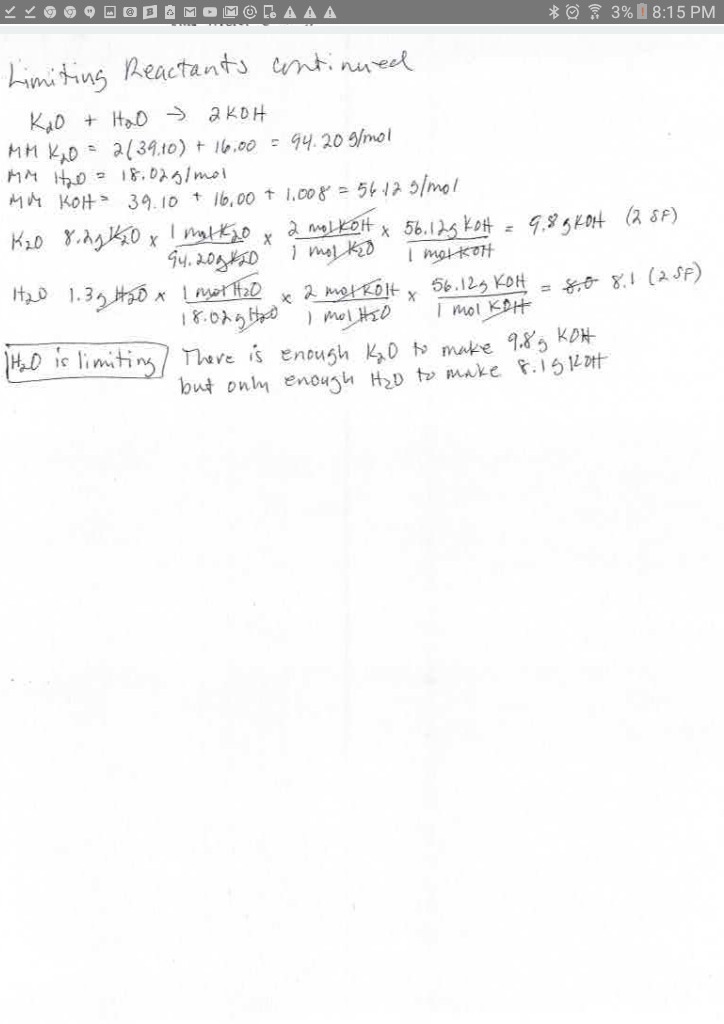
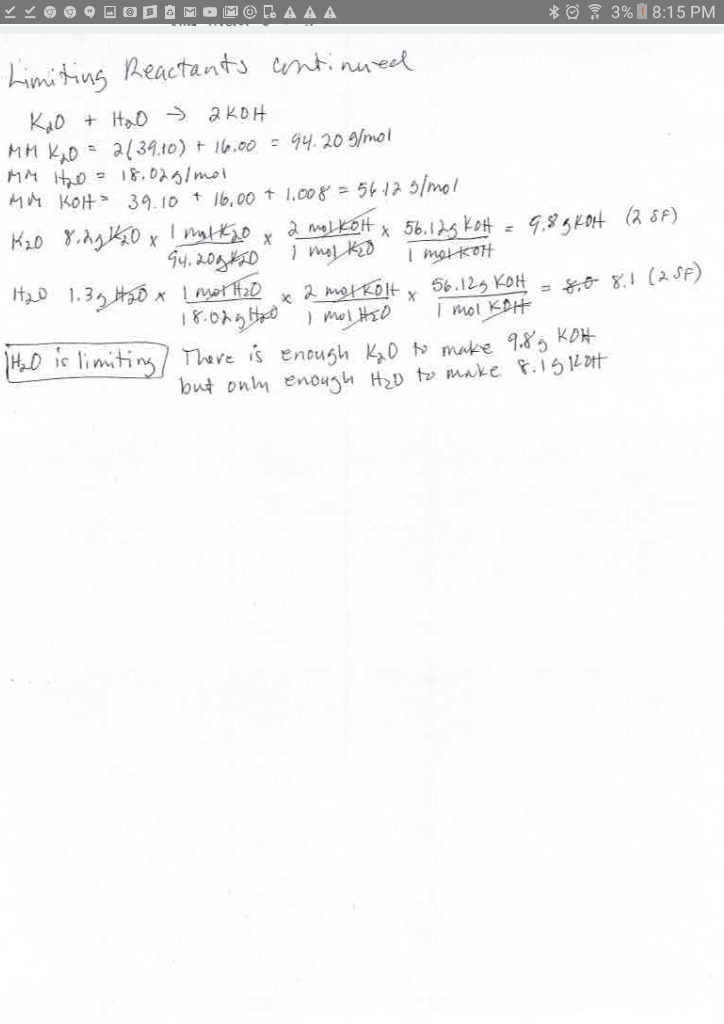
3) The answer is: mass of potassium hydroxide is 8.1 grams.

Balanced chemical reaction: K₂O + H₂O → 2KOH.

m(K₂O) = 8.2 g; mass of potassium oxide.

n(K₂O) = m(K₂O) ÷ M(K₂O).

n(K₂O) = 8.2 g ÷ 94.2 g/mol.

n(K₂O) = 0.087 mol; amount of potassium oxide.

m(H₂O) = 1.3 g; mass of water.

n(H₂O) = 1.3 g ÷ 18 g/mol.

n(H₂O) = 0.072 mol; limiting reactant.

From chemical reaction: n(H₂O) : n(KOH) = 1 : 2.

n(KOH) = 2 · 0.072 mol.

n(KOH) = 0.144 mol.

m(KOH) = 0.144 mol · 56.1 g/mol.

m(KOH) = 8.1 g; mass of potassium hydroxide.

4) The answer is: mass of aluminum chloride is 16.66 grams.

Balanced chemical reaction: 2Al + 3Cl₂ → 2AlCl₃.

m(Al) = 8.1 g; mass of aluminium.

n(Al) = m(Al) ÷ M(Al).

n(Al) = 8.1 g ÷ 27 g/mol.

n(Al) = 0.3 mol.

V(Cl₂) = 4.2 L; volume of chlorine.

n(Cl₂) = 4.2 L ÷ 22.4 L/mol.

n(Cl₂) = 0.1875 mol; limiting reactant.

From chemical reaction: n(Cl₂) : n(AlCl₃) = 3 : 2.

n(AlCl₃) = 2 · 0.1875 mol ÷ 3.

n(AlCl₃) = 0.125 mol; amount of aluminium chloride.

m(AlCl₃) = 0.125 mol · 133.34 g/mol.

m(AlCl₃) = 16.66 g; mass of aluminium chloride.
erastovalidia [21]2 years ago
4 0
This is the number 3..

You might be interested in
0.9775 grams of an unknown compound is dissolved in 50.0 ml of water. Initially the water temperature is 22.3 degrees Celsius. A
elena-14-01-66 [18.8K]

Answer:

The enthlapy of solution is -55.23 kJ/mol.

Explanation:

Mass of water = m

Density of water = 1 g/mL

Volume of water = 50.0 mL

m = Density of water × Volume of water = 1 g/mL × 50.0 mL=50.0 g

Change in temperature of the water ,ΔT= 27.0°C - 22.3°C = 4.7°C

Heat capacity of water,c =4.186 J/g°C

Heat gained by the water when an unknown compound is dissolved be Q

Q= mcΔT

Q=50.0 g\times 4.186 J/g^oC\times 4.7^oC=983.71 J

heat released when 0.9775 grams of an unknown compound is dissolved in water will be same as that heat gained by water.

Q'=-Q

Q'= -983.71 J =-0.98371 kJ

Moles of unknown compound = \frac{0.9975 g}{56 g/mol}=0.01781 mol

The enthlapy of solution :

\frac{Q'}{moles}

=\frac{-0.98371 kJ}{0.01781 mol}=-55.23 kJ/mol

The enthlapy of solution is -55.23 kJ/mol.

8 0
2 years ago
Draw Lewis structures for each of the following moecules. Show resonance structures, if they exist
Svetllana [295]

 A Lewis structure is a visual representation of the bonds between atoms and it shows the lone pairs of electrons in molecules. This structure is also referred as Lewis dot diagram. Resonance structure are multiple Lewis structure that describe a single molecule.<span>
</span>
6 0
2 years ago
**PLATO QUESTION, PLEASE ANSWER CORRECTLY**
Ivenika [448]
The corect answers will be:
1) A
2) B
3) D

Hope this helped :)
7 0
2 years ago
Element X is found in two forms: 90.0% is an isotope that has a mass of 20.0, and 10.0% is an isotope that has a mass of 22.0. W
VMariaS [17]
M_{X} = \frac{(20.0\cdot 90\%)+(22.0\cdot10\%)}{100\%} = \frac{2020}{100} = 20.2[u]

answer: B
7 0
2 years ago
Which of these statements is not necessarily true for two objects in thermal equilibrium?
Dmitrij [34]

1. Answer: C. The objects' temperatures have both changed by the same amount.

Explanation:

An object is said to be in thermal equilibrium when the objects have attained same temperature. Heat transfer from hotter object to colder one in contact takes place until the temperature of the two are equal. It is not necessary that the temperature of both the objects changes by same amount. After attainment of thermal equilibrium, the temperature of the objects stop changing and the tiny particles of the object move at the same rate.

Hence, the objects' temperatures have both changed by the same amount. is not necessarily true for two objects in thermal equilibrium.

2. Answer: C. Objects are made of tiny particles, and their motion depends on the temperature.

Explanation:

Kinetic theory of heat states that the kinetic energy of constituent particles determine the temperature of the object. The statement that best explains this is Objects are made of tiny particles, and their motion depends on the temperature.

5 0
2 years ago
Other questions:
  • Before raw data can be used as scientific evidence, it must be analyzed and summarized. One way of summarizing data is to find t
    15·1 answer
  • What is the melting point of a solution in which 3.5 grams of sodium chloride is added to 230 mL of water?
    11·2 answers
  • The volume of hcl gas required to react with excess ca to produce 11.4 l of hydrogen gas at 1.62 atm and 62.0 °c is ________ l.
    15·1 answer
  • The table shows the amount of radioactive element remaining in a sample over a period of time.
    5·1 answer
  • A mixture of three gases has a pressure at 298 K of 1380 mm Hg. The mixture is analysed and is found to contain 1.27 mol CO2, 3.
    6·1 answer
  • The compound Xe(CF3)2 decomposes in a first-order reaction to elemental Xe with a half-life of 30.0 min. If you place 4.5 mg of
    14·1 answer
  • Zinc has a specific heat capacity of 0.390 J/goC. What is its molar heat capacity? Enter your answer numerically to three signif
    14·1 answer
  • At a certain temperature, the reaction 2NO + Cl2 ⇌ 2NOCl has an equilibrium constant Kc of 45.0. A chemist creates a mixture wit
    5·1 answer
  • Which substance can not be broken down by a
    12·1 answer
  • How many moles of Helium gas are in a balloon with a volume of 6.452 L at 99.7 kPa
    11·1 answer
Add answer
Login
Not registered? Fast signup
Signup
Login Signup
Ask question!