answer.
Ask question
Login Signup
Ask question
All categories
  • English
  • Mathematics
  • Social Studies
  • Business
  • History
  • Health
  • Geography
  • Biology
  • Physics
  • Chemistry
  • Computers and Technology
  • Arts
  • World Languages
  • Spanish
  • French
  • German
  • Advanced Placement (AP)
  • SAT
  • Medicine
  • Law
  • Engineering
makvit [3.9K]
2 years ago
3

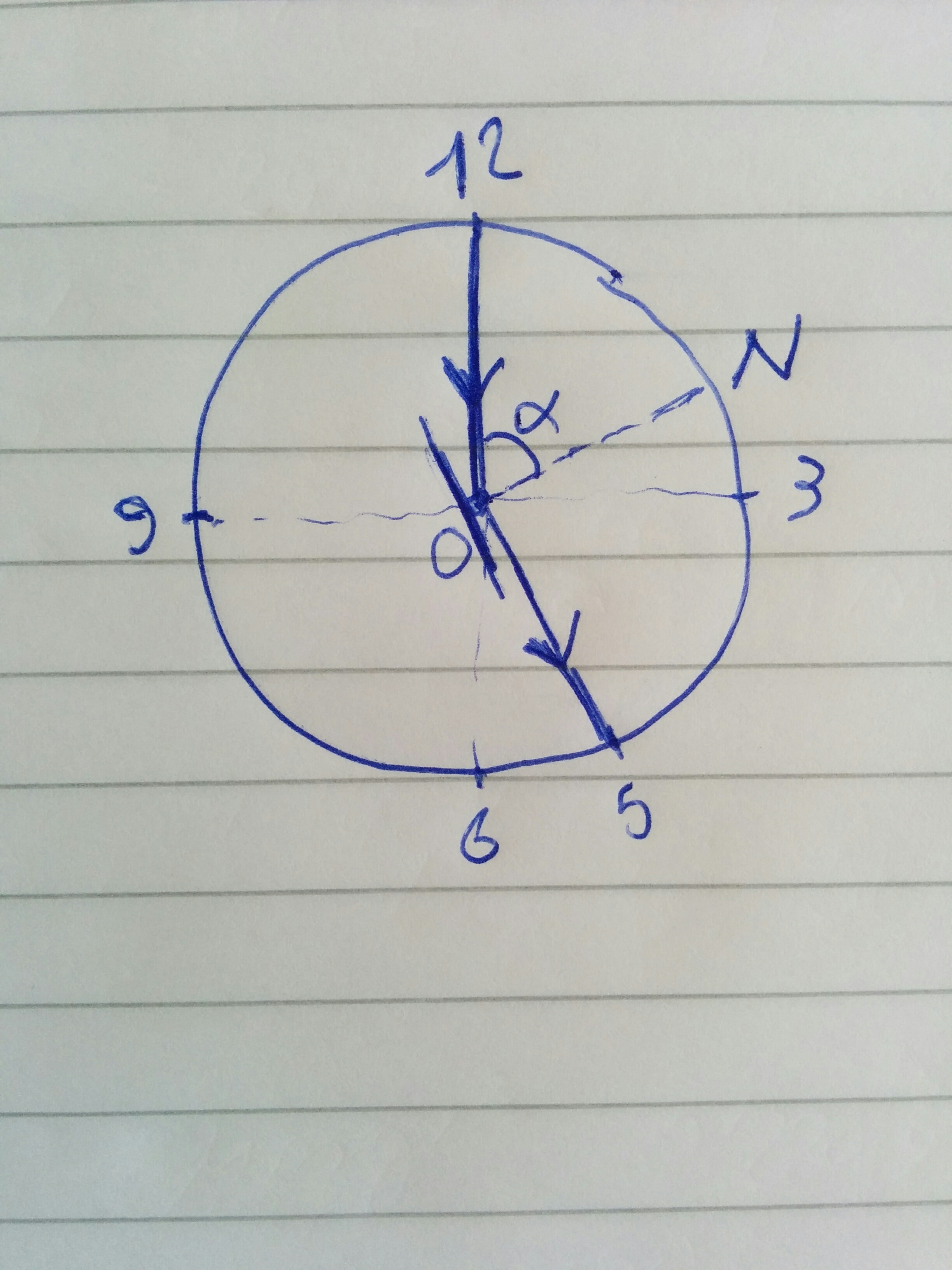
Suppose you are holding a flat mirror and standing at the center of a giant clock face built into the floor. someone standing at

12 o'clock shines a beam of light toward you, and you want to use the mirror to reflect the beam toward an observer standing at 5 o'clock. what should the angle of incidence be to achieve this? what should the angle of reflection be?

Physics
1 answer:
levacccp [35]2 years ago
7 0
The situation is shown in the figure attached.
The original beam of light comes from 12 o'clock, and it is reflected to 5 o'clock.
Since there are 12 hours on the clock, each hour covers an angle of
360^{\circ}/12=30^{\circ}.
This means that between 12 o'clock and 5 o'clock there is an angle of
30^{\circ}\cdot 5 = 150 ^{\circ}.
This corresponds to the total angle between the incident beam and the reflected beam. But for the law of reflection, we have that the incident angle should be equal to the angle of reflection, so this is only possible if both angles are half of 150^{\circ}, so we have:
- angle of incidence: 150^{\circ}/2 = 75^{\circ}
- angle of reflection: 150^{\circ}/2 = 75^{\circ}

You might be interested in
A gas laser has a cavity length of 1/3 m and a single oscillation frequency of 9.0 x 10¹⁴ Hz. What is the cavity mode number?
Eddi Din [679]

Answer:

2 × 10⁶

Explanation:

Data provided in the question:

Cavity length, L = \frac{1}{3}m

Oscillation frequency, f_m = 9.0 × 10¹⁴ Hz

Now,

we know,

f_m=\frac{c}{\lambda_m}

here,

c is the speed of light = 3 × 10⁸ m/s

\lambda_m = Wavelength of mode m inside the laser cavity

m is the cavity mode number

Thus,

9.0\times10^{14}=\frac{3\times10^8}{\lambda_m}

or

\lambda_m = \frac{1}{3} × 10⁻⁶

Also,

m\lambda_m = 2L

Therefore,

m × \frac{1}{3} × 10⁻⁶ = 2 × \frac{1}{3}

or

m = 2 × 10⁶

5 0
2 years ago
A 20~\mu F20 μF capacitor has previously charged up to contain a total charge of Q = 100~\mu CQ=100 μC on it. The capacitor is t
sertanlavr [38]

Explanation:

The given data is as follows.

       C = 20 \times 10^{-6} F

        R = 100 \times 10^{3} ohm

        Q_{o} = 100 \times 10^{-6} C

          Q = 13.5 \times 10^{-6} C

Formula to calculate the time is as follows.

          Q_{t}  = Q_{o} [e^{\frac{-t}{\tau}]

       13.5 \times 10^{-6} = 100 \times 10^{-6} [e^{\frac{-t}{2}}]

               0.135 = e^{\frac{-t}{2}}

         e^{\frac{t}{2}} = \frac{1}{0.135}

                         = 7.407

           \frac{t}{2} = ln (7.407)

                      t = 4.00 s

Therefore, we can conclude that time after the resistor is connected will the capacitor is 4.0 sec.

4 0
2 years ago
Water has a specific heat of 4.186 J/g°C, and ethanol has a specific heat of 2.450 J/g°C. Based on this information, which best
arlik [135]
I think the correct answer from the choices listed above is the second option.  Based on this information, we can say that there are more molecules in a gram of water since more energy is required to raise the temperature 1 gram of water than to raise the temperature of  1 gram of ethanol.
5 0
2 years ago
Read 2 more answers
The capacitors in each circuit are fully charged before the switch is closed. Rank, from longest to shortest, the length of time
IgorLugansk [536]

Answer:

C has the greatest capacitance and the lightest load. It will provide current to the load for the longest.

A & E are the same

B is next, and finally

D has the smallest equivalent capacitance and the heaviest load. it will run out of juice the quickest.

Curious that the pictures are out of alphabetic order A B C E D.

Explanation:

6 0
2 years ago
If 1.00 mol of argon is placed in a 0.500-L container at 28.0 ∘C , what is the difference between the ideal pressure (as predict
Rudik [331]

Answer:

1.98 atm

Explanation:

Given that:

Temperature = 28.0 °C

The conversion of T( °C) to T(K) is shown below:

T(K) = T( °C) + 273.15  

So,  

T₁ = (28 + 273.15) K = 301.15 K

n = 1

V = 0.500 L

Using ideal gas equation as:

PV=nRT

where,  

P is the pressure

V is the volume

n is the number of moles

T is the temperature  

R is Gas constant having value = 0.0821 L atm/ K mol  

Applying the equation as:

P × 0.500 L = 1 ×0.0821 L atm/ K mol  × 301.15 K

⇒P (ideal) = 49.45 atm

Using Van der Waal's equation

\left(P+\frac{an^2}{V^2}\right)\left(V-nb\right)=nRT

R = 0.0821 L atm/ K mol  

Where, a and b are constants.

For Ar, given that:

So, a = 1.345 atm L² / mol²

b =  0.03219 L / mol

So,  

\left(P+\frac{1.345\times \:1^2}{0.500^2}\right)\left(0.500-1\times 0.03219\right)=1\times 0.0821\times 301.15

P+\frac{1.345}{0.25}=\frac{24.724415}{0.46781}

P=\frac{24.724415}{0.46781}-\frac{1.345}{0.25}

⇒P  (real) = 47.47 atm

Difference in pressure = 49.45 atm - 47.47 atm = 1.98 atm
4 0
2 years ago
Other questions:
  • Nutrition, caregiver responsiveness, and learning opportunities are all __________ influences on maturation. A. environmental B.
    13·2 answers
  • A current of 0.2 A flows through an electric bell having a resistance of 65 ohms. What must be the applied voltage in the circui
    13·1 answer
  • Zamir and Talia raced through a maze. Zamir walked 2 m north, 2 m east, 4 m south, 2 m east, 4 m north, 2 m east, 3 m south, 4 m
    11·2 answers
  • Which of the following statements is false?
    6·2 answers
  • A stiff wire bent into a semicircle of radius a is rotated with a frequency f in a uniform magnetic field, as suggested in Fig.
    13·1 answer
  • Two lasers, one red (with wavelength 633.0 nm) and the other green (with wavelength 532.0 nm), are mounted behind a 0.150-mm sli
    10·1 answer
  • The box of negligible size is sliding down along a curved path defined by the parabola y=0.4x2. When it is a A(xA = 2 m, yA = 1.
    14·2 answers
  • Car A rounds a curve of 150‐m radius at a constant speed of 54 km/h. At the instant represented, car B is moving at 81 km/h but
    11·2 answers
  • You are driving along a highway at 35.0 m/s when you hear the siren of a police car approaching you from behind and you perceive
    15·1 answer
  • Three cars are tested in a 16 m/s frontal crash. The results of the crash tests are shown below, with data indicating how much t
    10·1 answer
Add answer
Login
Not registered? Fast signup
Signup
Login Signup
Ask question!
