answer.
Ask question
Login Signup
Ask question
All categories
  • English
  • Mathematics
  • Social Studies
  • Business
  • History
  • Health
  • Geography
  • Biology
  • Physics
  • Chemistry
  • Computers and Technology
  • Arts
  • World Languages
  • Spanish
  • French
  • German
  • Advanced Placement (AP)
  • SAT
  • Medicine
  • Law
  • Engineering
aleksandr82 [10.1K]
2 years ago
4

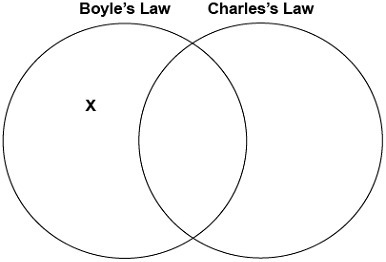
Loni makes a diagram to help organize what she has learned about the gas laws.

Physics
2 answers:
andrew11 [14]2 years ago
5 0
This abel belongs in the region marked X because it shows an inversely proportional relationship.The law itself can be stated as follows: For a fixed amount of an ideal gas kept at a fixed temperature, pressure and volume are inversely proportional.
Nimfa-mama [501]2 years ago
4 0

This question is based on Boyle's law and Charles' law.

As per Boyle's law the volume of a given mass of a gas is inversely proportional to the applied pressure at constant temperature. Mathematically it can be written as

                               P\ \alpha \frac{1}{V}     [at constant T and n]

Charles'law: It states that at constant pressure the volume of a given mass of a gas increases or decreases by 1/273 th of its volume at zero degree celsius for every 1 degree centigrade rise or fall of temperature.One may say that volume is directly proportional to temperature. Mathematically it can be written as

                                                    V∝T          [at constant P and n]

Here P,V,T and n stand for pressure,volume,temperature and number of moles respectively.

In the diagram given in the question the point X  is present in the region where Boyle's law is obeyed.Hence the correct option will be the third one which depicts the presence inverse relationship which is true for pressure and volume at constant temperature.


You might be interested in
A student states that 203.9 g of table sugar will form a saturated solution in 100 g of water.
riadik2000 [5.3K]

The temperature and the solubility of sugar at that temperature

Explanation:

The amount of substance which can be dissolved in the solvent depends on the temperature.

As the temperature increases, more substance can be dissolved.

A solution is  saturated if any more of the solute cannot be dissolved in the solution at the given temperature

Hence we need to know the temperature  and also the amount of substance which can be dissolved(solubility) at the same temperature

a) the statement given in option A is correct

b) molar mass has no correlation with the substance's solubility and hence option b is not correct

c) The percent by volume of the solution is not needed to find if the solution is saturated and hence option c is not correct

3 0
2 years ago
Two separate but nearby coils are mounted along the same axis. A power supply controls the flow of current in the first coil, an
gulaghasi [49]

Complete Question

The complete question is shown on the first uploaded image

Answer:

  The correct answer is option c

Explanation:

Faraday states that when there is a change in magnetic field of a coil of a wire, it means that there exist an emf in the circuit which in induced due to the change in the magnetic flux

From the question  two separate but nearby coils are mounted along the axis. First coil is connected to the power supply and the current flow is controlled by the supply.When the current alternates, it would produce magnetic field ,also the second coil is connected to an ammeter which indicates the current that is flowing in it when current in the first coil changes

This magnetic field that is produce would cause a change flux which would induce current in the second coil so the ammeter would indicate current flow in the second coil

a is incorrect because the current in fir coil is not change hence flux won't change therefore current is is not induced in second coil

This is the same reason b is incorrect

d is incorrect due to the fact that when the second coil is connected to a power supply by rewiring it to be in series with first coil the law of electromagnetism would no longer hold so he ammeter would show no reading  

6 0
2 years ago
A squirrel in a tree drops an acorn. how long does it take the acorn to fall 20 feet?
mart [117]

We use the equation of motion,

S= ut+\frac{1}{2}at^{2}

Here, S is the height, u is initial velocity and a is acceleration.

Given, S = 20 \ ft S = 20 \ ft = 20 \times\frac{1 \ m}{3.2808399 ft}  = 6.096 \ m

As  acorn falls from tree, therefore we take the value of a = 9.8 \ m/s^2 and initial velocity u = 0.

Substituting these values in equation of motion,

6.096 \ m = 0 \times t +\frac{1}{2} \times 9.8 m/s^2 (t)^2 \\\\\ t = 1.12 \ s

Thus, the time taken by the acorn to fall 20  feet ( 6.096 m ) is 1.12 s.

5 0
2 years ago
A stretched spring has 5184 J of elastic potential energy and a spring constant of 16,200 N/m. What is the displacement of the s
Bezzdna [24]

Hello!

A stretched spring has 5184 J of elastic potential energy and a spring constant of 16,200 N/m. What is the displacement of the spring?

0.57 m

0.64 m  

0.80 m  

1.25 m

Data:

E_{pe}\:(elastic\:potential\:energy) = 5184\:J

K\:(constant) = 16200\:N/m

x\:(displacement) =\:?

For a spring (or an elastic), the elastic potential energy is calculated by the following expression:

E_{pe} = \dfrac{k*x^2}{2}

Where k represents the elastic constant of the spring (or elastic) and x the deformation or displacement suffered by the spring.

Solving:  

E_{pe} = \dfrac{k*x^2}{2}

5184 = \dfrac{16200*x^2}{2}

5184*2 = 16200*x^2

10368 = 16200\:x^2

16200\:x^2 = 10368

x^{2} = \dfrac{10368}{16200}

x^{2} = 0.64

x = \sqrt{0.64}

\boxed{\boxed{x = 0.8\:m}}\end{array}}\qquad\checkmark

Answer:  

The displacement of the spring = 0.8 m (or 0.80 m)

_________________________________________

I Hope this helps, greetings ... Dexteright02! =)

8 0
2 years ago
Read 2 more answers
A particle with a charge of 3.00 elementary charges moves through a potential difference of 4.50 volts. What is the change in el
ollegr [7]
The answer:
the relationship between elementary charge, potential difference and electrical potential energy is given by 
   E= qV
E:  lectrical potential energy
q:   elementary charge
V:   potential difference

but we have  e=abs val(q)=3 
so we have E= qV=3ex4.5V=<span>13.5 eV
</span>
the answer is <span>(4)13.5 eV</span>
8 0
2 years ago
Other questions:
  • A scientist measures the growth of a bamboo plant over time. The table below shows the results.
    5·2 answers
  • What is the magnitude of the force acting on a spring with a spring constant of 275 N/m that is stretched 14.3 cm?
    13·1 answer
  • An electric resistance heater is embedded in a long cylinder of diameter 30 mm. when water with a temperature of 25°c and veloc
    8·1 answer
  • An engine does 15.0 kj of work while exhausting 37.0 kj to the cold reservoir. What is the efficiency of the engine?
    12·1 answer
  • A short current element dl⃗ = (0.500 mm)j^ carries a current of 5.40 A in the same direction as dl⃗ . Point P is located at r⃗ =
    15·1 answer
  • A 14000N car traveling at 25m/s rounds a curve of radius 200m. Find the following: a. The centripetal acceleration of the car.
    9·2 answers
  • The seeds were sown (change the voice)​
    15·1 answer
  • A weightlifter lifts a 13.0-kg barbel from the ground an moves it a distance of 1.3 meters. What is the work se does on the barb
    9·1 answer
  • A student is conducting a physics experiment and rolls four different-
    7·1 answer
  • The energy stored in a wooden log transforms when the log is burned. Which of the following explanations BEST describes how the
    13·1 answer
Add answer
Login
Not registered? Fast signup
Signup
Login Signup
Ask question!
