answer.
Ask question
Login Signup
Ask question
All categories
  • English
  • Mathematics
  • Social Studies
  • Business
  • History
  • Health
  • Geography
  • Biology
  • Physics
  • Chemistry
  • Computers and Technology
  • Arts
  • World Languages
  • Spanish
  • French
  • German
  • Advanced Placement (AP)
  • SAT
  • Medicine
  • Law
  • Engineering
iogann1982 [59]
2 years ago
5

Draw the product(s) that are expected when tert-butyl bromide undergoes solvolysis in isopropanol, (CH3)2CHOH.

Chemistry
2 answers:
N76 [4]2 years ago
5 0
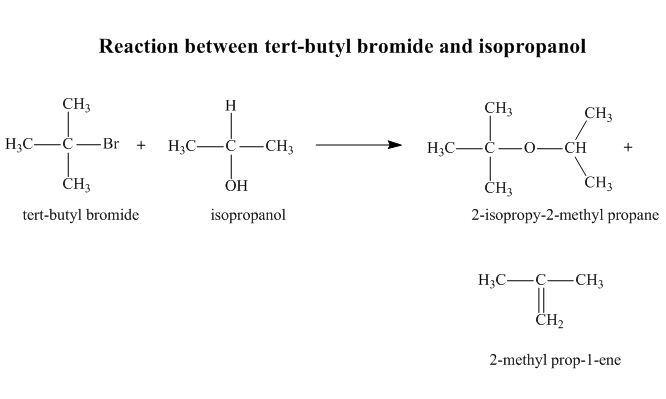
Those reactions in which Alkyl Halide reacts with the solvent without the involvement of any acid or base is called as Solvolysis. In given problem <em>tert</em>-Butyl Bromide is a tertiary Alkyl Halide and we know well that tertiary alkyl halides undergo SN¹ and E¹ elimination reaction due to the formation of stable tertiary carbocation. In given example after the formation of carbocation when Isopropyl act as nucleophile it will produce ether and when it acts as a base it will produce unsaturated compound. The reaction along with both products is shown below,

Novay_Z [31]2 years ago
4 0

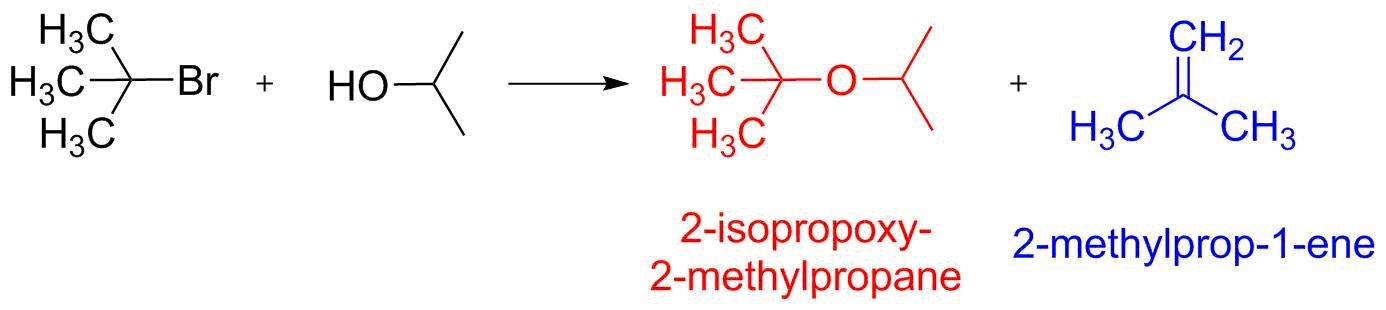
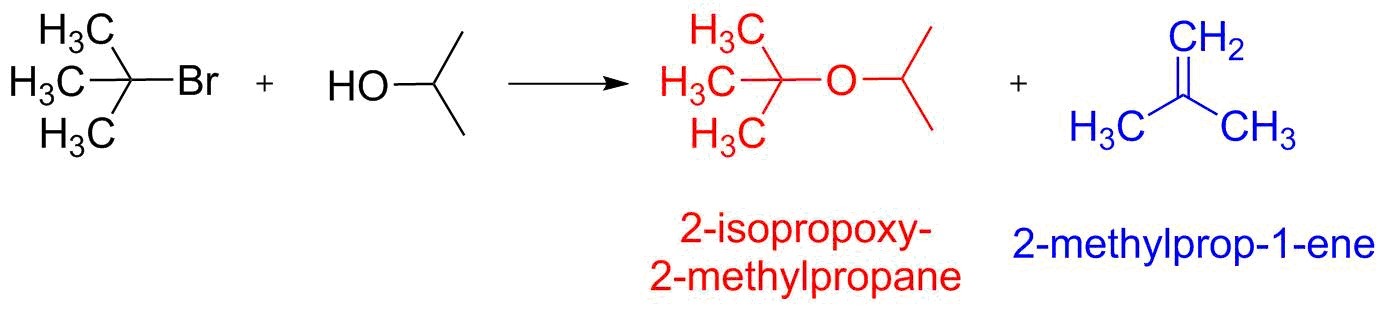
The product forms are\boxed{{\text{2 - isopropxy2 - methylpropane and 2 - methylprop1 - ene}}}. (Refer to image attached ).

Further explanation:

Solvolysis is a chemical reaction in which the solvent, such as water or alcohol, is one of the reagents. At high temperatures or in the presence of strong bases, some solvents act as eliminating agents, producing alkenes from alkyl halides.

SN1 reactions are nucleophilic substitution reactions that involve a nucleophile that can replace a leaving group from the substrate. SN1 reactions are unimolecular. Also, the rate of this reaction depends only on the concentration of one reactant. Sn1 reaction forms stable tertiary carbocation.

An elimination reaction is a type of organic reaction in which two substituents are removed from a molecule. The removal of substituent results in the formation of a double bond. The reaction proceeds through a carbocation intermediate.

Tert-butyl bromide is a tertiary alkyl halide. The tertiary alkyl halides undergo SN1 and E1 reactions due to the formation of a stable tertiary carbocation. It reacts with isopropanol under solvolysis to form ether and a double bond compound.

The solvolysis reaction between tert-butyl bromide and isopropanol is as follows:

{\text{tert - butylbromide}} + {\text{isopropanol}} \to {\text{2 - isopropxy2 - methylpropane}} + {\text{2 - methylprop1 - ene}}.

Hence, the product forms by solvolysis of tert-butyl bromide in isopropanol are{\mathbf{2 - isopropxy - 2 - methylpropane}} and {\mathbf{2 - methylprop - 1 - ene}}

Learn more:

1. Calculation of moles of NaOH: brainly.com/question/4283309.

2. The correct name of the compound: brainly.com/question/9535482.

Answer details:

Grade: Senior School

Subject: Chemistry

Chapter: Chemical reaction

Keywords: Solvolysis, Sn1 reaction, elimination reaction, carbocation, alcohol, tert-butyl bromide and isopropanol.
You might be interested in
A stone of mass 0.55 kilograms is released and falls to the ground. Measurements show that the stone has a kinetic energy of 9.8
Lelu [443]
Hope this helps you.

5 0
2 years ago
Read 2 more answers
The small intestine shown below contains lymphatic vessels but no capillaries. Which nutrient will be absorbed by this small int
Bumek [7]

Answer:

fatty acids

Explanation:

8 0
2 years ago
Read 2 more answers
A saturated solution of potassium iodide contains, in each 100 mL, 100 g of potassium iodide. The solubility of potassium iodide
Oksanka [162]

Answer:

Specific gravity of the saturated solution is 2

Explanation:

The specific gravity is defined as the ratio between density of a solution (In this case, saturated solution of potassium iodide, KI) and the density of water. Assuming density of water is 1:

Specific gravity  = Density

The density is the ratio between the mass of the solution and its volume.

In 100mL of water, the mass of KI that can be dissolved is:

100mL * (1g KI / 0.7mL) = 143g of KI

That means all the 100g of KI are dissolved (Mass solute)

As the volume of water is 100mL, the mass is 100g (Mass solvent)

The mass of the solution is 100g + 100g = 200g

In a volume of 100mL, the density of the solution is:

200g / 100mL = 2g/mL.

The specific gravity has no units, that means specific gravity of the saturated solution is 2

5 0
1 year ago
What is an azeotrope? 2. Under what conditions is it better to perform a steam distillation (instead of, say, a simple distillat
aleksandrvk [35]

Answer:

Explanation:

1.)azeotrope is a mixture of two or more liquid components under constant boiling, it has a constant mole fraction composition of present component which can be homogeneous or heterogeneous.

2.)the condition which it's best performed when there's liquids that is non-volatile which boils higher than other liquids with at least 26 degrees .

steam azentropic distillation

3.During a steam distillation, How to know if the organic compound is still coming over is when you see the solution becoming cloudy or when there is existence of two layers.

4.)The end of the steam distillation, the receiving flask should contain two layers of liquid, and the chemical identity of these two liquids most contain

A.) Layers that are mostly water H2O

B.) Layers that are mostly products

5.)What is the purpose of adding 10% sodium carbonate solution to the distillate if it is acidic to litmus is to neutralize the distillate.

7 0
2 years ago
Please Help Me!!
Cerrena [4.2K]

Answer:

1. Galvanic oxidation. Example is the corrosion of aluminium wires when in contact with copper wires under wet conditions.

2. Rainwater or Damp/moist air

3. Chromium-plated steel screws or stainless steel screws or galvanized steel screws

Explanation:

1. Galvanic oxidation or corrosion occurs when two different metals with different electrode potentials are brought into contact with each other by means of an electrolyte (usually a aqueous solution), such that a redox reaction occurs leading to one metal with the more negative electrode potential (the anode) becoming oxidized, while the other less negative potential (the cathode) is reduced.

In order for galvanic corrosion to occur, three elements are required.

i. Two metals with different corrosion potentials (anode and cathode)

ii. Direct metal-to-metal electrical contact

iii. A conductive electrolyte solution (e.g. water) must connect the two metals on a regular basis.

For example oxidation (corrosion) of aluminium wires when in contact with copper wire under wet conditions.

2. The most likely electrolyte will be rainwater containing dissoved solutes (if the panel is in an exposed part of the house) or damp/moist air.

3. From the table, the most likely screw will be chromium-plated steel screws or stainless steel (made of iron and nickel) screws or galvanized steel (zinc-plated) screws.

All these possible screw components have a more negative electrode potential than copper. Thus they will serve as the anode in a galvanic oxidation with copper.

3 0
2 years ago
Other questions:
  • How many grams of oxygen are in 56 g of c2h2o2?
    5·2 answers
  • A certain material has a mass of 241.25 g while occupying 12.5 cm3 of space. what is this material? (hint: use table 3.1).
    8·1 answer
  • Monochlorination of propane yields two constitutional isomers, and dichlorination yields four. Trichlorination yields five const
    6·2 answers
  • Suppose you wish to make 0.879 l of 0.250 m silver nitrate by diluting a stock solution of 0.675 m silver nitrate. how many mill
    11·1 answer
  • Substitution of an amino group on the para position of acetophenone shifts the cjo frequency from about 1685 to 1652 cm−1 , wher
    14·1 answer
  • Sea water's density can be calculated as a function of the compressibility, B, where p = po exp[(p - Patm)/B]. Calculate the pre
    7·1 answer
  • In the best Lewis structure for the fulminate ion, CNO–, what is the formal charge on the central nitrogen atom?
    9·1 answer
  • A large flask is evacuated and weighed, filled with argon gas, and then reweighed. When reweighed, the flask is found to have ga
    8·1 answer
  • The half-life of the first-order decay of radioac- . 14C . b l:Ive 1s a out 5720 years. Calculate the rate constant for the reac
    15·1 answer
  • Activity 1: My Incompleteness, Complete Me. Fill in the Punnett squares with the correct genotypes based on the key pictures tha
    14·1 answer
Add answer
Login
Not registered? Fast signup
Signup
Login Signup
Ask question!