answer.
Ask question
Login Signup
Ask question
All categories
  • English
  • Mathematics
  • Social Studies
  • Business
  • History
  • Health
  • Geography
  • Biology
  • Physics
  • Chemistry
  • Computers and Technology
  • Arts
  • World Languages
  • Spanish
  • French
  • German
  • Advanced Placement (AP)
  • SAT
  • Medicine
  • Law
  • Engineering
yuradex [85]
2 years ago
4

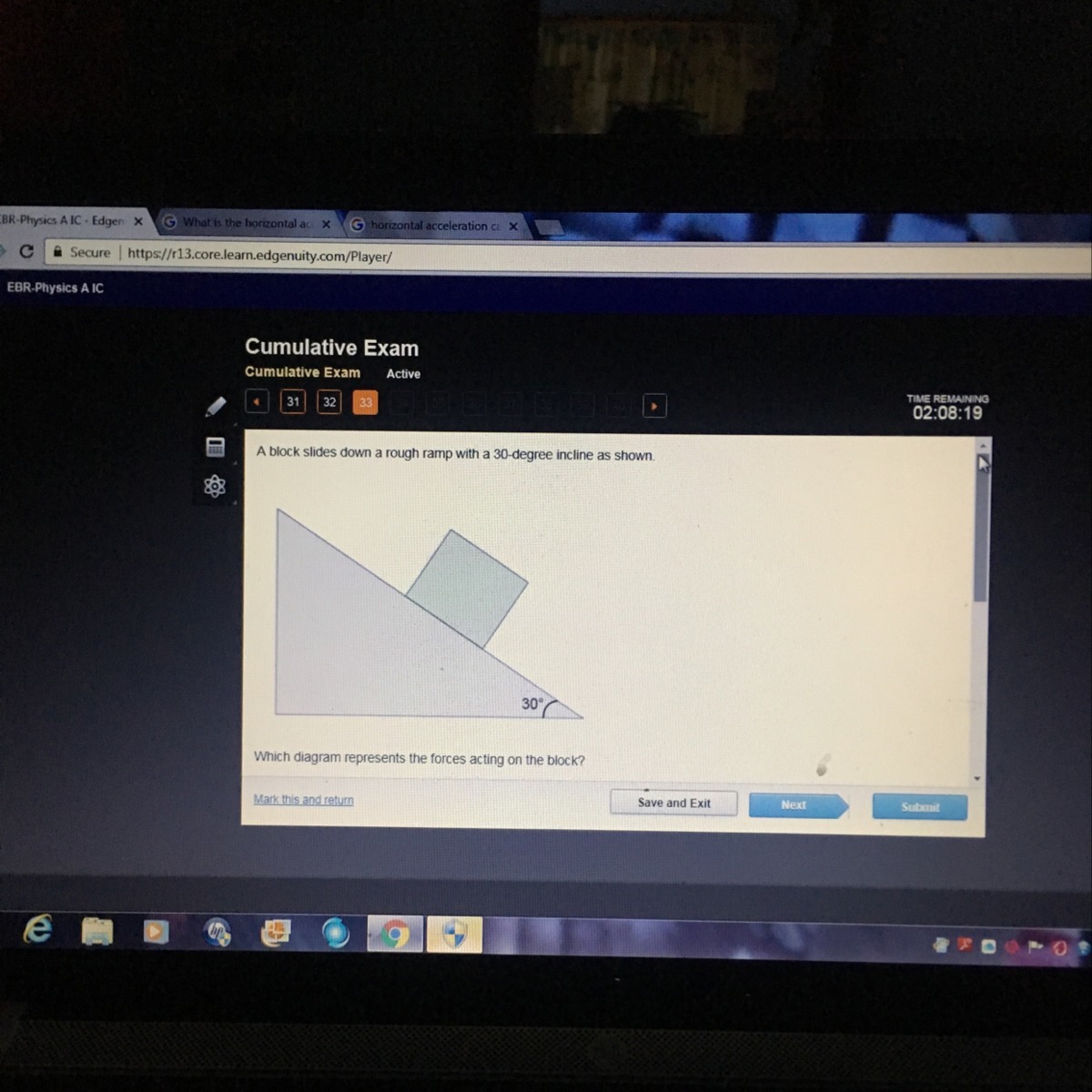
A block slides down a rough ramp with a 30-degree incline as shown.

Physics
1 answer:
masha68 [24]2 years ago
5 0
Assuming there's no friction forces present.

There are only two forces acting on the block, its weight and the normal force.

The weight can be drawn as a vector pointing straight down; or can be draw with its components, one component parallel the slope's surface (axis of motion) and the other perpendicular to the slope's surface (opposite to the normal force).

The normal force is drawn perpendicular to the surface pointing northeast.
You might be interested in
The resistivity of a silver wire with a radius of 5.04 × 10⁻⁴ m is 1.59 × 10⁻⁸ ω · m. if the length of the wire is 3.00 m, what
Alexxx [7]
<span>5.98 x 10^-2 ohms. Resistance is defined as: R = rl/A where R = resistance in ohms r = resistivity (given as 1.59x10^-8) l = length of wire. A = Cross sectional area of wire. So plugging into the formula, the known values, including the area of a circle being pi*r^2, gives: R = 1.59x10^-8 * 3.00 / (pi * (5.04 x 10^-4)^2) R = (4.77 x 10^-8) / (pi * 2.54016 x 10 ^-7) R = (4.77 x 10^-8) / (7.98015 x 10^-7) R = 5.98 x 10^-2 ohms So that wire has a resistance of 5.98 x 10^-2 ohms.</span>
4 0
2 years ago
A person on a diet loses 1.6 kg in a week. How many micrograms/second (µg/s) are lost?
Ivan
Based on the given values above, in order for us to get the answer, we need to convert the units first. So in 1 kilogram, there is 1,000,000 micrograms. In this case, 1.6 kilograms is 1,600,000 micrograms. For the week to seconds, 1 week is equivalent to 604,800 seconds. Therefore, 1,600,000 micrograms/604,800 seconds. So we are going to simplify this. So it would be 2.65<span>µg/s. Hope this answers your question.</span>
8 0
2 years ago
An electron and a proton are held on an x axis, with the electron at x = + 1.000 m and the proton at x = - 1.000 m.how much work
aksik [14]
It is required an infinite work. The additional electron will never reach the origin.

In fact, assuming the additional electron is coming from the positive direction, as it approaches x=+1.00 m it will become closer and closer to the electron located at x=+1.00 m. However, the electrostatic force between the two electrons (which is repulsive) will become infinite when the second electron reaches x=+1.00 m, because the distance d between the two electrons is zero:
F=k_e  \frac{q_e q_e}{d^2}
So, in order for the additional electron to cross this point, it is required an infinite amount of work, which is impossible.
5 0
2 years ago
In the late 19th century, great interest was directed toward the study of electrical discharges in gases and the nature of so-ca
gizmo_the_mogwai [7]

Answer:

A) He finds the same value of q / m for different materials , B)      y = ½ (q / m) E L² / v₀ₓ² , C) v = E / B , D)   B = 2.13 10⁻⁶ T, E) For the first part I have two off-center points., For the second part I can center one point but the other is off center

Therefore the third statement is correct
Explanation:

Part A

Thomson's experiments are the first proof that the atoms that until now were considered indivisible were constituted by different elements, in these experiments Thomson himself the ratio q / m of several cathodes and always found the same value, which allowed to establish that In atoms there are two types of particles, some of which are mobile and others are still.

When examining his statements the correct one is: He finds the same value of q / m for different materials

Part B

For this part let's use Newton's second law

        F = ma

        q E = m a

        a = q / m E

We use the kinematic relationship

          y = voy t - ½ to t²

          x = v₀ₓ t

The initial vertical velocity of electrons is zero

           y = ½ a (x / v₀ₓ)²

We replace

           y = ½ (q / m) E L² / v₀ₓ²

Part C

If there is no deflection, the electric and magnetic forces are the same and in the opposite direction

         Fm = Fe

         q v B = q E

          v = E / B

Part D


        We replace

        y = ½ (q / m) E L² / (E / B)²

         y = ½ (q / m) L² B² / E

If we do not want any deflection the magnetic field has to return the electrons the amount that they lower y = -4.12 cm

      -4.12 10⁻² = ½ q / m 0.12² B² / 1.1 10³

       -16.97 10⁻⁴ = 6.54 10⁻³ B² q / m

      B² = -2.59 10⁻¹ q / m

      q / m = -1.758 10¹¹ C/ kg

      B = √ 0.259 1.758 10¹¹ = √ 4.55 10⁻¹²

      B = 2.13 10⁻⁶ T

Part E

As the charge that the two particles is different

For the first part I have two off-center points.

For the second part I can center one point but the other is off center

Therefore the third statement is correct

8 0
2 years ago
Luke investigated the heating of water
Natali5045456 [20]
Amazingly awesome !
Go Luke !
See Luke investigate !
Water, water, water.
Heat, heat, heat.
Luke rocks !
He probably learned something.
3 0
2 years ago
Other questions:
  • You are stranded in a blizzard. You need water to drink to drink,and you're trying to stay warm.should the melt the snow and dri
    10·1 answer
  • What factors affect attractive force
    14·2 answers
  • A skydiver finds that she speeds up when she holds her arms close to her body. What does this do?
    5·2 answers
  • A square loop of wire with initial side length 10 cm is placed in a magnetic field of strength 1 T. The field is parallel to the
    10·1 answer
  • Question 8 (4 points)
    10·2 answers
  • Why is the entropy change negative for ring closures?
    14·1 answer
  • A short current element dl⃗ = (0.500 mm)j^ carries a current of 5.40 A in the same direction as dl⃗ . Point P is located at r⃗ =
    15·1 answer
  • A small glass bead charged to 5.0 nCnC is in the plane that bisects a thin, uniformly charged, 10-cmcm-long glass rod and is 4.0
    10·1 answer
  • An avant-garde composer wants to use the Doppler effect in his new opera. As the soprano sings, he wants a large bat to fly towa
    9·1 answer
  • In a grassland ecosystem, praying mantises catch and eat grasshoppers. However, there has been a significant decrease in the pra
    13·2 answers
Add answer
Login
Not registered? Fast signup
Signup
Login Signup
Ask question!
