answer.
Ask question
Login Signup
Ask question
All categories
  • English
  • Mathematics
  • Social Studies
  • Business
  • History
  • Health
  • Geography
  • Biology
  • Physics
  • Chemistry
  • Computers and Technology
  • Arts
  • World Languages
  • Spanish
  • French
  • German
  • Advanced Placement (AP)
  • SAT
  • Medicine
  • Law
  • Engineering
Airida [17]
2 years ago
12

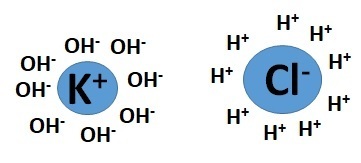
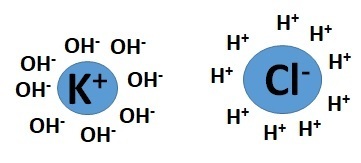
Draw the hydration shells that form around a potassium ion and a chloride ion when potassium chloride (kcl) dissolves in water.

label the positive, negative, and partial charges on the atoms.

Chemistry
1 answer:
DIA [1.3K]2 years ago
8 0

KCl is an ionized salt which readily dissolved in water and generate potassium and chloride ions. In which potassium posses one unit positive charge and chloride posses one unit negative charge. As water is a polar solvent there are partial positive and negative charge on the hydrogen and hydroxide ion respectively. The high solubility of the potassium chloride (KCl) in water is due to the stabilization of the ions in the polar solvent. The solvation of the ions can be shown as-    

You might be interested in
What is the maximum volume of a 0.788 M CaCl2 solution that can be prepared using 85.3 g CaCl2
LekaFEV [45]
Molar mass CaCl₂ = 111.0 g/mol

number of moles:

n = mass of solute / molar mass

n = 85.3 / 111.0

n = 0.7684 moles of CaCl₂

M = n / V

0.788 M = <span>0.7684 / V
</span>
V = 0.7684 / 0.788

V = 0.97512 L

hope this helps!


3 0
2 years ago
The volume of a gas at 7.00°c is 49.0 ml. if the volume increases to 74.0 ml and the pressure is constant, what will the tempera
marshall27 [118]
Using charles law
v1/t1=v2/t2
v1=49ml
v2=74
t1=7+273=280k
t2=?
49/280=74/t2
0.175=74/t2  cross multiply
0.175t2=74
t2=74/0.175
t2=422k or 149celcius
8 0
2 years ago
Which equation shows the proper setup to find the volume of a 0.250 M CaCl2 solution that contains 39.5 g of CaCl2?
Jlenok [28]
Molarity = number of mole of substance(n) / volume of solution (V).

n(CaCl2) = mass (CaCl2)/M(CaCl2)

M(CaCl2) = 40+2*35.5 = 111 g/mol 

n(CaCl2) =39.5 g CaCl2*1 mol/111g

0.250 M = 39.5 g CaCl2*1 mol/111g*volume of solution (V).

volume of solution (V) = 39.5 g CaCl2*1 mol/(0.250 M*111g) = 1.42 L
4 0
2 years ago
Read 2 more answers
. Divide 94.20 g by 3.167 22 mL.
jeka94
94.20 g/3.16722 mL = 29.74 g/mL

The ratio of mass to volume is equal to the substance's density. Thus, 29.74 g/mL is the density of whatever substance it may be. Density does not change for incompressible matter like solid and some liquids. Although, it may be temperature dependent.
7 0
2 years ago
Read 2 more answers
What is the overall charge of the compound frbr
sammy [17]

Answer:

Zero  

Explanation:

FrBr is an ionic compound .

Fr is in Group 1. Br is in Group 17.

The charges on the ions are +1 and -1, respectively.

The compound consists of Fr⁺Br⁻ ions.

However, there are equal numbers of + and - charges, so

The overall charge of the compound is zero.
5 0
2 years ago
Other questions:
  • The correct name for hno2 is ________. nitrous acid hyponitrous acid nitric acid pernitric acid hydrogen nitrate
    9·1 answer
  • What is the mass of a solution that has a density of 0.775 g/ml and a volume of 50.0ml?
    8·1 answer
  • When atoms lose or gain electrons in chemical reactions they form?
    14·1 answer
  • By mistake, you added salt instead of sugar to the oil. How can you remove the salt?
    7·2 answers
  • Consider the following reaction at 298 K: 2H2S(g)+SO2(g)→3S(s, rhombic)+2H2O(g),ΔG∘rxn=−102 kJ Calculate ΔGrxn under these condi
    12·1 answer
  • A class is given a demonstration of solution chemistry and solubility equilibria.Passage: A 6.57-g sample of NiSO4•6H2O (molar m
    10·1 answer
  • Iodine has a lower atomic weight than tellurium (126.90 for I, 127.60 for Te) even though it has a higher atomic number (53 for
    6·2 answers
  • Thiamine (vitamin B1) deficiency diseases have a lower prevalence now than in the past. However, they are seen as beriberi in so
    12·1 answer
  • Shelby measured the volume of a cylinder and determined it to be 54.5 cm3 . The teacher told her that she was 4.25% too high in
    13·1 answer
  • Choose two different particles found in the air. Explain how they are different and how they are the same
    5·1 answer
Add answer
Login
Not registered? Fast signup
Signup
Login Signup
Ask question!