answer.
Ask question
Login Signup
Ask question
All categories
  • English
  • Mathematics
  • Social Studies
  • Business
  • History
  • Health
  • Geography
  • Biology
  • Physics
  • Chemistry
  • Computers and Technology
  • Arts
  • World Languages
  • Spanish
  • French
  • German
  • Advanced Placement (AP)
  • SAT
  • Medicine
  • Law
  • Engineering
Sunny_sXe [5.5K]
2 years ago
13

Identify and sketch all the external forces acting on the chair. because the chair can be represented as a point particle of mas

s m, draw the forces with their tails centered on the black dot in the middle of the chair. be certain to draw your forces so that they have the correct orientation.

Physics
2 answers:
SOVA2 [1]2 years ago
8 0

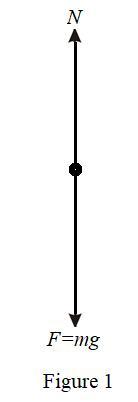
There are two external force acts on the chair.

1. The force due to earth gravity, acts in the downward direction.

2. Reaction force of the gravity, which acts in the Upward direction (Normal Force).

On every object, there is a force acts due to gravity of earth, which pulls the object towards the centre of earth, known as gravity force, always acts in the downward direction. Mathematically it's given as

F=mg

here, m is the mass of the object, and g is the acceleration of gravity.

To balance this gravity force, a counter force acts in the opposite direction, whose magnitude is equal to the force of gravity

dangina [55]2 years ago
4 0

 The two forces will act on the chair i.e. mg and N.

Further Explanation:

Free body diagram is the graphical representation or illustration of all the forces applied on the body with their directions. This helps us to visualize all the applied forces on the body with their directions and make us possible to solve complex problems based on kinematics.

The normal force which is always perpendicular to the surface of the object and there is force due to gravity of the earth which pulls the object toward the center of the earth given by F=mg. Its magnitude depends upon the mass of the body and expressed as mg. Here, the term g is called acceleration due to gravity and it has a constant value of 9.81{\text{ m/}}{{\text{s}}^{\text{2}}} .

Concept:

The chair is represented as a point particle of mass m.

The diagram is drawn as shown in Figure 1.

The chair has two forces acting in two directions, upward and downward direction.  

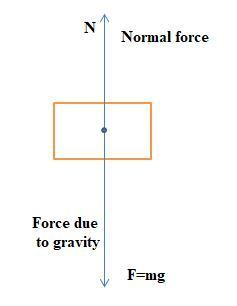
• The upward normal force or the reaction force.

• The downward force due to gravity of the earth.

The normal force is equal to the magnitude of the force due to gravity but opposite in direction to balance the force due to gravity.

Learn more:

1. Find the net force. https://brainly.in/question/8668644

2. The net force on free body diagrams. brainly.com/question/12345810

3. Acceleration of the object. brainly.com/question/11599933

Answer Details:

Grade: Collage

Subject: Physics

Chapter: Kinematics

Keywords:

Identify, sketch, external, forces, acting, chair, represented, point particle, mass, m, draw, tails, centered, black, dot, middle, certain, correct, orientation, upward, normal, reaction force, downward, force due to gravity, gravity force.
You might be interested in
Calculate the amount of energy produced in a nuclear reaction in which the mass defect is 0.187456 amu.
luda_lava [24]
For nuclear reactions, we determine the energy dissipated from the process from the Theory of relativity wherein energy is equal to the mass defect times the speed of light. We calculate as follows:

E = mc^2 = 0.187456 (3x10^8)^2 = 1.687x10^16 J

Hope this answers the question.
8 0
2 years ago
Read 2 more answers
A trebuchet was a hurling machine built to attack the walls of a castle under siege. A large stone could be hurled against a wal
Studentka2010 [4]

(a) 18.9 m/s

The motion of the stone consists of two independent motions:

- A horizontal motion at constant speed

- A vertical motion with constant acceleration (g=9.8 m/s^2) downward

We can calculate the components of the initial velocity of the stone as it is launched from the ground:

u_x = v_0 cos \theta = (25.0)(cos 41.0^{\circ})=18.9 m/s\\u_y = v_0 sin \theta = (25.0)(sin 41.0^{\circ})=16.4 m/s

The horizontal velocity remains constant, while the vertical velocity changes due to the acceleration along the vertical direction.

When the stone reaches the top of its parabolic path, the vertical velocity has became zero (because it is changing direction): so the speed of the stone is simply equal to the horizontal velocity, therefore

v=18.9 m/s

(b) 22.2 m/s

We can solve this part by analyzing the vertical motion only first. In fact, the vertical velocity at any height h during the motion is given by

v_y^2 - u_y^2 = 2ah (1)

where

u_y = 16.4 m/s is the initial vertical velocity

v_y is the vertical velocity at height h

a=g=-9.8 m/s^2 is the acceleration due to gravity (negative because it is downward)

At the top of the parabolic path, v_y = 0, so we can use the equation to find the maximum height

h_{max} = \frac{-u_y^2}{2a}=\frac{-(16.4)^2}{2(-9.8)}=13.7 m

So, at half of the maximum height,

h = \frac{13.7}{2}=6.9 m

And so we can use again eq(1) to find the vertical velocity at h = 6.9 m:

v_y = \sqrt{u_y^2 + 2ah}=\sqrt{(16.4)^2+2(-9.8)(6.9)}=11.6 m/s

And so, the speed of the stone at half of the maximum height is

v=\sqrt{v_x^2+v_y^2}=\sqrt{18.9^2+11.6^2}=22.2 m/s

(c) 17.4% faster

We said that the speed at the top of the trajectory (part a) is

v_1 = 18.9 m/s

while the speed at half of the maximum height (part b) is

v_2 = 22.2 m/s

So the difference is

\Delta v = v_2 - v_2 = 22.2 - 18.9 = 3.3 m/s

And so, in percentage,

\frac{\Delta v}{v_1} \cdot 100 = \frac{3.3}{18.9}\cdot 100=17.4\%

So, the stone in part (b) is moving 17.4% faster than in part (a).

4 0
2 years ago
Joel uses a claw hammer to remove a nail from a wall. He applies a force of 40 newtons on the hammer. The hammer applies a force
jarptica [38.1K]

Hi!


Mechanical advantage is defined as the<em> ratio of force produced by an object to the force that is applied to it.</em>

In our case, this would be the ratio of the force applied by the claw hammer on the nail to the force Joel applies to the claw hammer, which is

160:40 or 4:1

So the mechanical advantage of the hammer is four.


Hope this helps!


3 0
2 years ago
Read 2 more answers
A ski lift has a one-way length of 1 km and a vertical rise of 200 m. The chairs are spaced 20 m apart, and each chair can seat
myrzilka [38]

Answer:

P = 68.125 kW

P startup = 43.05 kW

Explanation:

4 0
2 years ago
In a movie, Tarzan evades his captors by hiding under water for many minutes while breathing through a long, thin reed. Assume t
gladu [14]

Answer: 0.98m

Explanation:

P = -74 mm Hg = 9605 Pa = 9709N/m^2

= 9605 kg m/s^2/m^2

density of water: rho = 1 g/cc = 1 (10^-3 kg)/(10^-2 m)^-3 = 1000 kg/m^3

Pressure equation: P = rho g h

h = P/(rho g)

h = (9605 kg/m/s^2) / (1000 kg/m^3) / (9.8 m/s^2)

h = 0.98 m

0.98m is the maximum depth he could have been.

8 0
2 years ago
Other questions:
  • An electron is in a vacuum near the surface of the Earth. Where should a second electron be placed so that the net force on the
    9·1 answer
  • A kayaker paddles at 4.0 m/s in a direction 30° south of west. He then turns and paddles at 3.7 m/s in a direction 20° west of s
    14·2 answers
  • Select the circle containing inaccurate information that does not align with the big bang theory.
    6·2 answers
  • Frequency is deoted as hertz; hertz is a measurement of the _________ _____ __________ that a wave is occurring.
    13·1 answer
  • A floating ice block is pushed through a displacement d = (14 m) i hat - (11 m) j along a straight embankment by rushing water,
    15·1 answer
  • On a horizontal frictionless floor, a worker of weight 0.900 kN pushes horizontally with a force of 0.200 kN on a box weighing 1
    7·1 answer
  • A jeweler is determining the optical properties of an unknown blue gemstone. She uses an angle of incidence of 62°, and measures
    7·1 answer
  • A positively-charged particle is released near the positive plate of a parallel plate capacitor. a. Describe its path after it i
    11·1 answer
  • Consider a steel tape measure with cross-sectional area, A = 0.0625 inches squared, and length L = 3, 600 inches at room tempera
    8·1 answer
  • A student redid the experiment of mixing room-temperature water and warm
    11·1 answer
Add answer
Login
Not registered? Fast signup
Signup
Login Signup
Ask question!