answer.
Ask question
Login Signup
Ask question
All categories
  • English
  • Mathematics
  • Social Studies
  • Business
  • History
  • Health
  • Geography
  • Biology
  • Physics
  • Chemistry
  • Computers and Technology
  • Arts
  • World Languages
  • Spanish
  • French
  • German
  • Advanced Placement (AP)
  • SAT
  • Medicine
  • Law
  • Engineering
lianna [129]
2 years ago
12

Fermium-253 is a radioactive isotope of fermium that has a half-life of 3.0 days. A scientist obtained a sample that contained 2

16 micrograms of fermium-253.
Complete the table to show how much fermium-253 should remain in the sample at the indicated times after the scientist obtained the sample.

Chemistry
2 answers:
Dahasolnce [82]2 years ago
5 0

Problem 2

You start out with 216 ugrams of Fermium - 253. After 3 days, you will have 1/2 as much. 108 ugrams is what you have.

Another 3 days goes by. You started with 108 ugrams. That gets cut in 1/2 again. Now you have 54 ugrams.

Finally another 3 days goes by. You started with 54 ugrams. you now have 1/2 as much which would be 27 ugrams

#days              Amount in micrograms

0                              216

3                               108

6                                54

9                                27

Problem One

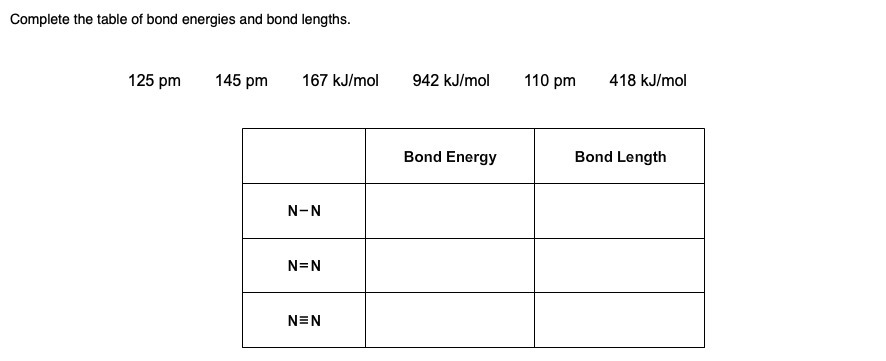
You are using Nitrogen as your base example. The first thing you should do is fill in the table. Then you should try and make some rules. You need the rules in case the exam you are preparing for picks a different element to talk about these bond tendencies. In any event, it's handy to think this way.

<em><u>Table</u></em>

Bond               Energy Kj/Mol               Bond Length pico meters

N - N                 167                                                145

N=N                  418                                                125

N≡N                  942                                               110

<em><u>Rules</u></em>

As the number of bonds INCREASES, the energy contained in the bond goes UP

As the number of bonds INCREASES, the length of the bond goes DOWN.

Lera25 [3.4K]2 years ago
5 0

1. <em>Radioactive decay </em>

The <em>half-life</em> of Fm-198 (3.0 days) is the time it takes for half the Fm to decay.  

After one half-life, half (50 %) of the original amount will remain.

After a second half-life, half of that amount (25 %) will remain, and so on.

We can construct a table as follows:

 No. of                   Fraction         Amount

<u>half-lives</u>  <em><u>t</u></em><u>/days</u>  <u>remaining</u>   <u>remaining/µg</u>

       1          3.0             ½                  216

       2         6.0             ¼                  108

       3         9.0             ⅛                    54

2. <em>Bond length and bond energy </em>

The <em>bond order</em> of a bond is the number of bonding electrons between the two nuclei.

As the <em>number of bonding electrons increases</em>, the nuclei are pulled more tightly together (the <em>bond energy increases</em>) and the <em>bond length decreases</em>.

We can construct a table as follows:

<u>Bond</u>  <u>Bond energy/kJ·mol⁻¹</u><u> </u>  <u>Bond length/pm </u>

N-N                 167                                 145

N=N                 418                                 125

N≡N                 942                                 110

You might be interested in
Many free radicals combine to form molecules that do not contain any unpaired electrons. The driving force for the radical–radic
Alexxandr [17]

Answer:

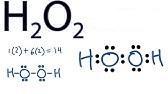
In the attached image the Lewis equation is shown where it is shown how two oxygens react with two hydrogens to meet the octet of the electrons.

Explanation:

Hydrogen peroxide is one of the most named chemicals since it is not only sold as "hydrogen peroxide" in pharmacies but it is also one of the great weapons of immune defense cells to defend ourselves against anaerobic bacteria.

The disadvantage of this compound is that when dividing it forms free oxygen radicals that are considered toxic or aging for our body.

4 0
2 years ago
PLEAS HELP!!!!!!!!!!!!!!!!!!!!!!!!!!!!!!!!!!!!!!!!! DUE TONIGHT
Jobisdone [24]

Answer:

It is required answer.

Explanation:

Given that :

1. using balanced chemical equation:

ammonium acetate:

The balanced equation is:

NH₃ + H₂O ===> NH₄OH

when ammonia gas dissolves in water then we get the base in form of ammonium hydroxide.

When  NH₄OH reacts with CH₃COOH then we get ammonium acetate and water

NH₄OH + CH₃COOH ===> [CH₃COO]- & NH₄+ & H₂O

So, we can say that,

when we are adding an acid and a base together then we get the product of H₂O and given elements.

2. addition of barium hydroxide to sulfuric acid:

the balanced equation is

H₂SO4+ Ba(OH)₂--> BaSO₄+ 2H₂O

when acid and base reacts together than we get barium sulphate and water

when sulfuric acid and barium hydroxide.

Hence, it is required answer.

8 0
2 years ago
When an aldose reacts with Barfoed's reagent, what type of organic compound forms? What type of chemical is this?
Fudgin [204]
Barfoed's test is a concoction test utilized for identifying the nearness of monosaccharides. It depends on the diminishment of copper(II) acetic acid derivation to copper(I) oxide (Cu2O), which frames a block red hasten. 
Barfoed's reagent comprises of a 0.33 molar arrangement of unbiased copper acetic acid derivation in 1% acidic corrosive arrangement. The reagent does not keep well and it is, thusly, fitting to make it up when it is really required. May store uncertainly as per a few MSDS's.
7 0
2 years ago
Read 2 more answers
Jaiden is writing a report about the structure of the atom. In her report, she says that the atom has three main parts and two s
andre [41]
No, because an atom consists of two main parts and three subatomic
particles, protons, neutrons, and electrons. Each one is smaller than an atom, therefore they are subatomic particles. An atom only requires protons and electrons to be an atom - e.g. Hydrogen has 1 proton and 1 electron. Neutrons do not effect the overall charge of the atom, and only increase the atomic mass. 
7 0
2 years ago
Read 2 more answers
A vessel contains Ar(g) at a high pressure. Which of the following statements best helps to explain why the measured pressure is
Luda [366]

Answer:

4. The combined volume of the Ar atoms is too large to be negligible compared with the total volume of the container.

Explanation:

Deviations from ideality are due to intermolecular forces and to the nonzero volume of the molecules themselves. At infinite volume, the volume of the molecules themselves is negligible compared with the infinite volume the gas occupies.

However, the volume occupied by the gas molecules must be taken into account. Each <u>molecule does occupy a finite, although small, intrinsic volume.</u>

The non-zero volume of the molecules implies that instead of moving in a given volume V they are limited to doing so in a smaller volume. Thus, the molecules will be closer to each other and repulsive forces will dominate, resulting in greater pressure than the one calculated with the ideal gas law, that means, without considering the volume occupied by the molecules.
5 0
2 years ago
Other questions:
  • What is the name of a hydrocarbon that has the formula CH3(CH2)4CCH?
    11·1 answer
  • Which material has a crystalline structure at room temperature ( 20 degrees Celsius )
    6·2 answers
  • What is the mass of 2.11 × 1024 sulfur atoms??
    14·1 answer
  • What mass of ni2+ is produced in solution by passing a current of 67.0 a for a period of 14.0 h , assuming the cell is 90.0 % ef
    15·1 answer
  • If you have 10cm of snow with a volume of 40mL and a density of 0.5 g/mL how many inches of rain is this?
    5·1 answer
  • The bond enthalpy of the C―N bond in the amide group of proteins can be treated as an average of C―N (276 kJ/mol) and C═N (615 k
    14·1 answer
  • a) (1 point) Build anthracene, optimize its geometry and examine its structure. Describe its shape. b) (1 point) Measure the C-C
    13·1 answer
  • A 23.74-mL volume of 0.0981 M NaOH was used to titrate 25.0 mL of a weak monoprotic acid solution to the stoi- chiometric point.
    5·2 answers
  • Question 096 Propose a three-step synthetic sequence to accomplish the transformation below. 1) HBr, ROOR; 2) t-BuOK; 3) CH3CH2C
    11·1 answer
  • Circle the molecule(s) in the atmosphere that come from animals. (circle all that apply)
    11·1 answer
Add answer
Login
Not registered? Fast signup
Signup
Login Signup
Ask question!