answer.
Ask question
Login Signup
Ask question
All categories
  • English
  • Mathematics
  • Social Studies
  • Business
  • History
  • Health
  • Geography
  • Biology
  • Physics
  • Chemistry
  • Computers and Technology
  • Arts
  • World Languages
  • Spanish
  • French
  • German
  • Advanced Placement (AP)
  • SAT
  • Medicine
  • Law
  • Engineering
prohojiy [21]
2 years ago
11

During a laboratory experiment, you discover that an enzyme-catalyzed reaction has a ∆g of -100 kcal/mol. if you double the amou

nt of enzyme in the reaction, what will be the ∆g for the new reaction?
a.-50 kcal/mol

b.-100 kcal/mol

c.0 kcal/mol

d.+100 kcal/mol
Chemistry
2 answers:
n200080 [17]2 years ago
7 0

The \Delta {\text{G}} for the new reaction is \boxed{ - 10{\text{0 kcal/mol}}} when the amount of enzyme is doubled.

Further explanation:

Properties are categorized into two types:

1. Intensive properties:

These properties depend on the nature of the substance and not on the size of the system. If the system is further divided into a number of subsystems, the values of intensive properties remain unchanged. Temperature, refractive index, molarity, concentration, pressure, and density are some of the examples of intensive properties.

2. Extensive properties:

These properties depend on the amount of the substance. These are additive in nature if a single system is divided into several subsystems. Mass, enthalpy, Gibbs free energy, volume, energy, size, weight, and length are some of the examples of extensive properties.

As {\Delta G}} is an extensive property, it should depend on the amount or quantity of substance. So if the amount of enzyme is doubled, the change in Gibbs free energy should also increase accordingly. But we are provided with the value of {\Delta G}} in terms of kcal/mol (-100 kcal/mol). It means it is the value of {\Delta G}} for one mole and therefore the amount of substance becomes constant. Hence the value of {\Delta G}} will not change on changing the concentration of enzyme.

So {\mathbf{\Delta G}} for the new reaction is -100 kcal/mol when the amount of enzyme is doubled in the reaction.

Learn more:

1. Calculate \Delta {\text{H}} for the reaction using Hess law: brainly.com/question/11293201

2. Find the enthalpy of dissociation of 1 mole of MgO: brainly.com/question/2416245

Answer details:

Grade: Senior school

Subject: Chemistry

Chapter: Thermodynamics

Keywords: Gibbs free energy, -100 kcal/mol, enzyme, doubled, intensive, extensive, amount of substance, nature of substance, unchanged, additive, new reaction, kcal/mol.

Debora [2.8K]2 years ago
4 0

The doubling the amount will change the gibbs free energy as it is an extensive property which depends upon the the amount of the substance


However as asked in question the DeltaG has unit of kcal /mol

So we have already defined the amount of substance to be one mole this means the value per mole will be same irrespective of the amount taken as we are reporting it for a fixed one mole of a substance

Hence answer is

-100 kcal/mol


You might be interested in
The solubility of N2 in blood can be a serious problem (the "bends") for divers breathing compressed air (78% N2 by volume) at d
OLga [1]

Answer:

The volume is 19.7 mL

Explanation:

<u>Step 1</u>: Given data

Pressure at sea level = 1.00 atm

Pressure at 50 ft = 2.47535 atm

kH for N2 in water at 25°C is 7.0 × 10⁻⁴ mol/L·atm

Molarity (M) = kH x P

<u>Step 2</u>: Calculate molarity

M at sea level:

M = 7.0*10^-4 * (1.00atm * 0.78) = 5.46*10^-4 mol/L

M at 50ft:

M = 7.0*10^-4 * (2.47535atm * 0.78) = 13.5*10^-4 mol/L

We should find the volume of N2. To find the volume whe have to find the number of moles first. This we calculate by calculating the difference between M at 50 ft and M at sea level.

13.5*10^-4 mol/L - 5.46*10^-4 mol/L = 8.04*10^-4 mol/L

Step 3: Calculate volume

P*V=nRT

with P = 1.00 atm

with V = TO BE DETERMINED

with n =  8.04*10^-4 mol/L  *1L = 8.04*10^-4

with R= 0.0821 atm * L/ mol *K

with T = 25 °C = 273+25 = 298 Kelvin

To find the volume, we re-organize the formula to: V=nRT/P

V= (8.04*10^-4 mol * 0.0821 (atm*L)/(mol*K)* 298K ) / 1.00atm = 0.0197L = 19.7ml

The volume is 19.7 mL

5 0
2 years ago
Describe how you would prepare exactly 100 mL of 0.109 M picolinate buffer, pH 5.61. Possible starting materials are pure picoli
Pepsi [2]

Answer:

1.342g of picolinic acid and 6.743mL of 1.0M NaOH diluting the mixture to 100.0mL

Explanation:

<em>The pKa of the picolinic acid is 5.4.</em>

Using Henderson-Hasselbalch formula for picolinic-picolinate buffer:

pH = pKa + log [Picolinate] / [Picolinic]

<em>Where [] could be taken as moles of each species</em>

<em />

5.61 = 5.4 + log [Picolinate] / [Picolinic]

0.21 = log [Picolinate] / [Picolinic]

1.62181 = [Picolinate] / [Picolinic] <em>(1)</em>

<em></em>

Now, both picolinate and picolinic acid will be:

0.100L * (0.109mol / L) =

0.0109 moles = [Picolinate] + [Picolinic] <em>(2)</em>

<em></em>

First, as we will start with picolinic acid, we need add:

0.0109 moles picolinic acid * (123.10g/mol) = 1.342g of picolinic acid

Now, replacing (2) in (1):

1.62181 = 0.0109 moles - [Picolinic] / [Picolinic]

1.62181 [Picolinic] = 0.0109 moles - [Picolinic]

2.62181 [Picolinic] = 0.0109 moles

[Picolinic] = 4.157x10⁻³ moles

And:

[Picolinate] = 0.0109 - 4.157x10⁻³ moles =

<h3>6.743x10⁻³ moles</h3><h3 />

To obtain these moles of picolinate ion we need to make the reaction of the picolinic acid with NaOH:

Picolinic acid + NaOH → Picolinate + Water

<em>That means to obtain 6.743x10⁻³ moles of picolinate ion we need to add 6.743x10⁻³ moles of NaOH</em>

<em />

6.743x10⁻³ moles of NaOH that is 1.0M are, in mL:

6.743x10⁻³ moles * (1L / 1mol) = 6.743x10⁻³L * 1000 =

<h3>6.743mL of the 1.0M NaOH must be added</h3><h3 />

Thus, we obtain the desire moles of picolinate and picolinic acid to obtain the buffer we want, the last step is:

<h3>Dilute the mixture to 100mL, the volume we need to prepare</h3>
3 0
2 years ago
Element X is a radioactive isotope such that every 82 years, its mass decreases by half. Given that the initial mass of a sample
lesantik [10]

Answer: 17 years

Explanation:

Expression for rate law for first order kinetics  for radioactive substance is given by:

t=\frac{2.303}{k}\log\frac{a}{a-x}

where,

k = rate constant

t = age of sample

a = let initial amount of the reactant

a - x = amount left after decay process  

a) for completion of half life:

Half life is the amount of time taken by a radioactive material to decay to half of its original value.

t_{\frac{1}{2}}=\frac{0.693}{k}

k=\frac{0.693}{82years}=8.4\times 10^{-3}years^{-1}

b) for 8900 g of the mass of the sample to reach  7700 grams

t=\frac{2.303}{8.4\times 10^{-3}}\log\frac{8900}{7700}

t=17years

Thus it will take 17 years

4 0
2 years ago
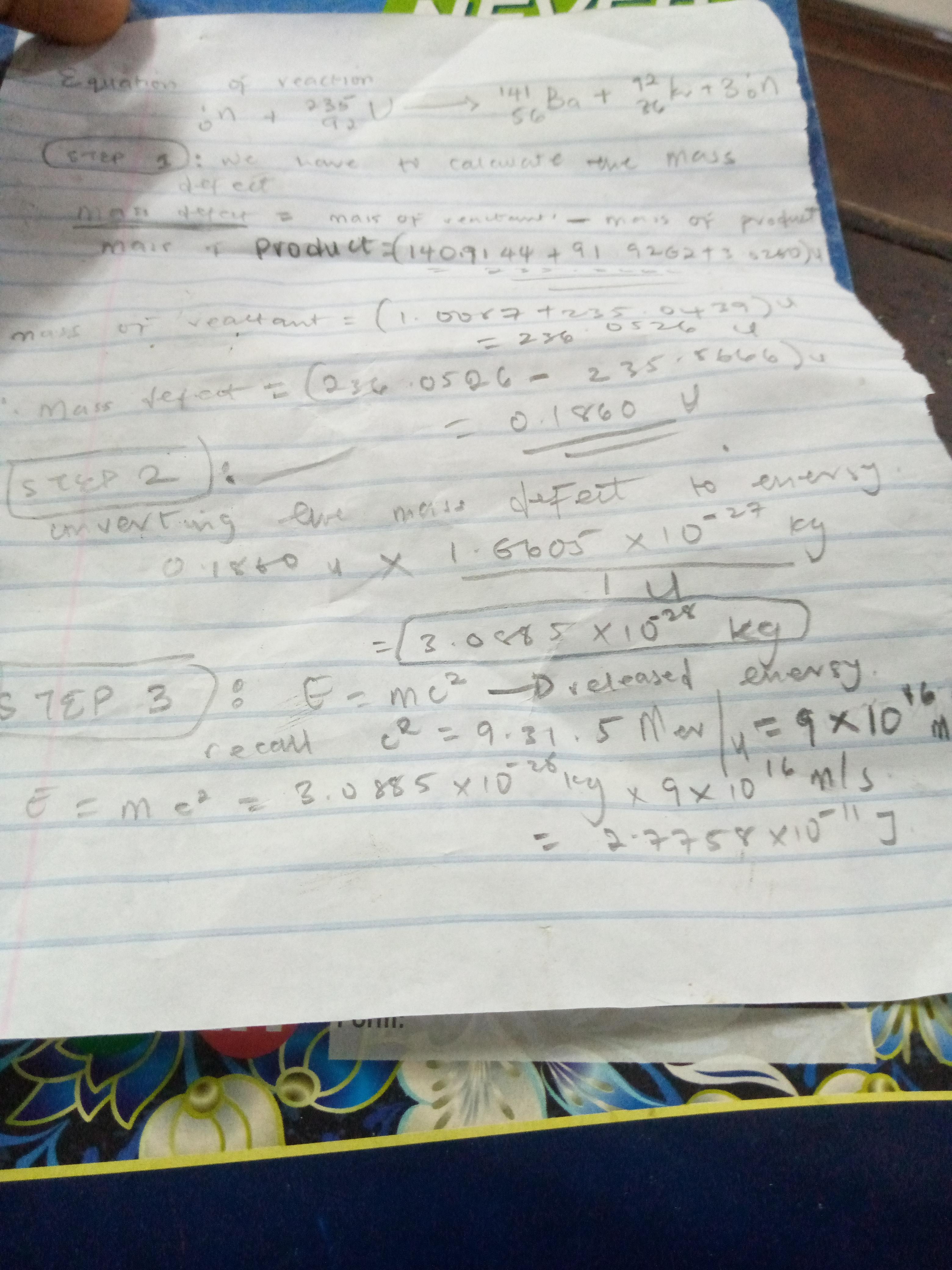
What is the reaction energy Q of this reaction? Use c2=931.5MeV/u. Express your answer in millions of electron volts to three si
emmasim [6.3K]

Answer:

Energy= 2.7758 × 10^-11 J ;

71.112×10^-6 kJ.

Mass defect in Kilogram= 3.0885×10^-28 kg.

That is; 3.1×10^-28 kg(to two significant figure).

Explanation:

(Note: Check equation of reaction in the attached file/picture).

STEP ONE: we have to calculate the Mass defect.

Mass defect= Mass of reactants -- Mass of products.

Mass of the products: (140.9144+91.9262+3.060) u.

= 235.8666 u.

Mass of reactants: (1.0087+235.0439) u= 236.0526 u.

Therefore, the Mass defect= (236.0526 -- 235.8666) u

= 0.1860 u.

STEP TWO: Converting the Mass defect to energy;

0.18860 × 1.6605 × 10^27 kg

= 3.0885× 10^-28 kg

STEP THREE: Calculating energy released . Recall(from the question) c^2= 931.5 Mev/u. This is also equals to 9×10^16 m/s.

E=Mc^2.

Where E= energy released, c= speed of light, M= Mass.

Slotting in the values;

E= 3.0885×10^-28 kg × 9×10^16 m/s.

E=2.7758 × 10^-11 J.

Know that;( 1g of uranium × 1 mol of uranium ÷ 235.0439 g of uranium) × (6.002×10^23 atom of uranium/ 1 mol of uranium) × 2.7758× 10^-11.

=7.1112×10^-10 J

= 71.112×10^6 kJ.

3 0
2 years ago
Write the reduction reaction of glucose to form sorbitol. List and explain the side effects caused by too much sorbitol consumpt
Lemur [1.5K]

Answer:

The product of reduction of glucose is sorbitol

The side effects caused by too much sorbitol consumption include: Diarrhea, Nausea, stomach discomfort

Explanation:

Please find attached the reaction of glucose with NADPH to produce sorbitol

5 0
2 years ago
Read 2 more answers
Other questions:
  • Compare and contrast the outer core and the inner core.
    8·2 answers
  • Al(s)+hcl(aq) → alcl3(aq)+h2(g). assume you have plenty of hcl and 6.0 mol of al. how many moles of h2 are formed?
    7·1 answer
  • How to calculate electronegativity with 3 elements?
    11·1 answer
  • Na3X, Enter the group number of X?
    15·2 answers
  • What is the empirical formula of a compound containing 90 grams carbon, 11 grams hydrogen, and 35 grams nitrogen? A. C3H4N B. C2
    6·1 answer
  • A mixture of three gases has a total pressure at 298 K of 1560 mm Hg. the mixture is analyzed and is found to contain 1.50 mol N
    10·1 answer
  • What is the best example of a cyclic event?
    7·1 answer
  • To save time you can approximate the initial volume of water to ±1 mL and the initial mass of the solid to ±1 g. For example, if
    14·1 answer
  • What effect do tube dwelling worms have on mudflat ecosystems?
    9·1 answer
  • If you weighed out 203 mg of the green chloro complex and dissolved it in 24.14 mL of acidic solvent, the molarity of your stock
    14·1 answer
Add answer
Login
Not registered? Fast signup
Signup
Login Signup
Ask question!