answer.
Ask question
Login Signup
Ask question
All categories
  • English
  • Mathematics
  • Social Studies
  • Business
  • History
  • Health
  • Geography
  • Biology
  • Physics
  • Chemistry
  • Computers and Technology
  • Arts
  • World Languages
  • Spanish
  • French
  • German
  • Advanced Placement (AP)
  • SAT
  • Medicine
  • Law
  • Engineering
zhenek [66]
2 years ago
12

In advertising, which aspect does music help to address when a brand uses different types of music for advertising in the United

States and in Asia?
Physics
1 answer:
Oksi-84 [34.3K]2 years ago
5 0

im pretty sure its entertainment

You might be interested in
Three balls are in water. Ball 1 floats, with half of it exposed above the water level. Ball 2, with a density less than the den
Ymorist [56]

Answer:

The magnitude of buoyancy force is equal to that of ball's weight.

Explanation:

Ball 1 is floating on water. Weight of ball 1 is Fg=m1g  is acting vertically downward

Force of buoyancy FB = ρVdisg is acting vertically upward.

Net force acting on the ball is zero, FB=Fg

Answer

The magnitude of buoyancy force is equal to that of ball's weight.

4 0
2 years ago
Read 2 more answers
A particle with a charge of -1.24 x 10"° C is moving with instantaneous velocity (4.19 X 10⁴ m/s)î + (-3.85 X 10⁴ m/s)j. What is
astra-53 [7]

Answer:

(a) F= 6.68*10¹¹⁴ N (-k)

(b) F =( 6.68*10¹¹⁴ i  + 7.27*10¹¹⁴ j  ) N

Explanation

To find the magnetic force in terms of a fixed amount of charge q that moves at a constant speed v in a uniform magnetic field B we apply the following formula:

F=q* v X B Formula (1 )

q: charge (C)

v: velocity (m/s)

B: magnetic field (T)

vXB : cross product between the velocity vector and the magnetic field vector

Data

q= -1.24 * 10¹¹⁰ C

v= (4.19 * 10⁴ m/s)î + (-3.85 * 10⁴m/s)j

B  =(1.40 T)i  

B  =(1.40 T)k

Problem development

a) vXB = (4.19 * 10⁴ m/s)î + (-3.85* 10⁴m/s)j X (1.40 T)i =

            = - (-3.85*1.4) k = 5.39* 10⁴ m/s*T (k)

1T= 1 N/ C*m/s

We apply the formula (1)

  F= 1.24 * 10¹¹⁰ C*  5.39* 10⁴ m/s* N/ C*m/s (-k)

   F= 6.68*10¹¹⁴ N (-k)

a)  vXB = (4.19 * 10⁴ m/s)î + (-3.85* 10⁴m/s)j X (1.40 T)k =

             =( - 5.39* 10⁴i - 5.87* 10⁴j)m/s*T

1T= 1 N/ C*m/s

We apply the formula (1)

F= 1.24 * 10¹¹⁰ C*  (  5.39* 10⁴i + 5.87* 10⁴j) m/s* N/ C*m/s

F =( 6.68*10¹¹⁴  i  + 7.27*10¹¹⁴  j  ) N

8 0
2 years ago
Jeremy accidently dropped his toy stuffed animal from the balcony of his apartment on the fourth floor. The toy hit the ground a
LekaFEV [45]
According to the second law of motion, force is the product of mass times acceleration. If we were to solve for the force, we would need the acceleration and the mass. 

Acceleration was not given in the problem, but we can solve for it by using the velocity and the time because by definition, acceleration is the change in velocity over time. 

a =  \frac{vf-vi}{t}

The initial velocity is 16.0m/s because it is the first recorded time. The final is 0 m/s or the last recorded velocity. The time we will use is 2.0 s because it is the time the change in velocity occurred. 

a = \frac{vf-vi}{t}
a = \frac{0m/s-16.0m/s}{2.0s}
a = \frac{-16.0m/s}{2.0s}
a=-8.0m/ s^{2}

Now that we have acceleration, we can now solve for the Force. Again Force is the product of mass and acceleration. 

F=ma
F=(0.25kg)(-8.0m/ s^{2} )
F=-2kg.m/ s^{2} ) or -2N

The force is -2N. Now if you are looking for the magnitude of the force then you can just put 2N.

The negative sign indicates the direction of the force, if it is negative this means that the force applied was in the opposite direction.  

4 0
2 years ago
A student releases a block of mass m from rest at the top of a slide of height h1. The block moves down the slide and off the en
Nina [5.8K]

Answer:

B)   d = √  ( 4 h₂ ( H - 2h₂))

Explanation:

A) 1) If the height of the slide is very small, there is no speed to leave the table, therefore do not recreate almost any horizontal distance

2) If the height is very small downwards, it touches the earth a little and the horizon is small,

B) to find an equation for horizontal distance (d)

We must maximize the speed at the bottom of the slide let's use energy

Starting point Higher

         Em₀ = U = m g h₁

Final point. Lower (slide bottom)

           Emf = K + U = ½ m v² + m gh₂

As there is no friction the energy is conserved

            mgh₁ = ½ m v² + mgh₂

            v² = 2 g (h₁-h₂)

This is the speed with which the block leaves the table, bone is the horizontal speed (vₓ)

The distance traveled when leaving the table can be searched with kinematics, projectile launch

          x = v₀ₓ t

         y =  t - ½ g t²

The height is the height of the table (y = h₂), as it comes out horizontally the vertical speed is zero

        t = √ 2h₂ / g

We substitute in the other equation

        d = √ (2g (h₁-h₂))  √ 2h₂ / g

        d = √ (4 h₂ (h₁-h₂))

        H = h₁ + h₂

        h₁ = H -h₂

        d = √  ( 4 h₂ ( H - 2h₂))

Explanation:

7 0
2 years ago
A 1100kg car pulls a boat on a trailer. (a) what total force resists the motion of the car, boat,and trailer, if the car exerts
likoan [24]
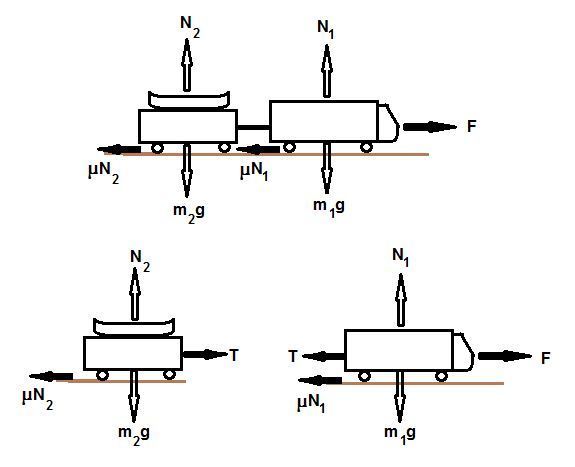
Refer to the figure shown below.

m₁ = 1100 kg, the mass of the car
m₂ = 700 kg, the mass of the trailer and boat
F = 1900 N, the driving force acting on the car
N₁ = m₁g,  the normal reaction on the car
N₂ = m₂g, the normal force on the trailer and boat
μN₁ and μN₂ are frictional forces, where  =  kinetic coefficient of friction
T = the force in the hitch between the car and trailer.

Part (a)
Let R₁ = the total force that resists the motion of the car, boat, and trailer.
Because the acceleration is 0.550m/s², therefore
(m₁ + m₂ kg)*(0.55 m/s²) = F
(1100+700 kg)*(0.55 m/s²) = (1900 - R₁) N
990 = 1900 - R
R₁ = 910 N

Answer: The resistive force is 910 N

Part (b)
80% of the resistive forces are experienced by the boat and trailer.
Let the resistive force be R₂.
Then
R₂ = 0.8*R₁ = 728 N
If the tension in the hitch between the car and the trailer is T, then
T - R₂ = m₂(0.55 m/s²)
(T - 728 N) = (700 kg)*(0.55 m/s²)
T - 728 = 385
T = 1113 N

Answer: The force in the hitch is 1113 N

3 0
2 years ago
Other questions:
  • Why did the acorn fall to earth instead of rising up to the moon?
    8·2 answers
  • A block of mass m1 = 3.5 kg moves with velocity v1 = 6.3 m/s on a frictionless surface. it collides with block of mass m2 = 1.7
    6·1 answer
  • A helicopter flies 250 km on a straight path in a direction 60° south of east. The east component of the helicopter’s displaceme
    7·2 answers
  • Charlie is playing with his daughter Torrey in the snow. She sits on a sled and asks him to slide her across a flat, horizontal
    10·2 answers
  • A couch is pushed with a horizontal force of 80 N and moves the couch a
    11·2 answers
  • You know that you sound better when you sing in the shower. This has to do with the amplification of frequencies that correspond
    9·1 answer
  • Which of the answer choices is a true statement? Select all that apply. Metallic elements usually exist as molecules, combining
    7·1 answer
  • You use a slingshot to launch a potato horizontally from the edge of a cliff with speed v0. The acceleration due to gravity is g
    13·1 answer
  • Which of the following describes a physical change? A. A marshmallow burns over an open flame. B. Icicles melt from a rooftop. C
    14·1 answer
  • A group of students collected the data shown below while attempting to measure the coefficient of static friction (of course, it
    9·1 answer
Add answer
Login
Not registered? Fast signup
Signup
Login Signup
Ask question!