answer.
Ask question
Login Signup
Ask question
All categories
  • English
  • Mathematics
  • Social Studies
  • Business
  • History
  • Health
  • Geography
  • Biology
  • Physics
  • Chemistry
  • Computers and Technology
  • Arts
  • World Languages
  • Spanish
  • French
  • German
  • Advanced Placement (AP)
  • SAT
  • Medicine
  • Law
  • Engineering
Afina-wow [57]
2 years ago
4

How does energy travel in a mechanical wave?

Chemistry
1 answer:
Bumek [7]2 years ago
7 0

How does energy travel in a mechanical wave

A) In A Medium

You might be interested in
Sulfurous acid is a diprotic acid with the following acid-ionization constants: Ka1 = 1.4x10⁻², Ka2 = 6.5x10⁻⁸ If you have a 1.0
REY [17]

Answer:

pH = 7.1581

Explanation:

The equilibrium of NaHSO₃ with Na₂SO₃ is:

HSO₃⁻ ⇄ SO₃²⁻ + H⁺

<em>Where K of equilibrium is the Ka2: 6.5x10⁻⁸</em>

HSO₃⁺ reacts with NaOH, thus:

HSO₃⁻ + NaOH → SO₃²⁻ + H₂O + Na⁺

As the buffer is of 1.0L, initial moles of HSO₃⁻ and SO₃²⁻ are:

HSO₃⁻: 0.252 moles

SO₃²⁻: 0.139 moles

Based on the reaction of NaOH, moles added of NaOH are subtracting moles of HSO₃⁻ and producing SO₃²⁻. The moles added are:

0.0500L ₓ (1mol /L): 0.050 moles of NaOH.

Thus, final moles of both compounds are:

HSO₃⁻: 0.252 moles - 0.050 moles = 0.202 moles

SO₃²⁻: 0.139 moles + 0.050 moles = 0.189 moles

Using H-H equation for the HSO₃⁻ // SO₃²⁻ buffer:

pH = pka + log [SO₃²⁻] / [HSO₃⁻]

Where pKa is - log Ka = 7.187

Replacing:

pH = 7.187 + log [0.189] / [0.202]

<h3>pH = 7.1581</h3>

4 0
2 years ago
A scientist measures the mass of two liquids before and after combining them. The mass after combining the liquids is less then
Lelu [443]

Answer:

A chemical change occurred and a gas was produced.  

Step-by-step explanation:

If there is no chemical reaction, the <em>Law of Conservation of Mass</em> says that  

Total mass = Mass 1 + Mass 2

However, if the two liquids react and give off a gas, then

Total mass = Mass 1 + Mass 2 + Mass of gas

You are not measuring the mass of the gas, so the mass of the liquids after mixing is less than it was before mixing.

For example, if Liquid 1 was a solution of HCl and Liquid 2 was a solution of Na₂CO₃, they would give off CO₂ on mixing. but you would not be measuring the mass of the CO₂.

4 0
2 years ago
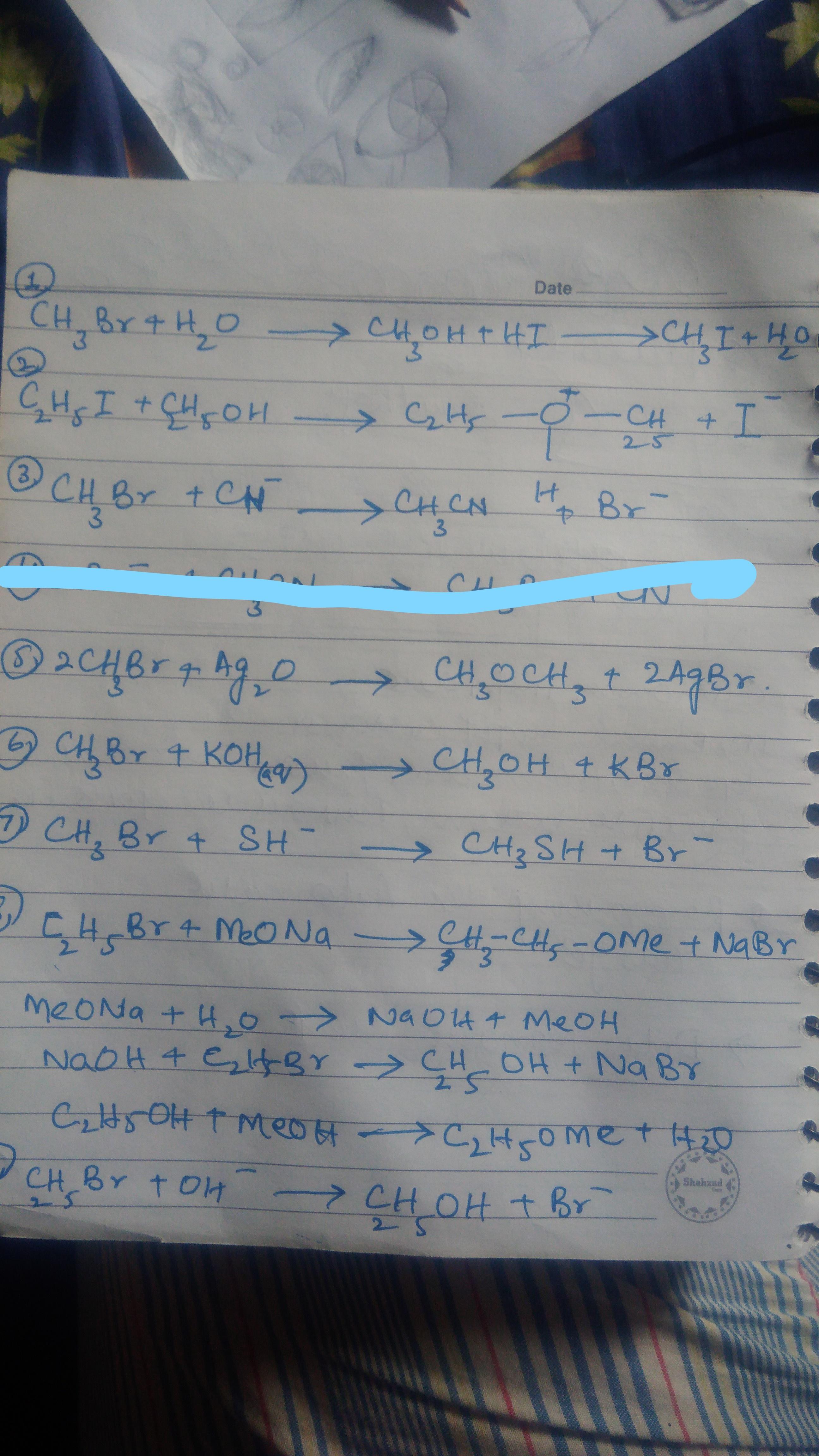
With methyl, ethyl, or cyclopentyl halides as your organic starting materials and using any needed solvents or inorganic reagent
Scorpion4ik [409]

Answer:

In the attachment you can find all the possible chemical reactions.

Some reaction can not be obtained by using alkyl halides because halides are weak leaving group which can leave compound during reaction easily but hydroxyl groups is a strong nucleophile which can not leave compound easily. So we can obtain alcohol from ethyl bromide, but we can not obtain hydroxyl ion from ethyl bromide.  

Explanation:

7 0
2 years ago
A patient is receiving 3000 mL/day of a solution that con-
frutty [35]

Answer:

600 kCal/ day

Explanation:

You can solve this type of problems using proportions, with the rule of three.

Follow these steps:

1. Analyze the giving data

2. Organize it

3.Write the proportions  

4. Clear the value you are looking for

5. Solve the equations by multiplying or dividing

Now for the exercise:

You have the following data:

3000 mL Solution per 1 day ----> 3000 mL S

The concentration of the solution is  

5 g of dextrose per 100 mL  Solution ----> 5g D - 100 mL S

The glucose provides some specific energy

4 kCal per 1 g of dextrose ----> 4kCal - 1 g D

First find the total grams of  dextrose (glucose) given in one day.

3000 mL S - x g D?

 100 mL S - 5 g D

The grams of glucose given in one day

xg D? = 3000 mL S(5 g D)/100 mL S  

you also can cancel the units mL S

xg D? = 150 g D.

Answer: The grams given in one day of glucose are 150 g /day

Now find the total Energy in those grams:

4 kCal -      1 g D

x kCal?-150 g D

Clear x kCal?

x kCal? = 4kCal (150g D)/(1g D)

x kCal? = 600 kCal  remember is for one day!

so the answer is

The patient is receiving 600 kCal/day

5 0
2 years ago
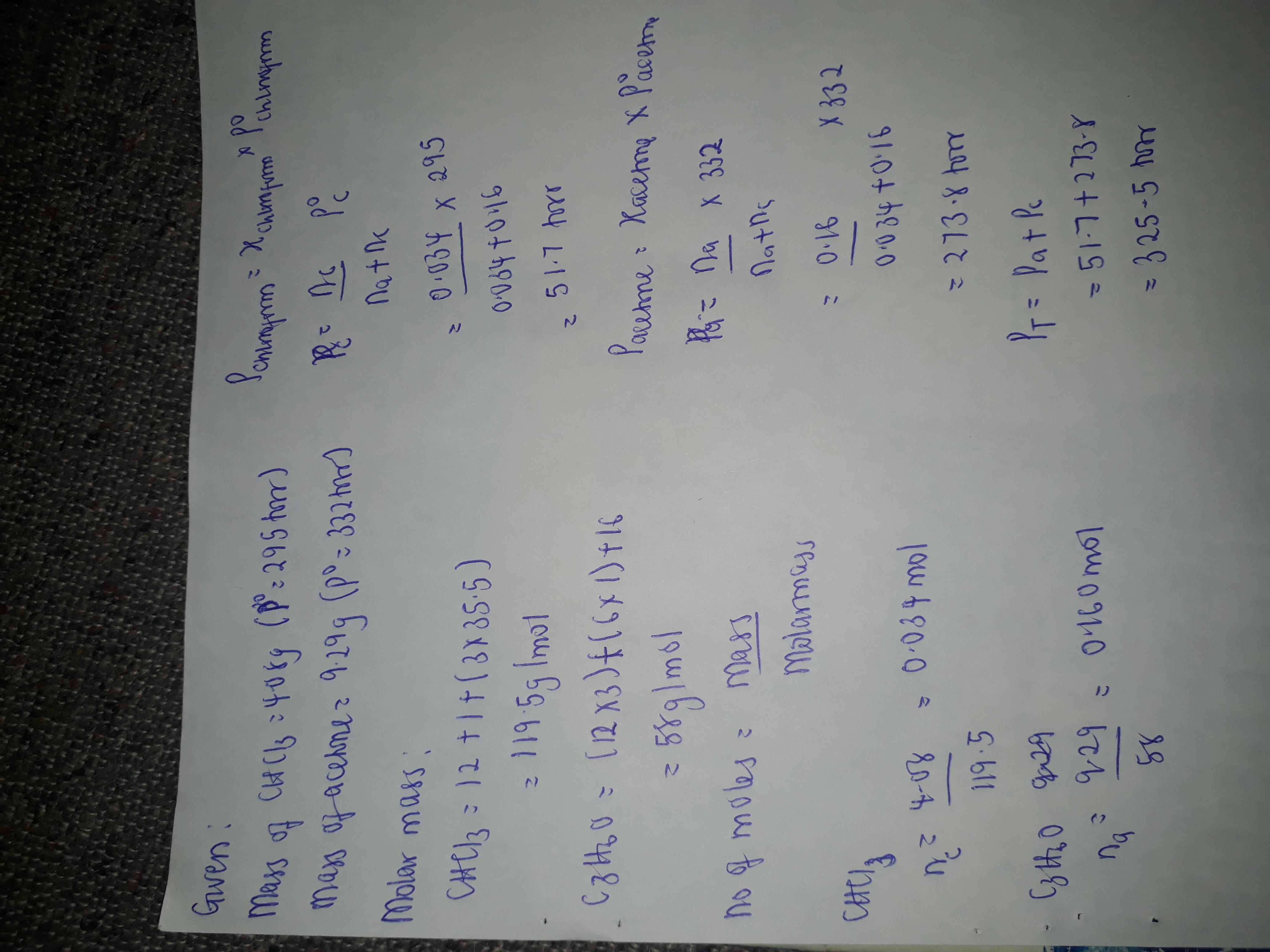
A solution contains 4.08 g of chloroform (CHCl3) and 9.29 g of acetone (CH3COCH3). The vapor pressures at 35 ∘C of pure chlorofo
Sergeeva-Olga [200]

Explanation:

Below is an attachment containing the solution.

8 0
2 years ago
Read 2 more answers
Other questions:
  • Is iron bromide magnetic if no why
    14·2 answers
  • Exactly 500 grams of ice are melted at a temperature of 32°f. (lice = 333 j/g.) calculate the change in entropy (in j/k). (give
    5·1 answer
  • Among these processes, which is the slowest chemical reaction?
    13·2 answers
  • Label each statement with its corresponding type of scientific knowledge.
    9·2 answers
  • How many moles of calcium chloride (CaCl2) are needed to react completely with 6.2 moles of silver nitrate (AgNO3)? 2AgNO3 + CaC
    15·1 answer
  • An increase in temperature will effect vapor pressure by:
    6·1 answer
  • When the reaction CO2(g) + H2(g) ⇄ H2O(g) + CO(g) is at equilibrium at 1800◦C, the equilibrium concentrations are found to be [C
    11·1 answer
  • What is the total mass of D-glucose dissolved in a 2-μL aliquot of the solution used for this experiment?
    11·1 answer
  • A titration is performed to determine the amount of sulfuric acid, H2SO4, in a 6.5 mL sample taken from car battery. About 50 mL
    10·1 answer
  • A student has two samples of NaCl, each one from a different source. Assume that the only potential contaminant in each sample i
    9·1 answer
Add answer
Login
Not registered? Fast signup
Signup
Login Signup
Ask question!