answer.
Ask question
Login Signup
Ask question
All categories
  • English
  • Mathematics
  • Social Studies
  • Business
  • History
  • Health
  • Geography
  • Biology
  • Physics
  • Chemistry
  • Computers and Technology
  • Arts
  • World Languages
  • Spanish
  • French
  • German
  • Advanced Placement (AP)
  • SAT
  • Medicine
  • Law
  • Engineering
Citrus2011 [14]
2 years ago
14

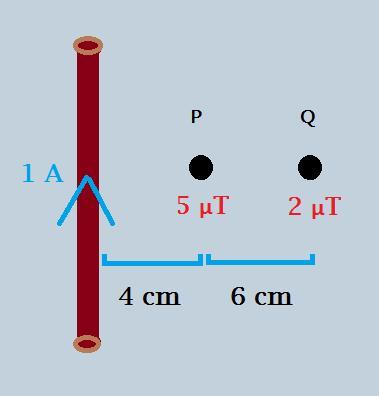
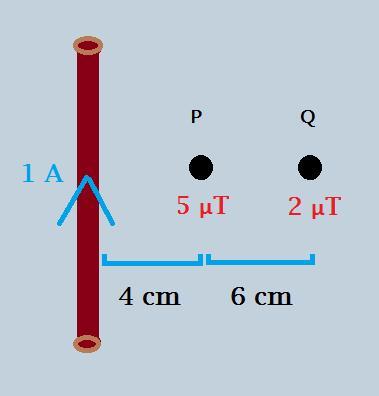
The magnetic field 10 cm from a wire carrying a 1 A current is 2 μT. What is the field 4 cm from the wire? Express your answer w

ith the appropriate units.

Physics
2 answers:
Aloiza [94]2 years ago
8 0

Answer:

5 \mu T

Explanation:

We can solve the problem in two ways:

1) The magnetic field around a current-carrying wire is given by

B=\frac{\mu_0 I}{2 \pi r}

where

\mu_0 = 4\pi \cdot 10^{-7}Tm/A is the permeabilty of free space

I is the current

r is the distance from the wire

Substituting I=1 A and r=4 cm=0.04 m, we find:

B=\frac{(4\pi \cdot 10^{-7})(1 A)}{2 \pi (0.04 m)}=5\cdot 10^{-6} T=5 \mu T

2) We can notice that the magnitude of the magnetic field around a current-carrying wire is inversely proportional to the distance from the wire:

B\propto \frac{1}{r}

which means that the product B \cdot r is constant if we keep the same wire. So we can write

B_1 r_1 = B_2 r_2

and using B_1 = 2 \mu T, r_1 = 10 cm, r_2 = 4 cm we can find the magnetic field at 4 cm from the wire:

B_2 = \frac{B_1 r_1}{r_2}=\frac{(2 \mu T)(10 cm)}{4 cm}=5 \mu T

Naya [18.7K]2 years ago
3 0

The field 4 cm from the wire is 5 μT

\texttt{ }

<h3>Further explanation</h3>

Let's recall magnetic field strength from current carrying wire:

\large {\boxed {B = \mu_o \frac{I}{2 \pi d} } }

<em>B = magnetic field strength (T)</em>

<em>μo = permeability of free space = 4π × 10⁻⁷ (Tm/A)</em>

<em>I = current (A)</em>

<em>d = distance (m)</em>

Let's tackle the problem now !

\texttt{ }

<u>Given:</u>

initial distance = d₁ = 10 cm

current = I = 1 A

initial magnetic field strength = B₁ = 2 μT

final distance = d₂ = 4 cm

<u>Asked:</u>

final magnetic field strength = B₂ = ?

<u>Solution:</u>

B_1 : B_2 = \mu_o \frac{I}{2\pi d_1} : \mu_o \frac{I}{2\pi d_2}

B_1 : B_2 = \frac{1}{d_1} : \frac{1}{d_2}

B_1 : B_2 = d_2 : d_1

B_2 = \frac{d_1}{d_2} \times B_1

B_2 = \frac{10}{4} \times 2

B_2 = 5 \ \mu T

\texttt{ }

<h3>Learn more</h3>
  • Temporary and Permanent Magnet : brainly.com/question/9966993
  • The three resistors : brainly.com/question/9503202
  • A series circuit : brainly.com/question/1518810
  • Compare and contrast a series and parallel circuit : brainly.com/question/539204

\texttt{ }

<h3>Answer details</h3>

Grade: High School

Subject: Physics

Chapter: Magnetic Field

\texttt{ }

Keywords: Magnet , Field , Magnetic , Current , Wire , Unit ,

You might be interested in
If a force of 65 N is exerted on a 45 kg sofa and the sofa is moved 6.0 meters, how much work is done in moving the sofa? 17,550
abruzzese [7]

Answer:

The answer to your question is:   W = 390 J

Explanation:

Work is the transfer of energy when a body is moved from one place to another.

Data

Force = 65 N

mass = 45 kg

distance = 6 meters

work = ? J

Formula

W = F x d

Process

                   W = 65 N x 6 m

                   W = 390 J

5 0
2 years ago
Read 2 more answers
Consider the two moving boxcars in Example 5. Car 1 has a mass of m1 = 65000 kg and a velocity of v01 = +0.80 m/s. Car 2 has a m
Amiraneli [1.4K]

Answer:

1.034m/s

Explanation:

We define the two moments to develop the problem. The first before the collision will be determined by the center of velocity mass, while the second by the momentum preservation. Our values are given by,

m_1 = 65000kg\\v_1 = 0.8m/s\\m_2 = 92000kg\\v_2 = 1.2m/s

<em>Part A)</em> We apply the center of mass for velocity in this case, the equation is given by,

V_{cm} = \frac{m_1v_1+m_2v_2}{m_1+m_2}

Substituting,

V_{cm} = \frac{(65000*0.8)+(92000*1.2)}{92000+65000}

V_{cm} = 1.034m/s

Part B)

For the Part B we need to apply conserving momentum equation, this formula is given by,

m_1v_1+m_2v_2 = (m_1+m_2)v_f

Where here v_f is the velocity after the collision.

v_f = \frac{m_1v_1+m_2v_2}{m_1+m_2}

v_f = \frac{(65000*0.8)+(92000*1.2)}{92000+65000}

v_f = 1.034m/s

8 0
2 years ago
Determine the change in thermal energy of 100 g of copper (M = 63,5, Debye 348K) if it is cooled from
Setler [38]

Answer:

given,

mass of copper = 100 g

latent heat of liquid (He) = 2700 J/l

a) change in energy

Q = m Cp (T₂ - T₁)

Q = 0.1 × 376.812 × (300 - 4)

Q = 11153.63 J

He required

Q = m L

11153.63 = m × 2700

m = 4.13 kg

b) Q = m Cp (T₂ - T₁)

Q = 0.1 × 376.812 × (78 - 4)

Q = 2788.41 J

He required

Q = m L

2788.41 = m × 2700

m = 1.033 kg

c) Q = m Cp (T₂ - T₁)

Q = 0.1 × 376.812 × (20 - 4)

Q = 602.90 J

He required

Q = m L

602.9 = m × 2700

m =0.23 kg

8 0
2 years ago
A curtain hangs straight down in front of an open window. A sudden gust of wind blows past the window; and the curtain is pulled
VikaD [51]

Answer:

option B.

Explanation:

The correct answer is option B.

The phenomenon of the curtains to pull out of the window can be explained using Bernoulli's equation.

According to Bernoulli's Principle when the speed of the moving fluid increases the pressure within the fluid decrease.

When wind flows in the outside window the pressure outside window decreases and pressure inside the room is more so, the curtain moves outside because of low pressure.

3 0
2 years ago
Steam enters a counterflow heat exchanger operating at steady state at 0.07 MPa with a specific enthalpy of 2431.6 kJ/kg and exi
PIT_PIT [208]

Answer:

Explanation:

Given:

Steam Mass rate, ms = 1.5 kg/min

= 1.5 kg/min × 1 min/60 sec

= 0.025 kg/s

Air Mass rate, ma = 100 kg/min

= 100 kg/min × 1 min/60 sec

= 1.67 kg/s

A.

Extracting the specific enthalpy and temperature values from property table of “Saturated water – Pressure table” which corresponds to temperature at 0.07 MPa.

xf, quality = 0.9.

Tsat = 89.9°C

hf = 376.57 kJ/kg

hfg = 2283.38 kJ/kg

Using the equation for specific enthalpy,

hi = hf + (hfg × xf)

= 376.57 + (2283.38 × 0.9)

= 2431.552 kJ/kg

The specific enthalpy of the outlet, h2 = hf

= 376.57 kJ/kg

B.

Rate of enthalpy (heat exchange), Q = mass rate, ms × change in specific enthalpy

= ms × (hi - h2)

= 0.025 × (2431.552 - 376.57)

= 0.025 × 2055.042

= 51.37455 kW

= 51.38 kW.
5 0
2 years ago
Other questions:
  • Henry can lift a 200 N load 20 m up a ladder in 40 s. Ricardo can lift twice the load up one-half the distance in the same amoun
    14·2 answers
  • A photon has an energy of 5.53 × 10⁻¹⁷ j. what is its frequency in s–1 (h = 6.63 × 10⁻³⁴ j • s)?
    6·2 answers
  • A turtle takes 3.5 minutes to walk 18 m toward the south along a deserted highway. A truck driver stops and picks up the turtle.
    11·1 answer
  • A student wants to verify a claim that for a given change in momentum, the average applied force decreases as the time interval
    12·1 answer
  • Solar wind particles can be captured by the Earth's magnetosphere. When these particles spiral down along the magnetic field int
    5·1 answer
  • Electric field lines always begin at _______ charges (or at infinity) and end at _______ charges (or at infinity). One could als
    5·1 answer
  • In a particular application involving airflow over a surface, the boundary layer temperature distribution may be approximated as
    15·1 answer
  • A child is playing with a spring toy, first stretching and then compressing it.
    10·1 answer
  • Which phrases describe NASA's goals in the coming years? Check all that apply.
    5·2 answers
  • Henrietta is going off to her physics class, jogging down the sidewalk at a speed of 4.15 m/s . Her husband Bruce suddenly reali
    6·1 answer
Add answer
Login
Not registered? Fast signup
Signup
Login Signup
Ask question!