answer.
Ask question
Login Signup
Ask question
All categories
  • English
  • Mathematics
  • Social Studies
  • Business
  • History
  • Health
  • Geography
  • Biology
  • Physics
  • Chemistry
  • Computers and Technology
  • Arts
  • World Languages
  • Spanish
  • French
  • German
  • Advanced Placement (AP)
  • SAT
  • Medicine
  • Law
  • Engineering
kaheart [24]
2 years ago
10

A particle with a charge of −1.24×10⁻⁸c is moving with instantaneous velocity v⃗ = (4.19×10⁴m/s)i^ + (−3.85×10⁴m/s)j^ . part a w

hat is the force exerted on this particle by a magnetic field b⃗ = (1.80 t ) i^? enter the x, y, and z components of the force separated by commas.

Physics
2 answers:
givi [52]2 years ago
8 0

The particle’s force is <em><u>( - 8.59 × 10⁻⁴ </u></em><em><u>k</u></em><em><u> ) N</u></em>

\texttt{ }

<h3>Further explanation</h3>

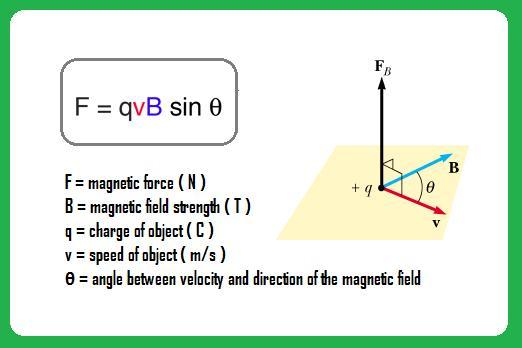
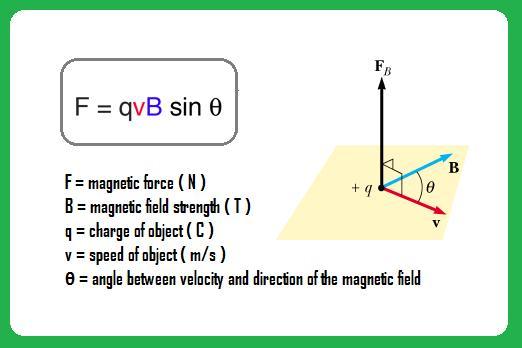
<em>Let's recall </em><em>magnetic force on moving charge</em><em> as follows:</em>

F = B q v \sin \theta

<em>where:</em>

<em>F = magnetic force ( N )</em>

<em>B = magnetic field strength ( T )</em>

<em>q = charge of object ( C )</em>

<em>v = speed of object ( m/s )</em>

<em>θ = angle between velocity and direction of the magnetic field </em>

Let's tackle the problem now !

\texttt{ }

<u>Given:</u>

speed of particle = v_y = -3.85 × 10⁴ m/s

magnetic field strength = B_x = 1.80 T

charge of particle = q = -1.24 × 10⁻⁸ C

direction of speed = θ = 90°

<u>Asked:</u>

the particle's force = F = ?

<u>Solution:</u>

F = B_x q v_y \sin \theta

F = 1.80 \times 1.24 \times 10^{-8} \times 3.85 \times 10^4 \times \sin 90^o

\boxed{F \approx 8.59 \times 10^{-4} \texttt{ N}}

<em>According to the Left Hand Rule , the direction of force is in </em><em>negative z-axis.</em>

We could write this force in vector form as follows:

\overrightarrow{F} = - (8.59 \times 10^{-4}) ~ \widehat{k} \texttt{ N}

\texttt{ }

<h3>Learn more</h3>
  • Temporary and Permanent Magnet : brainly.com/question/9966993
  • The three resistors : brainly.com/question/9503202
  • A series circuit : brainly.com/question/1518810
  • Compare and contrast a series and parallel circuit : brainly.com/question/539204

\texttt{ }

<h3>Answer details</h3>

Grade: High School

Subject: Physics

Chapter: Magnetic Field
Bezzdna [24]2 years ago
6 0

Answer:

F = 0i (in the x-direction), 0j (in the y-direction),-8.59*10^-4 N k (In the z-direction)

Explanation:

The force given by charged particles moving in a magnetic field is given below (cross is cross product, they don't have that format in the equation tool):

F=qv (cross) B\\

Now we can perform the cross product between v and B

v(cross)B = \left[\begin{array}{cc}4.19*10^{4} &-3.85*10^{4}\\1.8&0&\en[tex]v(cross)B = 69300 (kg*m/(s^2*C))\\d{array}\right][/tex]

Now multiply by Q (charge) to get the force

F = -1.24*10^-8 * 69300\\F = -8.59*10^-4N

F = -8.59*10^-4 N k

F = 0i, 0j, (-8.59*10^-4)k

You might be interested in
A neutron at rest decays (breaks up) to a proton and an electron. Energy is released in the decay and appears as kinetic energy
SashulF [63]

Answer:

5.444\times 10^{-4}

Explanation:

The momentum of the neutron before and after the decay  is the same since there's no external force.

P_{sys}=const\\\\P=mv\\\\K=0.5mv^2

#The neutron is initially at rest, so after the decay:

P_A+P_B=0\\\\P_A=-P_B

#After decay, the proton has +ve direction  with a velocity v_Awhile the electron moves in a negative direction with a velocity v_B

Therefore:

P_A=m_Av_A, P_B=m_Bv_B\\\\\therefore m_Av_A,=m_Bv_B

Let the energy released during the decay be Q:

Q=K_{tot}=K_A+K_B\\\\Q=K_A+0.5m_Bv_B^2\\\\Q=K_A+0.5m_B(\frac{m_A}{m_B})^2v_A^2\\\\\ But \ K_A=0.5m_Av_A^2\\\\\therefore Q=K_A+\frac{m_A}{m_B}K_A=K_A(1+\frac{m_A}{m_B})\\\\=Q=\frac{m_A+m_B}{m_B}K_A\\\\m_A=1836m_B\\\\\frac{K_A}{Q}=\frac{m_B}{1836m_B+m_B}=\frac{1}{1837}\\\\\frac{K_A}{Q}=5.444\times10^{-4}

Hence,Kp/Ktot is 5.444x10^(-4)

4 1
2 years ago
A physics student walks 100 meters in 80 seconds. The student stops for 30 seconds, and then walks 200 meters farther in 90 seco
Elan Coil [88]

Answer:

B i think is the answer

Explanation:

i feel like it is B because if you put them together and the answer is 1.5 so it is B

8 0
2 years ago
PLEASE HELP!!!!!! WILL GIVE BRAINLIEST TO WHOEVER ANSWERS WITH THE RIGHT ANSWER !!!!!!!! 
Solnce55 [7]

It would be B and D your welcome


7 0
2 years ago
Read 2 more answers
Listed following are three possible models for the long-term expansion (and possible contraction) of the universe in the absence
Lynna [10]

Answer:

1) Recollapsing universe

2) critical universe

3) Coasting universe

Explanation:

According to the smallest ration (ratio actual mass density to current density) to largest ration, rank of models for expansion of universe are

1) Recollapsing universe -in this, metric expansion of space is reverse and universe recollapses.

2) critical universe - in this, expansion of universe is very low.

3) Coasting universe -  in this, expansion of universe is steady and uniform

6 0
2 years ago
The standing vertical jump is a good test of an athlete's strength and fitness. The athlete goes into a deep crouch, then extend
SashulF [63]

Answer:

<em>The athlete will rise 1.10 meters off the ground</em>

Explanation:

<u>Vertical Motion</u>

If an object is launched vertically upwards at an initial speed vo, then it will reach a maximum height given by

\displaystyle y_m=\frac{v_o^2}{2g}

The athlete can exert a net force upwards equal to twice his weight. It makes him accelerate upwards at

\displaystyle a=\frac{F_n}{m}=\frac{2W}{m}=2g

The speed at the end of his push can be computed by

v^2=2ay

Replacing the value of a obtained above:

v^2=4gy

where y is the length of this crouch

v^2=4\cdot 9.8\cdot 0.55

v=4.64\ m/s

This is the initial speed of this vertical launch, thus

\displaystyle y_m=\frac{4.64^2}{2\cdot 9.8}

y_m=1.10\ m

5 0
2 years ago
Other questions:
  • The amplitude of a lightly damped oscillator decreases by 3.0% during each cycle. what percentage of the mechanical energy of th
    13·1 answer
  • Given equal time periods, which statement is correct?
    13·2 answers
  • A geologist is studying the shore along a river. She finds a pile of rocks at the base of a riverbank. These broken rock pieces
    14·2 answers
  • Part F - Example: Finding Two Forces (Part I)
    5·1 answer
  • 3.00 kg block moving 2.09 m/s right hits a 2.22 kg block moving 3.92 m/s left. afterwards, the 3.00 kg block moves 1.71 m/s left
    11·1 answer
  • A ball of mass 5.0kg is lifted off the floor a distance of 1.7m. 1. What is the change in the gravitational potential energy of
    13·1 answer
  • In order to get a tree stump out of the ground, chains are connected to two trucks. One truck pulls with a force of 600 N to the
    9·1 answer
  • A stationary boat in the ocean is experiencing waves from a storm. The waves move at 59 km/h and have a wavelength of 145 m . Th
    15·1 answer
  • 1. A2 .7-kg copper block is given an initial speed of 4.0m/s on a rough horizontal surface. Because of friction, the block final
    10·1 answer
  • A ball bearing of radius of 1.5 mm made of iron of density
    11·1 answer
Add answer
Login
Not registered? Fast signup
Signup
Login Signup
Ask question!