answer.
Ask question
Login Signup
Ask question
All categories
  • English
  • Mathematics
  • Social Studies
  • Business
  • History
  • Health
  • Geography
  • Biology
  • Physics
  • Chemistry
  • Computers and Technology
  • Arts
  • World Languages
  • Spanish
  • French
  • German
  • Advanced Placement (AP)
  • SAT
  • Medicine
  • Law
  • Engineering
Marysya12 [62]
2 years ago
3

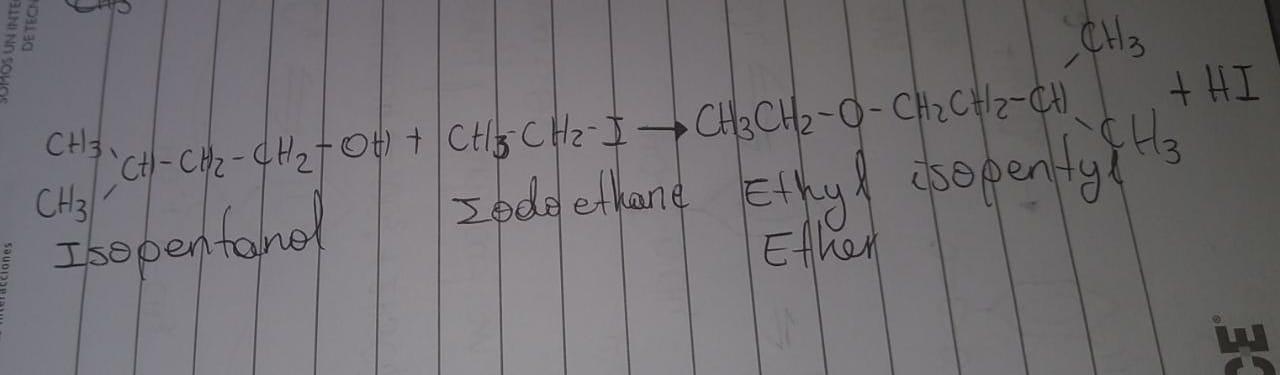
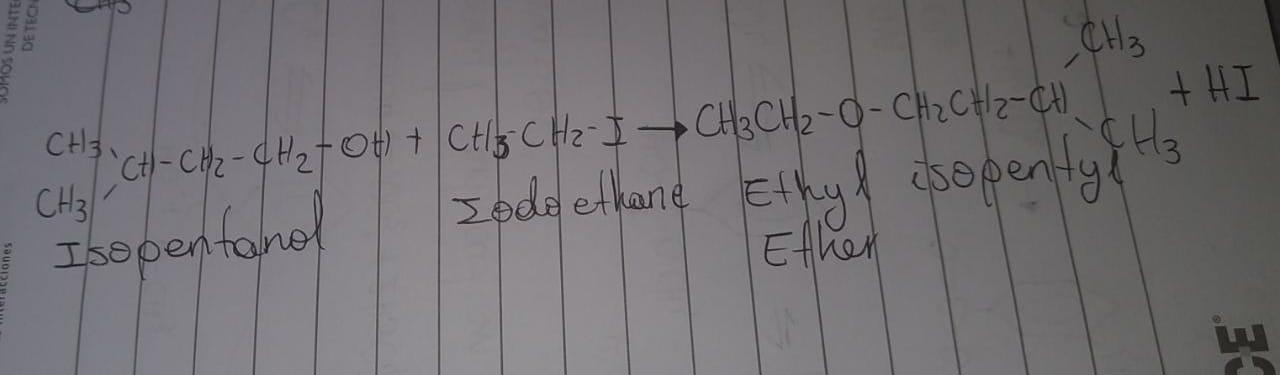
Give the set of reactants (including an alkyl halide and a nucleophile) that could be used to synthesize the following ether: Dr

aw the molecules on the canvas by choosing buttons from the Tools (for bonds and charges), Atoms, and Templates toolbars, including charges where needed.
CH3CH2OCH2CH2CHCH3
|
CH3

Chemistry
2 answers:
Bingel [31]2 years ago
8 0

Answer:yeet

Explanation your mom yeeted you

ser-zykov [4K]2 years ago
7 0

Answer:

Iodoethane and isopentanol.

Explanation:

Hello,

This is a case in which the Williamson ether synthesis is carried out by the reaction between the alcoxide's anion and an alkyl halide (more reactive towards the substitution). In such a way, on the attached picture, you will find the necessary chemical reaction which involves iodoethane and isopentanol as the set of reactants to obtain the shown ether ethyl isopentyl ether and hydrogen iodide as a side product.

Best regards.

You might be interested in
You want to determine ΔH o for the reaction Zn(s) + 2HCl(aq) → ZnCl2(aq) + H2(g) To do so, you first determine the heat capacity
Assoli18 [71]

Answer:

(A) The heat capacity of the calorimeter is therefore = −2.1428KJ÷13.5°C

= −0.1587KJ/°C


(B) ΔHo for the reaction Zn(s) + 2HCl(aq) → ZnCl2(aq) + H2(g) = –15.42KJ

Explanation:

Solution


Calculate the heat actually evolved.

                 q = mcΔt


Finding the mass of the reactants in grams we have.


Use density. (50 mL + 50 mL ) = 100 mL of solution.


100 mL X 1.04g/mL     = 104 grams of solution. (mass = Volume X Density)


Find the temperature change.


       Δt =tfinal - tinitial = 30.4°C – 16.9°C = 13.5°C


    q = mcΔt

       = 104grams × 3.93J/g°C  × 13.5°C = 5.51772×10³J


       = 5.51772 × 10³ J


This is the heat lost in the reaction between HCl and NaOH, therefore q = -5.52 × 10³ J.


this is an exothermic heat producing reaction.

 To calculate the total heat of the reaction or heat per mole we have


50.0 mL of HCl X 2.00 mol HCl /(1000 mL HCl ) = 0.100 mol HCl


The same quantity of base, 0.100 mole NaOH, was used.

The energy per unit mole is given by


i.e. molar enthalpy = J/mol = -5.52 × 10³J / 0.100 mol

            = -5.52 × 10⁴ J/mol

            = -55177.2 J/mol

            = -55.177 kJ/mol


Therefore, the enthalpy change for the neutralization of HCl and NaOH, that is the enthalpy, heat, of reaction is ΔH = -55.177 kJ/mol

Heat absorbed by the calorimeter = −57.32kJ − 55.177 kJ = −2.1428KJ

The heat capacity of the calorimeter is therefore = −2.1428KJ÷13.5°C

= −0.1587KJ/°C


(B) For the ZnCl we have


Calculate the heat actually evolved.

                            q = mcΔt


Finding the mass of the reactants in grams we have.


Use density.  100 mL of solution of HCl


100 mL X 1.015g/mL        = 101.5 grams of solution. (mass = Volume X Density)


Find the temperature change.


       Δt =tfinal - tinitial = 20.5°C – 16.8°C = 3.7 °C


    q = mcΔt

       = 101.5grams × 3.95J/g°C  × 3.7°C = 1483.422×103J


       = -1483.422×103J


This is the heat lost in the reaction between HCl and NaOH, therefore q = -1.483 × 10³ J.


this is an exothermic heat producing reaction.

 To calculate the total heat of the reaction or heat per mole we have


100.0 mL of HCl X 1.00 mol HCl /(1000 mL HCl ) = 0.100 mol HCl


The energy per unit mole is given by


i.e. molar enthalpy = J/mol = -1.483 × 10³J / 0.100 mol

                                         = -1.483 × 10⁴ J/mol

                                         = -14834.22 J/mol

                                         = -14.834 kJ/mol


Therefore, the enthalpy change for the neutralization of HCl and NaOH, that is the enthalpy, heat, of reaction is ΔH = -14.834 kJ/mol

ΔHo for the reaction Zn(s) + 2HCl(aq) → ZnCl2(aq) + H2(g)

= -14.834 kJ –(0.1587KJ/°C×3.7°C) = -15.42KJ

ΔHo for the reaction Zn(s) + 2HCl(aq) → ZnCl2(aq) + H2(g) = –15.42KJ
5 0
2 years ago
A sample of a solid labeled as NaCl may be impure. a student analyzes the sample and determines that it contains 75 percent chlo
Evgesh-ka [11]

Answer:

D

Explanation:

The sample must contain impurity that is lower in atomic mass to sodium and since potassium has higher atomic mass to sodium, the answer is the sample contains NaCl and LiCl. We are sure already that the sample is not pure which rules out  option a and option b contains sodium iodide which cannot contribute to the increase in chlorine

5 0
2 years ago
Analyze and solve this partially completed galvanic cell puzzle. There are 4 electrodes each identified by a letter of the alpha
klasskru [66]

Complete Question

The complete question is shown on the first uploaded image

Answer:

The correct option is  E_{cell}__{AC}} = 0.94

Explanation:

  From the question we are told that

          the cell voltage for AD is  E_{cell}__{AD}} = 1.56V

From the data give we can see that

               E_{cell}__{AD}} - E_{cell}__{BD}} = E_{cell}__{AB}}

i.e           1.56 - 1.53 = 0.03

   In the same way we can say that

              E_{cell}__{AD}}-E_{cell}__{CD}} = E_{cell}__{AC}}

=>        E_{cell}__{AC}}=1.56- 0.62

                       E_{cell}__{AC}} = 0.94


5 0
2 years ago
Which issue is a limitation of using synthetic polymers? Check all that apply.
Margarita [4]

#1 (As trash, synthetic polymers are not biodegradable)

#2 (Landfills can easily fill up with synthetic polymers)

#4 (Recycling synthetic polymers is costly)

4 0
2 years ago
Read 2 more answers
5. Gabi has plans with her friends to go to a concert on her birthday in 4 days. She is so excited that she wants to know how ma
drek231 [11]

Answer:

So she is very anxious because she has to wait 345600 seconds

Explanation:

60 second = 1 minute

60 minute = 1 hour

1 hour has 3600 seconds (60*60)

24 hour = 1 day

3600 second * 24 hours =

1 day has 86400 seconds so in four days

86400 * 4 = 345600

7 0
2 years ago
Other questions:
  • Which isolated gaseous atom has a total of five electrons occupying spherically shaped orbitals?
    7·1 answer
  • Draw the structure of (z)-3-methylhept-3-ene. be sure the stereochemistry is drawn clearly.
    7·1 answer
  • A certain gas is present in a 12.0 L cylinder at 4.0 atm pressure. If the pressure is increased to 8.0 atm the volume of the gas
    13·2 answers
  • What does the oxidizing agent do in a redox reaction apex?
    8·2 answers
  • An atom of oxygen has an atomic number of 8 and a mass number of 18. How many of each type of subatomic particle does it contain
    12·2 answers
  • Adam wants to work in the field of forensic science and follow the rules for handling evidence. Which organization can he join t
    12·2 answers
  • Atorvastatin is sold under the trade name Lipitor and is used for lowering cholesterol. Annual global sales of this compound exc
    6·1 answer
  • According to the following reaction, how many moles of Fe(OH)2 can form from 175.0 mL of 0.227 M LiOH solution? Assume that ther
    10·1 answer
  • Which of the following is an extensive property of liquid benzene?
    15·1 answer
  • Every Methane molecule looks different. True or false?
    5·1 answer
Add answer
Login
Not registered? Fast signup
Signup
Login Signup
Ask question!