answer.
Ask question
Login Signup
Ask question
All categories
  • English
  • Mathematics
  • Social Studies
  • Business
  • History
  • Health
  • Geography
  • Biology
  • Physics
  • Chemistry
  • Computers and Technology
  • Arts
  • World Languages
  • Spanish
  • French
  • German
  • Advanced Placement (AP)
  • SAT
  • Medicine
  • Law
  • Engineering
DiKsa [7]
2 years ago
4

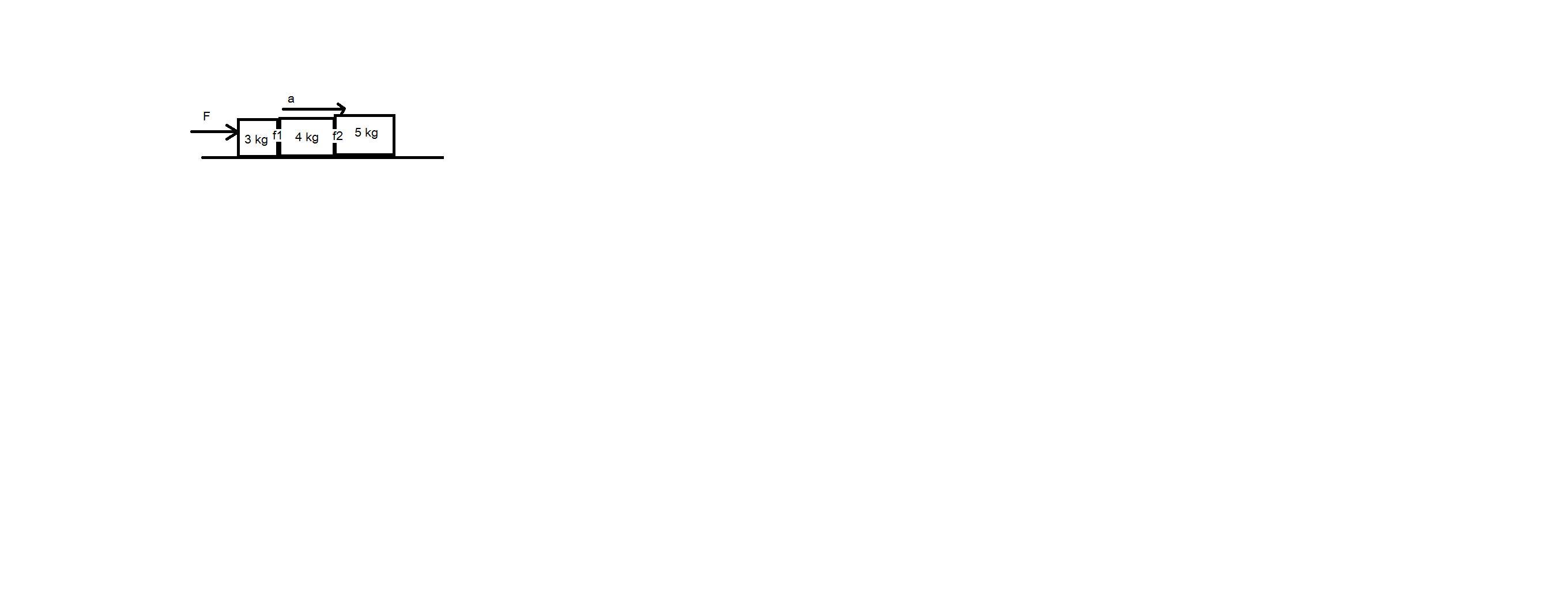
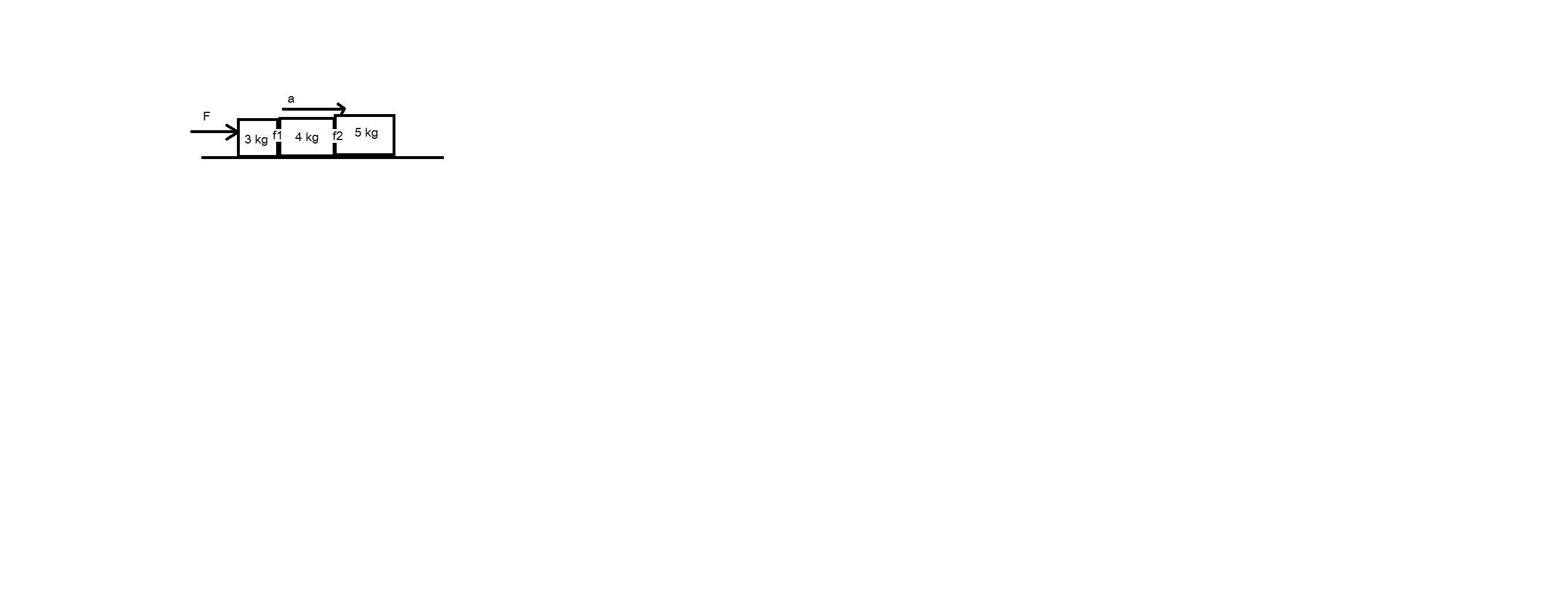
Blocks with masses of 3.0 kg, 4.0 kg, and 5.0 kg are lined up in a row on a frictionless table. All three are pushed forward by

a 13 N force applied to the 3.0 kg block. How much force does the 4.0 kg block exert on the 5.0 kg block?

Physics
2 answers:
Ne4ueva [31]2 years ago
8 0

Answer:

5.42 N

Explanation:

Let the contact force between 3 kg anf 4 kg is f1 and between 4 kg and 5 kg is f2.

F = 13 N

Let a be the acceleration in the system.

Use the free body diagrams and apply Newton's second law of motion.

F - f1 = 3 x a .....(1)

f1 - f2 = 4 x a  .... (2)

f2 = 5 x a .....(3)

By adding all these equation, we get

a = 13 / 12 m / s^2

Substitute the value of a in equation (3), we get

f2 = 5 x 13 / 12 = 5.42 N

Luda [366]2 years ago
3 0

Answer:

Fc =  5.41 N

Explanation:

Newton's second law:

∑F = m*a Formula (1)

∑F : algebraic sum of the forces in Newton (N)

m : mass s (kg)

a : acceleration  (m/s²)

Newton's second law for the set of the three blocks

F =  13 N

m=3.0 kg+ 4.0 kg+5.0 kg = 12 kg

F = m*a

13 = 12*a

a = 13 / 12

a = 1.083 m/s² : acceleration of the set of the three blocks

Newton's second law for the  5.0 kg block

m= 5.0 kg

a = 1.083 m/s²

Fc: Contact force of the 4 kg block on the 5 kg block

Fc =  5.0 kg * 1.083 m/s²

Fc =  5.41 N

You might be interested in
One end of a piano wire is wrapped around a cylindrical tuning peg and the other end is fixed in place. The tuning peg is turned
liq [111]

Answer:

T = 3183 N

Explanation:

When the screw is turned by two turns then change in the length of the wire is given as

\Delta L = 2(2\pi r)

\Delta L = 4\pi r

\Delta L = 4(\pi)(1.0 mm)

\Delta L = 12.56 mm

now we know by the formula of Young's modulus

Y = \frac{T/A}{\Delta L/L}

so we have

T = \frac{AY \Delta L}{L}

T = \frac{\pi (0.55 \times 10^{-3})^2(2.0 \times 10^{11})(12.56 \times 10^{-3})}{0.75}

T = 3183 N

3 0
2 years ago
7. A local sign company needs to install a new billboard. The signpost is 30 m tall, and the ladder truck is parked 24 m away fr
wolverine [178]
<h2>Solution :</h2>

Here ,

• Height of sign post = 30 m

• Distance between signpost and truck = 24 m

Let the

• Top of signpost = A

• Bottom of signpost = B

• The end of truck facing sign post be = C

Now as we can clearly imagine that the ladder will act as an hypotenuse to the Triangle ABC .

Where

• AB = Height of signpost = 30 m

• BC = distance between both = 24 m

• AC = Minimum length of ladder

→ AC² = AB² + BC² ( As we can see AB is perpendicular to BC )

→ AC² = (30)² + (24)²

→ AC² = 900 + 576

→ AC² = 1476

→ AC = 38.41875

or AC apx = 38.42

So minimum height of ladder = 38.42

6 0
2 years ago
For a group class project, students are building model roller coasters. Each roller coaster needs to begin at the top of the fir
abruzzese [7]

Case A :

A .75 kg 65 N/m 1.2 m

m = mass of car = 0.75 kg

k = spring constant of the spring = 65 N/m

h = height of the hill = 1.2 m

x = compression of spring = 0.25 m

Using conservation of energy between Top of hill and Bottom of hill

Total energy at Top of hill = Total energy at Bottom of hill

spring energy + potential energy = kinetic energy

(0.5) k x² + mgh = (0.5) m v²

(0.5) (65) (0.25)² + (0.75 x 9.8 x 1.2) = (0.5) (0.75) v²

v = 5.4 m/s


Case B :

B .60 kg 35 N/m .9 m

m = mass of car = 0.60 kg

k = spring constant of the spring = 35 N/m

h = height of the hill = 0.9 m

x = compression of spring = 0.25 m

Using conservation of energy between Top of hill and Bottom of hill

Total energy at Top of hill = Total energy at Bottom of hill

spring energy + potential energy = kinetic energy

(0.5) k x² + mgh = (0.5) m v²

(0.5) (35) (0.25)² + (0.60 x 9.8 x 0.9) = (0.5) (0.60) v²

v = 4.6 m/s


Case C :

C .55 kg 40 N/m 1.1 m

m = mass of car = 0.55 kg

k = spring constant of the spring = 40 N/m

h = height of the hill = 1.1 m

x = compression of spring = 0.25 m

Using conservation of energy between Top of hill and Bottom of hill

Total energy at Top of hill = Total energy at Bottom of hill

spring energy + potential energy = kinetic energy

(0.5) k x² + mgh = (0.5) m v²

(0.5) (40) (0.25)² + (0.55 x 9.8 x 1.1) = (0.5) (0.55) v²

v = 5.1 m/s


Case D :

D .84 kg 32 N/m .95 m

m = mass of car = 0.84 kg

k = spring constant of the spring = 32 N/m

h = height of the hill = 0.95 m

x = compression of spring = 0.25 m

Using conservation of energy between Top of hill and Bottom of hill

Total energy at Top of hill = Total energy at Bottom of hill

spring energy + potential energy = kinetic energy

(0.5) k x² + mgh = (0.5) m v²

(0.5) (32) (0.25)² + (0.84 x 9.8 x 0.95) = (0.5) (0.84) v²

v = 4.6 m/s


hence closest is in case C at 5.1 m/s


7 0
2 years ago
Read 2 more answers
1. A diffraction grating with 5.000 x 10³ lines/cm is used to examine the sodium
Nuetrik [128]

Answer:

0.0002°, 0.1691°, 0.338°

Explanation:

Difference between the two line = 5.97 * 10-⁸m

d = 1 / N

N = 5.0 * 10³

d = 2.0 * 10⁴m

nL = Nsin¤

For first order

588.995 * 10-⁹ = 2.0 * 10-⁴ sin ¤

Sin¤ = 2.944*10-³

¤ = sin-¹ 0.002944

¤ = 0.1687°

First order ¤ =

Sin-¹(589.592*-⁹ / 2.0 * 10-⁴)

Sin-¹ (0.002947) = 0.1689°

Angular separation = 0.1689 - 0.1687 = 0.0002°

Second order ¤ = sin-¹ [2 (589.59*10-⁹ / 2.0*10-⁴)] = sin-¹ (0.005895)

Second order ¤ = 0.3378°

Angular difference = 0.3378° - 0.1687° = 0.1691°

Third order ¤ = sin-¹ [3(589.59*10-⁹ /2.0*10-⁴] = 0.5067°

Angular difference = 0.5067° - 0.1687° = 0.338°

7 1
2 years ago
Read 2 more answers
One end of a rope is tied to the handle of a horizontally-oriented and uniform door. a force fis applied to the other end of the
sergeinik [125]
<span>Answer:The weight of the door creates a CCW torque given by Tccw = 145 N*3.13 m / 2 You need a CW torque that's equal to that Tcw = F*2.5 m*sin20</span>
4 0
3 years ago
Read 2 more answers
Other questions:
  • A trooper is moving due south along the freeway at a speed of 23 m/s. at time t = 0, a red car passes the trooper. the red car m
    12·2 answers
  • Suppose you look out the window of a skyscraper and see someone throw a tomato downward from above your window. your window is a
    8·1 answer
  • what velocity must a 1340kg car have in order to havw the same momentum as a 2680 kg truck traveling at a velocity of 15m/s to t
    12·1 answer
  • 0.5000 kg of water at 35.00 degrees Celsius is cooled, with the removal of 6.300 E4 J of heat. What is the final temperature of
    8·2 answers
  • A beam of unpolarized light shines on a stack of five ideal polarizers, set up so that the angles between the polarization axes
    12·1 answer
  • 8. The fact that voltage can be created by exerting force on a crystal is used in which type of sensor?
    5·1 answer
  • Study the free body diagram above. Which scenario below can best be described with this free body diagram? A. a cup is at rest o
    11·1 answer
  • Three identical resistors are connected in series to a battery. If the current of 12 A flows from the battery, how much current
    9·1 answer
  • PLEASE HELP John is rollerblading down a long, straight path. At time zero, there is a mailbox about 1 m in front of him. In the
    5·1 answer
  • A water park is designing a new water slide that finishes with the rider flying horizontally off the bottom of the slide. The sl
    6·1 answer
Add answer
Login
Not registered? Fast signup
Signup
Login Signup
Ask question!