answer.
Ask question
Login Signup
Ask question
All categories
  • English
  • Mathematics
  • Social Studies
  • Business
  • History
  • Health
  • Geography
  • Biology
  • Physics
  • Chemistry
  • Computers and Technology
  • Arts
  • World Languages
  • Spanish
  • French
  • German
  • Advanced Placement (AP)
  • SAT
  • Medicine
  • Law
  • Engineering
Rudik [331]
2 years ago
3

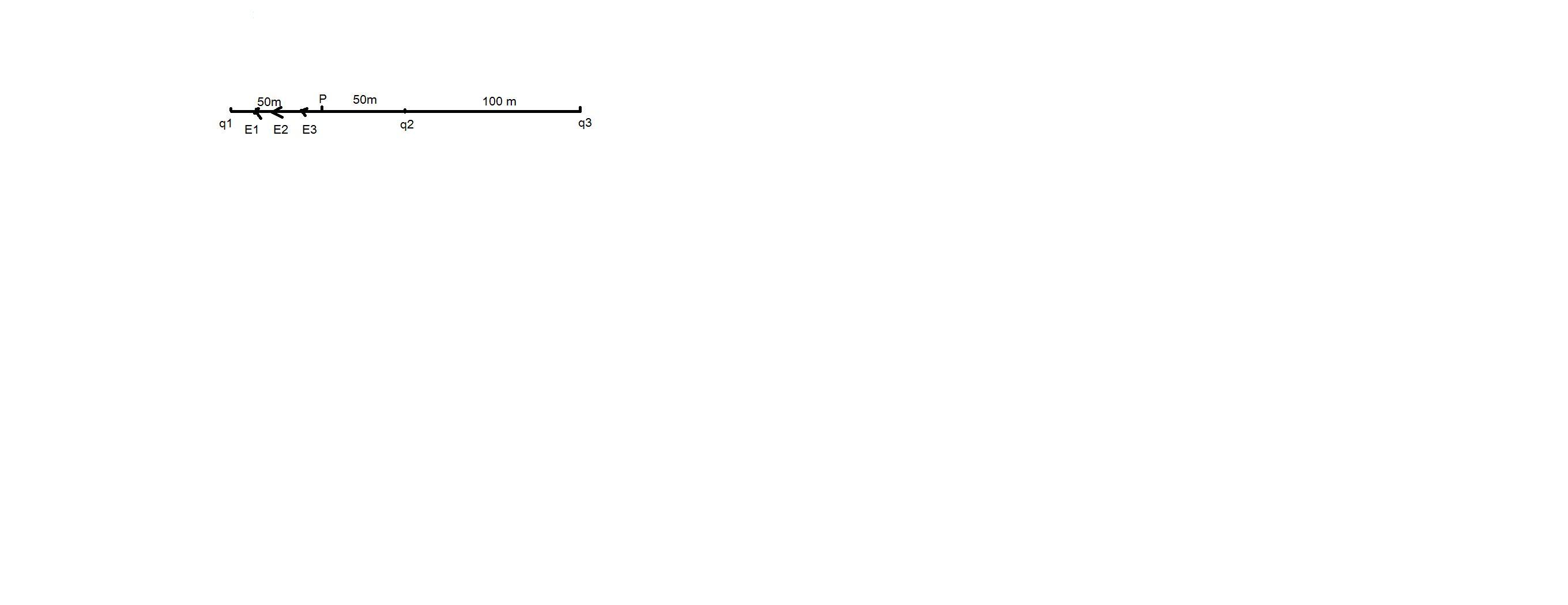
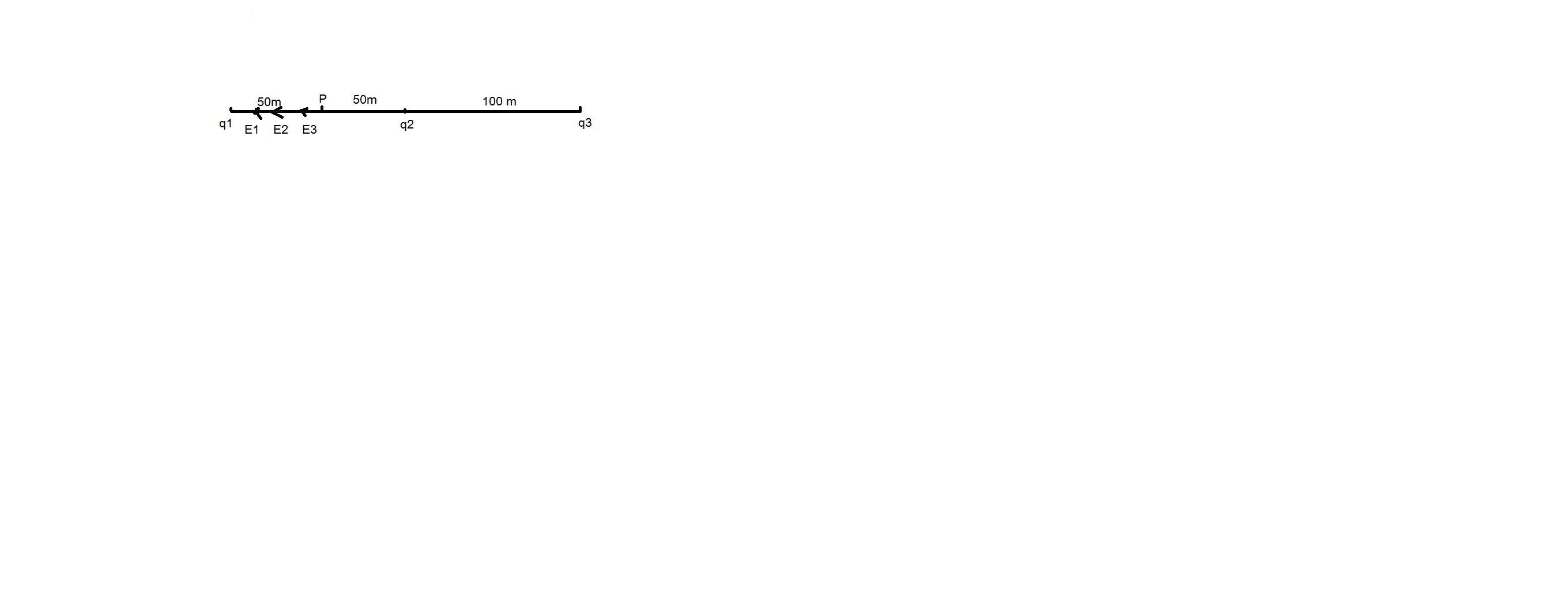
Three charges are located at 100-m intervals along a horizontal line: a charge of –3.0 C on the left, 2.0 C in the middle, and 1

.0 C on the right. What is the electric field on the horizontal line halfway between the –3.0 C and 2.0 C charges?

Physics
1 answer:
astra-53 [7]2 years ago
8 0

Answer:

1.84 x 10^7 N/C

Explanation:

Let q 1 = - 3 C, q2 = 2 C, q3 = 1 C

Electric field at P due to q1 is E1, due to q2 is E2 and due to q3 is E3.

E1 = k (3) / (50)^2 = 9 x 10^9 x 3  / 2500 = 108 x 10^5 N/C

E2 = k (2) / (50)^2 = 9 x 10^9 x 2 / 2500 = 72 x 10^5 N/C

E3 = k (1) / (150)^2 = 9 x 10^9 x 1 / 22500 = 4 x 10^5 N/C

Resultant electric field at P is given by

E = E1 + E2 + E3 = (108 + 72 + 4) x 10^5 = 184 x 10^5 = 1.84 x 10^7 N/C

You might be interested in
Some gliders are launched from the ground by means of a winch, which rapidly reels in a towing cable attached to the glider. Wha
MArishka [77]

Answer:

P = 1.64 \times 10^4 Watt

Explanation:

Here we know that the glider is accelerated uniformly from rest to final speed of 25.7 m/s in total distance of d = 46.9 m

so we will have

v_f = 25.7 m/s

v_i = 0

d = 46.9

so for uniformly accelerated motion we have

d = \frac{v_f + v_i}{2} t

46.9 = \frac{25.7 + 0}{2}t

t = 3.65 s

now we will find the total work done given as change in kinetic energy

W = \frac{1}{2}mv^2

W = \frac{1}{2}(181)(25.7^2)

W = 5.97 \times 10^4 J

now power is given as

P = \frac{W}{t}

P = \frac{5.97 \times 10^4}{3.65}

P = 1.64 \times 10^4 Watt

6 0
2 years ago
Which of the following best describes the dependant variable?
weeeeeb [17]
Hello!

The independent variable is the variable deliberately changed.

The dependent variable is the variable that responds to change. So the answer is A.

Hope this helps. Any questions please just ask! Thank you!
5 0
2 years ago
A block is projected with speed v across a horizontal surface and slides to a stop due to friction. The same block is then proje
natka813 [3]

Answer: C. The case on the inclined surface had the least decrease intotal mechanical energy.

Explanation:

First and foremost, it should be noted that the mechanical energy is the addition of the potential and the kinetic energy.

From the information given, it should be known that when the block is projected with the same speed v up an incline where is slides to a stop due to friction, the box will lose its kinetic energy but there'll be na increase in the potential energy as a result of the veritcal height. This then brings about an increase in the mechanical energy.

Therefore, the total mechanical energy of the block will decrease the least when the case on the inclined surface had the least decrease intotal mechanical energy.

8 0
1 year ago
The apartment’s explosion, reportedly caused by a gas leak, produced a violent release of gas and heat. the heat increased the _
uranmaximum [27]
<h2>Apartment Explosion Reported </h2>

The apartment’s explosion, reportedly caused by a gas leak, produced a violent release of gas and heat. The heat increased the temperature of the air in the room, which means an increase in the air's molecular kinetic energy.

When heat is provided then temperature increases and the molecules of substances move rapidly by increase of kinetic energy (K.E) temperature increases. It is understood that heat increases temperature.

6 0
2 years ago
Read 2 more answers
You slip a wrench over a bolt. Taking the origin at the bolt, the other end of the wrench is at x=18cm, y=5.5cm. You apply a for
mart [117]

Answer:

The torque on the wrench is 4.188 Nm

Explanation:

Let r = xi + yj where is the distance of the applied force to the origin.

Since x = 18 cm = 0.18 cm and y = 5.5 cm = 0.055 cm,

r = 0.18i + 0.055j

The applied force f = 88i - 23j

The torque τ = r × F

So, τ = r × F = (0.18i + 0.055j) × (88i - 23j) = 0.18i × 88i + 0.18i × -23j + 0.055j × 88i + 0.055j × -23j

= (0.18 × 88)i × i + (0.18 × -23)i × j + (0.055 × 88)j × i + (0.055 × -22)j × j  

= (0.18 × 88) × 0 + (0.18 × -23) × k + (0.055 × 88) × (-k) + (0.055 × -22) × 0   since i × i = 0, j × j = 0, i × j = k and j × i = -k

= 0 - 4.14k + 0.0484(-k) + 0

= -4.14k - 0.0484k

= -4.1884k Nm

≅ -4.188k Nm

So, the torque on the wrench is 4.188 Nm
8 0
2 years ago
Other questions:
  • a satellite is orbiting Earth at a distance of 35 kilometers. The satellite has a mass of 500 kilograms. what is the force betwe
    7·2 answers
  • Someone fires a 0.04 kg bullet at a block of wood that has a mass of 0.5 kg. (The block of wood is sitting on a frictionless sur
    12·1 answer
  • Un pasager a intarziar la tren. Ajuns pe peron a observat trenul in miscare si a constatat ca unul dintre vagoane a trecut prin
    6·1 answer
  • A 0.305 kg book rests at an angle against one side of a bookshelf. The magnitude and direction of the total force exerted on the
    10·1 answer
  • A 50.0 kg object is moving at 18.2 m/s when a 200 N force
    14·1 answer
  • Two objects have masses m and 5m, respectively. They both are placed side by side on a frictionless inclined plane and allowed t
    9·1 answer
  • Picture a long, straight corridor running east-west, with a water fountain located somewhere along it. Starting from the west en
    12·1 answer
  • Four rods that obey Hooke's law are each put under tension. (a) A rod 50.0 cm50.0 cm long with cross-sectional area 1.00 mm21.00
    5·1 answer
  • A roller coaster accelerates from initial velocity of 6.0 m/s to a final velocity of 70 m/s over 4 seconds . what is the acceler
    5·1 answer
  • Which of these is the largest? <br> a. star<br> b. nebula<br> c. galaxy<br> d. sun
    11·2 answers
Add answer
Login
Not registered? Fast signup
Signup
Login Signup
Ask question!