answer.
Ask question
Login Signup
Ask question
All categories
  • English
  • Mathematics
  • Social Studies
  • Business
  • History
  • Health
  • Geography
  • Biology
  • Physics
  • Chemistry
  • Computers and Technology
  • Arts
  • World Languages
  • Spanish
  • French
  • German
  • Advanced Placement (AP)
  • SAT
  • Medicine
  • Law
  • Engineering
Rudik [331]
2 years ago
11

Using the formula for work, Match the Force × Distance problems with their correct "Work Performed" answer. The first example ha

s been completed for you.Force × Distance = Work Performed 10 newtons 6 meters =60 ng Click the item in the left column. Use the plus sign to move it up or the minus sign to move it down until it matches the correct entry in the right column. Lock your answer in place by clicking the square beside the item. (A check mark means it is locked.)5 ft.-lbs 40 pounds 100 feet 62 n-m 2.5 pounds 24 inches 200 ft.-lbs. 62 newtons 1 meter 40,000 ft.-lbs. 1 ton 20 foot 4000 ft.-lbs. 400 pounds 0.5 feet

Physics
1 answer:
Elina [12.6K]2 years ago
3 0

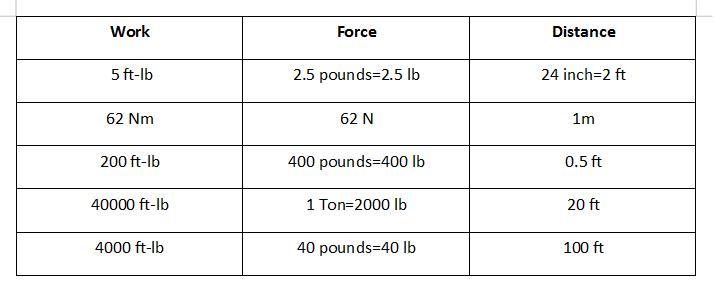
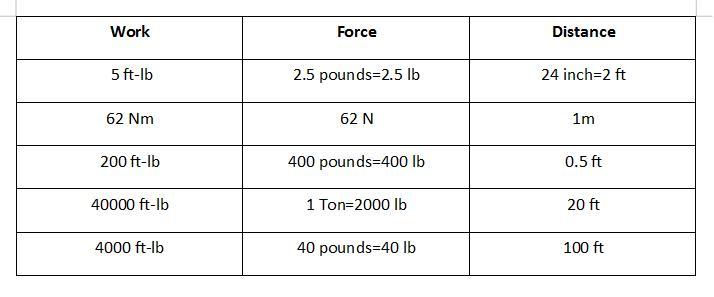
Answer: The answer is in the figure attached.

Explanation:

The Work W done by a Force F refers to the release of potential energy from a body that is moved by the application of that force to overcome a resistance along a path.  

It should be noted that it is a scalar magnitude, and its unit in the <u>International System of Units</u> is the Joule (J). Therefore, 1 Joule is the work done by a force of 1 Newton when moving an object, in the direction of the force, along 1 meter:  

1J=(1N)(1m)=Nm  

However, in the British Engineering and Gravitational Systems its unit is Foot-pound (ft-lb). Where 1ft-lb=1.355818J

Now, when the applied force F) is constant and the direction of the force and the direction of the movement (traveled distance) d  are parallel, the equation to calculate it is:  

W=(F)(d)

So, taking into account the explanation above, the attached table shows the Work done for each situation.

You might be interested in
Hydrogen peroxide is sold commercially as an aqueous solution in brown bottles to protect it from light. Calculate the longest w
snow_lady [41]

Explanation:

Below is an attachment containing the solution

5 0
2 years ago
Read 2 more answers
A tuning fork produces a sound with a frequency of 256 hz and a wavelength in air of 1.33 m. find the speed of sound in the vici
aalyn [17]
<span>We can think this through intuitively. A frequency of 256 Hz means that the wave has 256 cycles each second. If the wavelength is 1.33 meters, then there are 256 of them each second. Therefore, we just need to multiply the wavelength by the frequency to find the speed of sound. (Note that the units Hz = 1 / s) v = (frequency) x (wavelength) v = (256 Hz) x (1.33 m) v = 340.5 m/s The speed of sound in the vicinity of the fork is 340.5 m/s</span>
4 0
2 years ago
A truck with a heavy load has a total mass of 7100 kg. It is climbing a 15∘ incline at a steady 15 m/s when, unfortunately, the
Andrej [43]

Answer:

The load has a mass of 2636.8 kg

Explanation:

Step 1 : Data given

Mass of the truck = 7100 kg

Angle = 15°

velocity = 15m/s

Acceleration = 1.5 m/s²

Mass of truck = m1 kg

Mass of load = m2 kg

Thrust from engine = T

Step 2:

⇒ Before the load falls off, thrust (T) balances the component of total weight downhill:

T = (m1+m2)*g*sinθ

⇒ After the load falls off, thrust (T) remains the same but downhill component of weight becomes  m1*gsinθ .

Resultant force on truck is F = T – m1*gsinθ  

F causes the acceleration of the truck: F= m*a

This gives the equation:

T – m1*gsinθ = m1*a  

T = m1(a + gsinθ)

Combining both equations gives:

(m1+m2)*g*sinθ = m1*(a + gsinθ)

m1*g*sinθ + m2*g*sinθ =m1*a + m1*g*sinθ

m2*g*sinθ = m1*a

Since m1+m2 = 7100kg, m1= 7100 – m2. This we can plug into the previous equation:

m2*g*sinθ = (7100 – m2)*a

m2*g*sinθ = 7100a – m2a

m2*gsinθ + m2*a = 7100a

m2* (gsinθ + a) = 7100a

m2 = 7100a/(gsinθ  + a)

m2 = (7100 * 1.5) / (9.8sin(15°) + 1.5)

m2 = 2636.8 kg

The load has a mass of 2636.8 kg

6 0
2 years ago
If 500 thousand btus of energy are available to raise the temperature of a water boiler from 20°f to 100°f, how many gallons o
sashaice [31]
In this question, you are given the energy( 500,000btus) and the temperature difference( 100F-20F= 80F). You are asked to find the volume of water.
1 BTU mean 1 degree of F increased for 1 pound mass. First, we can calculate the mass of the water in lb unit. The calculation would be:

mass= energy/temperature increase = 500,000/80= 6250lb.

Then we need to convert the weight into gallons. The calculation would be:
6250lb x kg/2.204lb x 1kg/m3 x 264.172 gallons/m3= 3638969.3 gallons
7 0
2 years ago
An astronaut weighs 8.00x10^2 newtons on the surface of Earth. What is the weight of the astronaut 6.37x10^6 meters above the su
Orlov [11]
800/2^2=2.oo10^10^2N
8 0
2 years ago
Other questions:
  • What would be the weight of a 59.1-kg astronaut on a planet with the same density as Earth and having twice Earth's radius? . .
    6·2 answers
  • In which scenario is an animal doing work? Check all that apply.
    15·2 answers
  • A noise level of 95 db is ______ than the lowest level at which hearing protection is required (85 db), and your exposure should
    11·2 answers
  • What would happen to the apparent change in mass if the direction of the current is reversed?
    12·1 answer
  • SELECT TWO!!!!!!!!!!!!!!!!!! Two buses leave school moving in opposite directions. After 15 minutes, they are both 10 miles away
    11·2 answers
  • A11) A solenoid of length 18 cm consists of closely spaced coils of wire wrapped tightly around a wooden core. The magnetic fiel
    5·1 answer
  • Garret's swimming coach is giving him important and helpful tips to improve his swimming skills. Which gesture suggests that Gar
    11·2 answers
  • When a train’s velocity is 12.0 m/s east-ward, raindrops that are falling vertically with respect to the earth make traces that
    6·1 answer
  • You are riding a rollercoaster going around a vertical loop, on the inside of the loop. If the loop has a radius of 30 meters, h
    14·2 answers
  • In this experiment, you need to examine the idea of thermal energy transfer. Using a controlled experiment, what might a good qu
    12·3 answers
Add answer
Login
Not registered? Fast signup
Signup
Login Signup
Ask question!