answer.
Ask question
Login Signup
Ask question
All categories
  • English
  • Mathematics
  • Social Studies
  • Business
  • History
  • Health
  • Geography
  • Biology
  • Physics
  • Chemistry
  • Computers and Technology
  • Arts
  • World Languages
  • Spanish
  • French
  • German
  • Advanced Placement (AP)
  • SAT
  • Medicine
  • Law
  • Engineering
Anvisha [2.4K]
2 years ago
10

A strong person and a weak person are trying to carry a ladder.How should they carry it in such a way that the weak person feels

less weight of the ladder?
plz its urgent .​

Physics
2 answers:
egoroff_w [7]2 years ago
8 0

Answer:

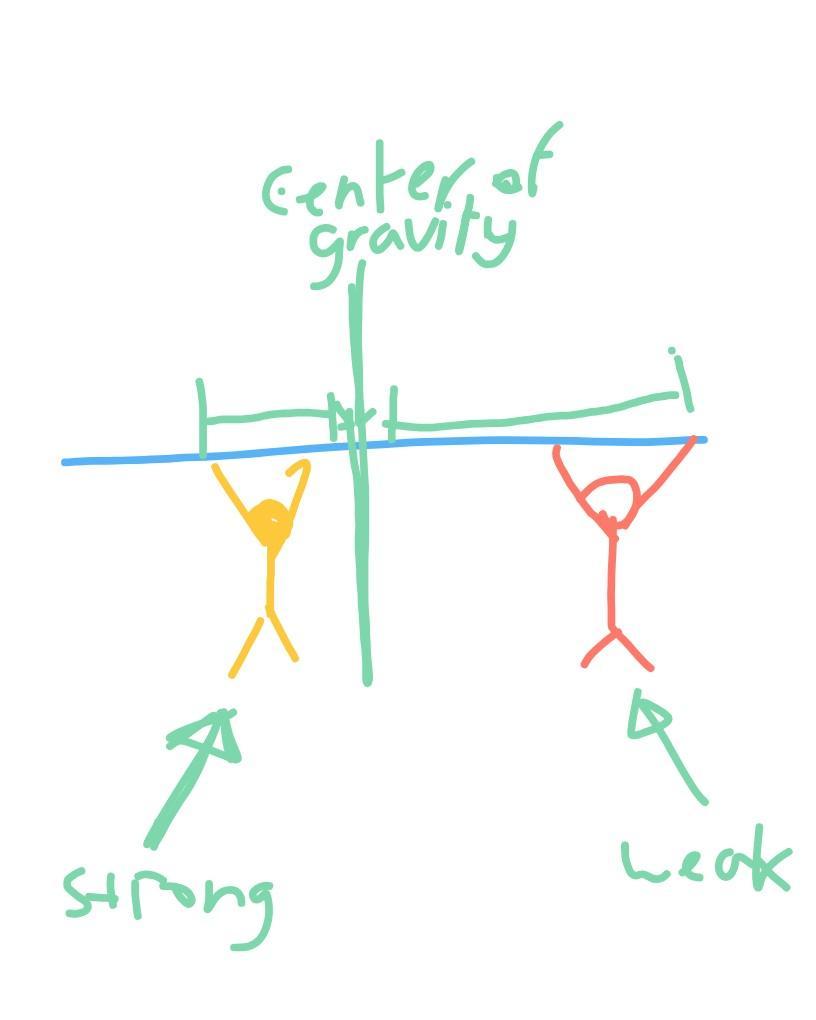
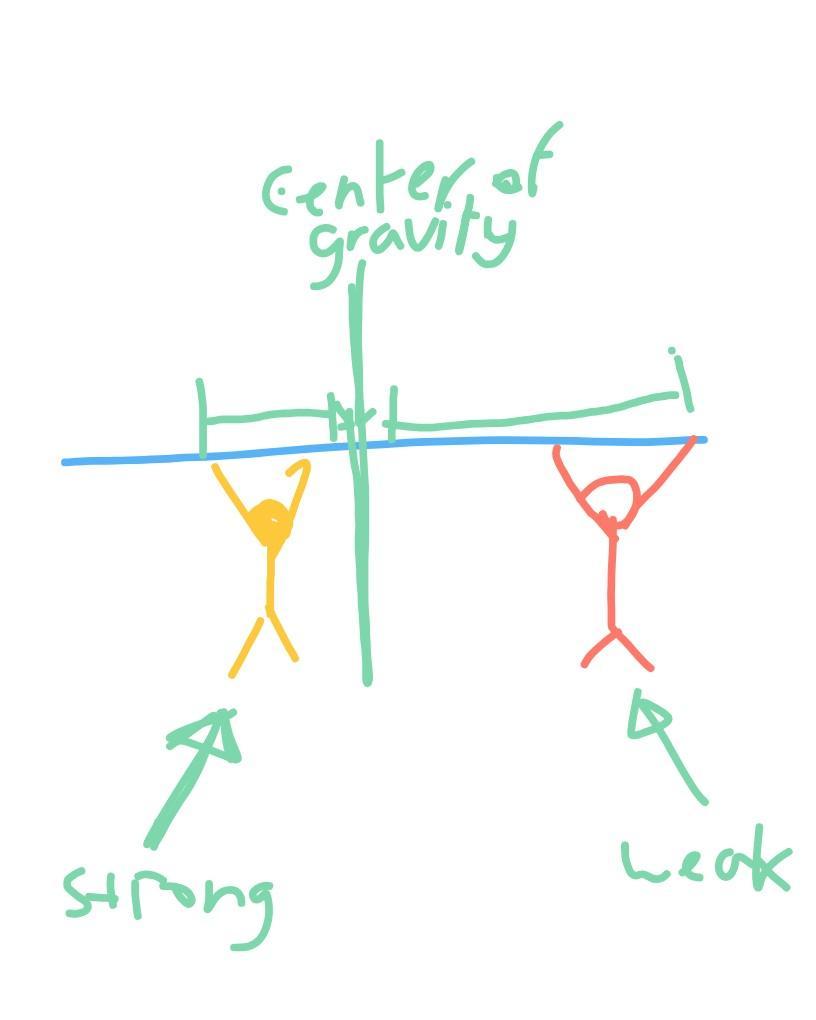
The stronger person holds it closer to them.

Explanation:

if the stronger person were to hold the ladder closer to them, they would be holding more of the weight thus making the weaker person have less weight. this is because of the center of gravity being closer to the stronger person.

zlopas [31]2 years ago
4 0

Answer:

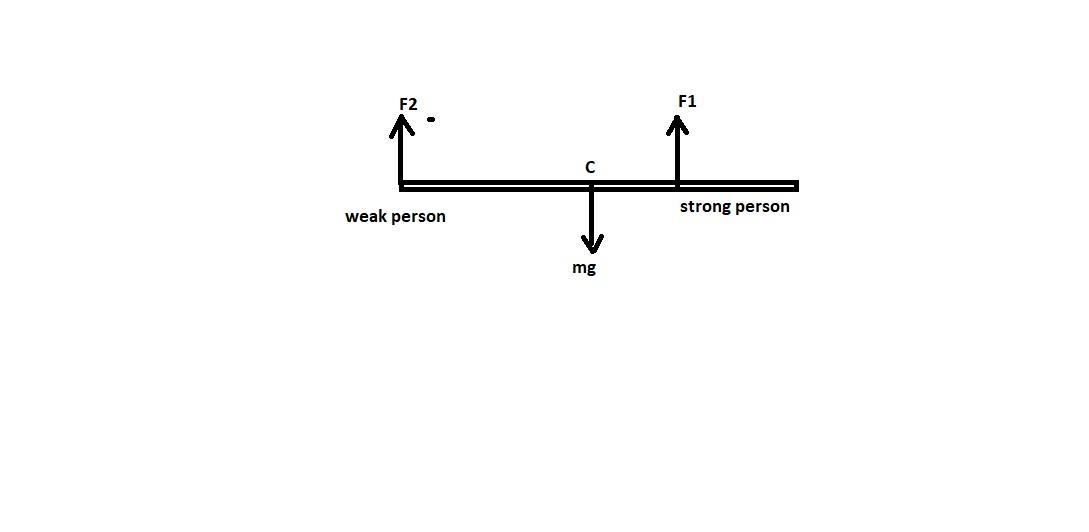
Strong person should hold the ladder near the center while weak person should hold it at the end

Explanation:

So here we can see from the figure that in order to hold the ladder straight the two forces must counter balance the weight of the ladder

So here we know that

mg = F_1 + F_2

also for torque balance of the ladder we know that

F_1 r_1 = F_2 r_2

here we know that the distance of force F1 is less than that of other force F2 so

\frac{r_1}{r_2} < 1

so we can say that

\frac{F_2}{F_1} < 1

so weak person will apply less force if he hold it at the long distance

You might be interested in
Find the angle ϕ between the filter's polarizing axis and the direction of polarization of light necessary to increase the ratio
nika2105 [10]
D. that looks like a rubber band.
3 0
2 years ago
Olivia wants to find out whether a substance will fluoresce. She says she should put it in a microwave oven. Do you agree with h
Sophie [7]
I disagree.
Many substances show fluorescence under ULTRAVIOLET light, NOT microwaves. :)
5 0
2 years ago
Read 2 more answers
Which of the following combinations of variables results in the greatest period for a pendulum? length = L, mass = M, and maximu
kipiarov [429]

Answer:

length = 2L, mass = M/2, and maximum angular displacement = 1 degree

Explanation:

We consider only small amplitude oscillations (like in this case), so that the angle θ is always small enough. Under these conditions recall that the equation of motion of the pendulum is:

\ddot{\theta}=\frac{g}{l}\theta

And its solution is:

\theta=Asin(\omega t + \phi)

Where \omega=\sqrt\frac{g}{l} are the angular frequency of the oscillations, from which we determine their period:

T=\frac{2\pi}{\omega}\\T=2\pi\sqrt\frac{l}{g}

Therefore the period of a pendulum will only depend on its length, not on its mass or angle, for angles small enough. So, the answer is the one with the greater length.

3 0
2 years ago
A scale used to weigh fish consists of a spring hung from a support. The spring's equilibrium length is 10.0 cm. When a 4.0 kg f
givi [52]

A) 1153 N/m

We can find the spring constant by using Hooke's law:

F=kx

where

F is the force applied to the spring

k is the spring constant

x is the displacement of the spring

In this problem, a fish of mass m = 4.0 kg is hanging on the spring, so the force applied is the weight of the fish:

F=mg=(4.0 kg)(9.8 m/s^2)=39.2 N

and the displacement of the spring is:

x = 13.4 cm - 10.0 cm = 3.4 cm = 0.034 m

so, the spring constant is

k=\frac{F}{x}=\frac{39.2 N}{0.034 m}=1153 N/m

B) 16.8 cm

In this case, a fish of mass

m = 8.0 kg

is hanging on the spring. Therefore, the force applied to the spring is

F=mg=(8.0 kg)(9.8 m/s^2)=78.4 N

So we can find the displacement of the spring:

x=\frac{F}{k}=\frac{78.4 N}{1153 N/m}=0.068 m = 6.8 cm

And since the equilibrium length of the spring is

x_0 = 10.0 cm

the new length of the spring will be

x' = 10.0 cm + 6.8 cm = 16.8 cm

5 0
2 years ago
During an investigation, a scientist heated 123.6 g of copper carbonate till it decomposed to form a black residue. The total ma
zloy xaker [14]

Answer:

See below explanation

Explanation:

The correspondent chemical reaction for copper carbonate decomposed by heat is:

CuCO₃ (s) → CuO (s) + CO₂ (g)

Considering all molar mass (MM) for each element ( we consider rounded numbers) :

MM CuCO₃ = 123 g/mol

MM CuO = 79 g/mol

MM CO₂ = 44 g/mol

Statement mentions that scientis heated 123.6 g of CuCO₃ (almost a MM), until a black residue is obtained, which weights 79.6 g : this solid residue is formed by CuO, and the remaining mass (approximatelly 44 g) belongs to teh second product, this is, CO₂; as it is a gas compund, it is not certainly included on the solid residue.

So, law of conservation mass is true for this case, since: 123.6 g = 79.6 g + 44 g. As explained, on the solid residue, we don not include the 44 g, which  "escaped" from our system, since it is a gas compound (CO₂)
5 0
2 years ago
Other questions:
  • in which sealed container would the organisms be able to continuously cycle o2 and co2 gases? a. a jar with a lizard eating a sn
    5·2 answers
  • An arrow is shot vertically upward at a rate of 250ft/s. Use the projectile formula h=−16t2+v0t to determine at what time(s), in
    15·2 answers
  • Changes that occur in the urinary system with aging include all of the following, EXCEPT
    7·1 answer
  • A truck of mass 1800kg is moving with a speed 54km/h. When brakes are applied, it
    12·1 answer
  • A 14000N car traveling at 25m/s rounds a curve of radius 200m. Find the following: a. The centripetal acceleration of the car.
    9·2 answers
  • Derive an expression for the acceleration of the car. Express your answer in terms of D and vt Determine the time at which the s
    10·1 answer
  • A 1.5 m cylinder of radius 1.1 cm is made of a complicated mixture materials. Its resistivity depends on the distance x from the
    9·1 answer
  • The human head weighs 4.8 kg and its center of mas 1.8 cm in front of the spinal column joint. If the trapezius muscle inserts 1
    6·2 answers
  • A beam of unpolarized light with intensity I0 falls first upon a polarizer with transmission axis θTA,1 then upon a second polar
    6·1 answer
  • Select all the correct answers.
    10·1 answer
Add answer
Login
Not registered? Fast signup
Signup
Login Signup
Ask question!