answer.
Ask question
Login Signup
Ask question
All categories
  • English
  • Mathematics
  • Social Studies
  • Business
  • History
  • Health
  • Geography
  • Biology
  • Physics
  • Chemistry
  • Computers and Technology
  • Arts
  • World Languages
  • Spanish
  • French
  • German
  • Advanced Placement (AP)
  • SAT
  • Medicine
  • Law
  • Engineering
KiRa [710]
2 years ago
4

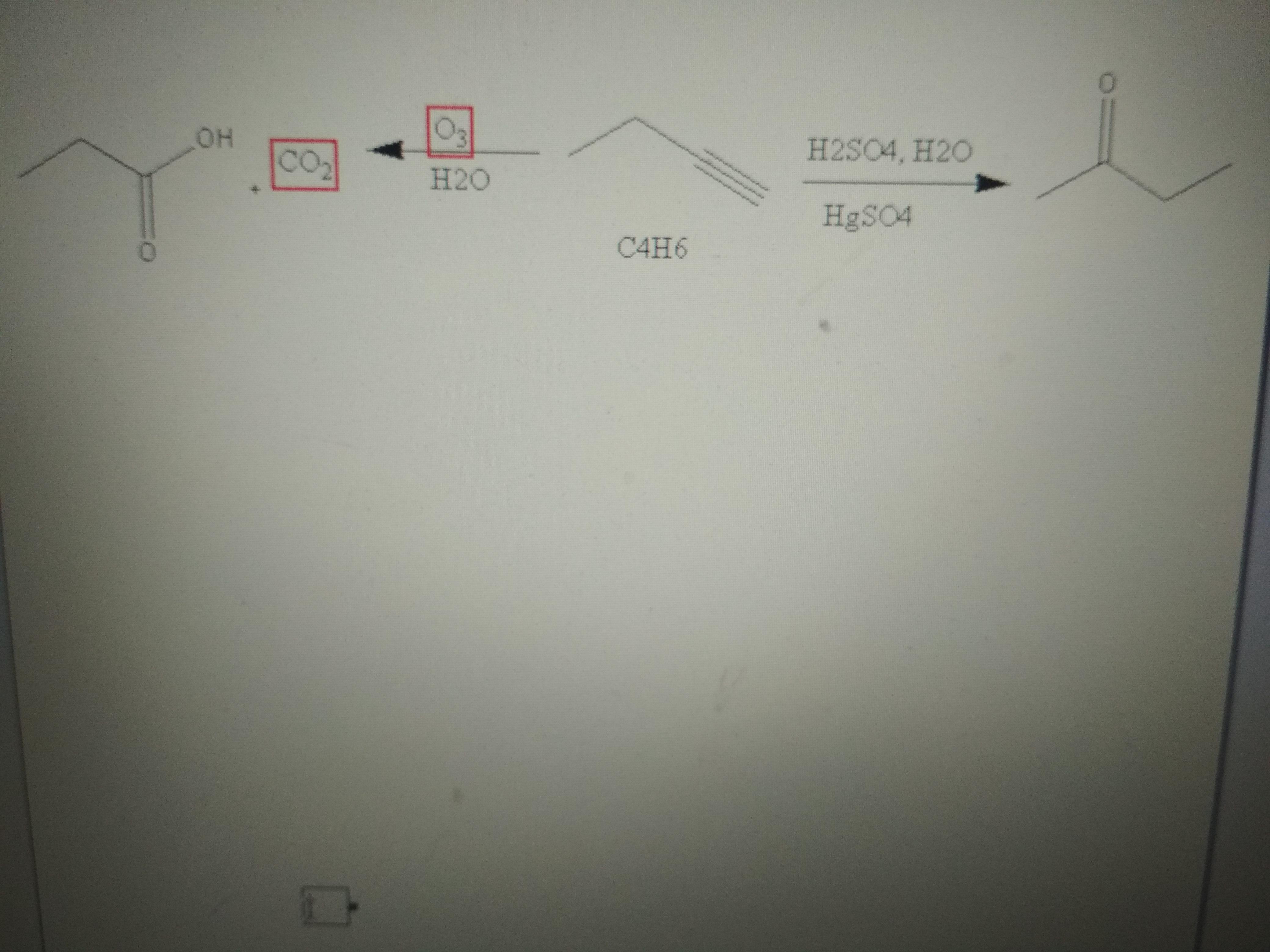
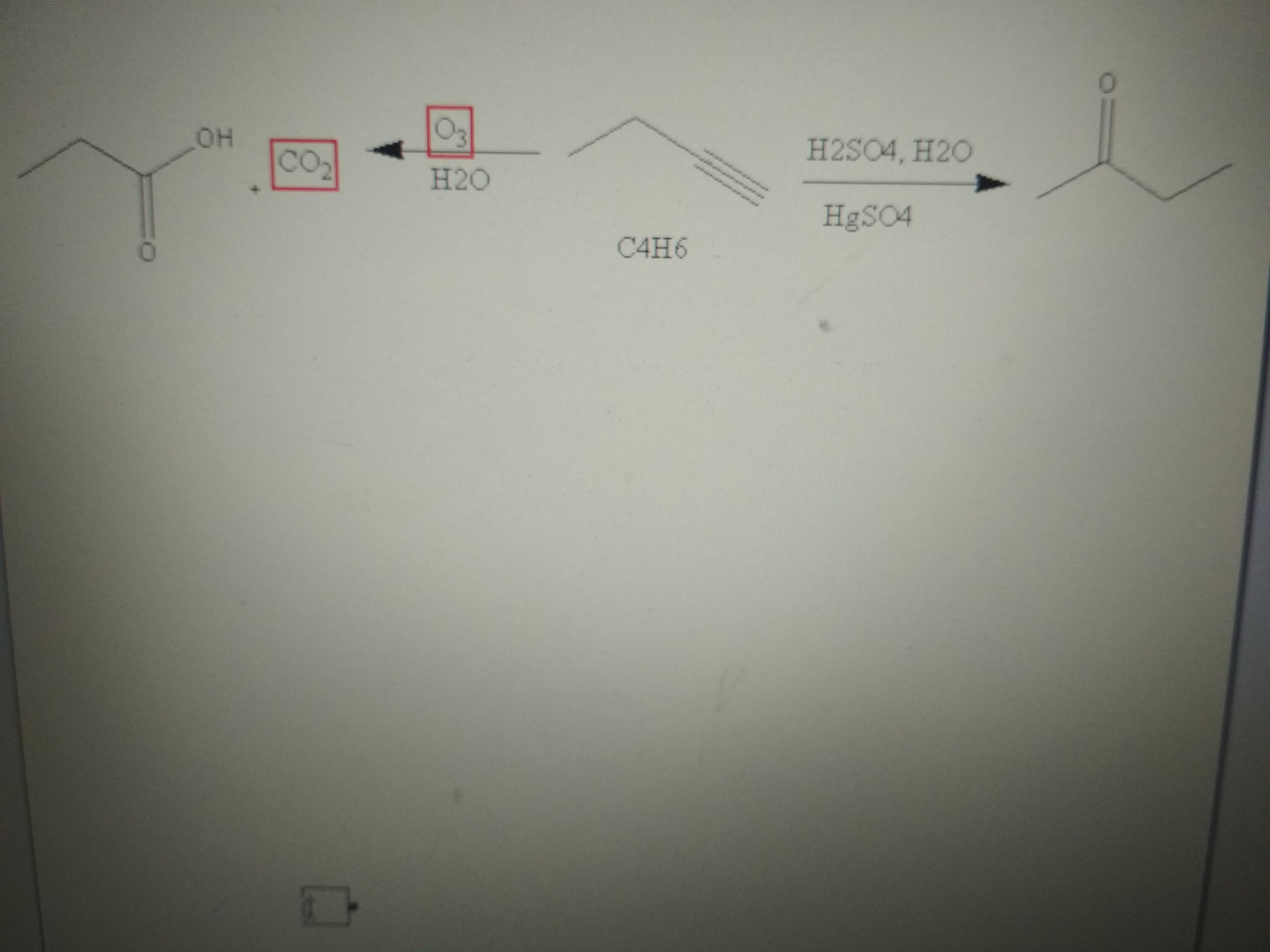
An alkyne with molecular formula C4H6 was treated with ozone followed by water to produce a carboxylic acid and carbon dioxide.

Draw the expected product when the alkyne is treated with aqueous acid in the presence of mercuric sulfate.

Chemistry
1 answer:
Umnica [9.8K]2 years ago
3 0

Answer:

Explanation:

Ozonolysis of terminal alkyne gives Carboxylic acid and carbon dioxide

While terminal alkyne gives methyl ketone(2-butanone) with aqueous acid in the presence of mercuric sulphate.

You might be interested in
The production of NOx gases is an unwanted side reaction of the main engine combustion process that turns octane, C8H18, into CO
borishaifa [10]

Answer:

710,33 g NO2

Explanation:

2 C8H18 + 25 O2 → 16 CO2 + 18 H2O  

(800 g octane) / (114.2293 g C8H18/mol x (25/2)) = 87.54 mol O2 used to combust the octane

87.54 mol O2 x \frac{15}{85} = 15.44 mol O2 used to form NO2

O2 + 2NO → 2NO2

(15.44 mol O2) x (2/2) x (46.0056 g NO2/mol) = 710,33 g NO2

4 0
2 years ago
Read 2 more answers
Analysis of a sample of a gaseous compound shows that it contains 85.7% C and 14.3% H by mass. At standard conditions, 112 mL of
KIM [24]

Answer: The molecular formula for the given compound is C_3H_6

Explanation : Given,

Percentage of C = 85.7 %

Percentage of H = 14.3 %

Let the mass of compound be 100 g. So, percentages given are taken as mass.

Mass of C = 85.7 g

Mass of H = 14.3 g

To formulate the empirical formula, we need to follow some steps:

Step 1: Converting the given masses into moles.

Moles of Carbon =\frac{\text{Given mass of Carbon}}{\text{Molar mass of Carbon}}=\frac{85.7g}{12g/mole}=7.14moles

Moles of Hydrogen = \frac{\text{Given mass of Hydrogen}}{\text{Molar mass of Hydrogen}}=\frac{14.3g}{1g/mole}=14.3moles

Step 2: Calculating the mole ratio of the given elements.

For the mole ratio, we divide each value of the moles by the smallest number of moles calculated which is 7.14 moles.

For Carbon = \frac{7.14}{7.14}=1

For Hydrogen  = \frac{14.3}{7.14}=2.00\approx 2

Step 3: Taking the mole ratio as their subscripts.

The ratio of C : H = 1 : 2

The empirical formula for the given compound is C_1H_2=CH_2

Mass of empirical formula = CH_2  = 1(12) + 2(1) = 14 g/eq.

Now we have to determine the molar mass of compound.

As, 112 mL of volume contains 0.21 g of compound

So, 22400 mL of volume contains \frac{22400}{112}\times 0.21=42g of compound

For determining the molecular formula, we need to determine the valency which is multiplied by each element to get the molecular formula.

The equation used to calculate the valency is :

n=\frac{\text{molecular mass}}{\text{empirical mass}}

We are given:

Mass of molecular formula = 42 g/mol

Mass of empirical formula = 14 g/mol

Putting values in above equation, we get:

n=\frac{42}{14}=3

Multiplying this valency by the subscript of every element of empirical formula, we get:

CH_2=(CH_2)_n=(CH_2)_3=C_3H_6

Thus, the molecular formula for the given compound is C_3H_6
4 0
2 years ago
Saturated liquid water flows steadily into a well-insulated electrical water heater (see Anim. 4-1-1) with a mass flow rate (m⋅)
Otrada [13]

Answer:

a. 2257.7 kW  b. 6.057kw/K

Explanation:

Steam existing at 100KPa with t = 20C, we can obtain values of enthalpy and entropy from table

h1 = hf = 417.4 kJ/kg

s1 = 1.302 KJ/kg.K

h2 = hg = 2675.1 kJ/kg

s2 = 7.359 kJ/K

a. Electrical Power consumption of system is given by Wel = mass x Change in Enthalpy

Wel = 1 x (h2 - h1) = 1 x (2675.1 - 417.4) = 2257.7 kw

b . Entropy Generation is given by Change in Entropy  = Entropy generation - heat dissipated/temperature, since we have a well insulated system with no losses, q =0, hence

ΔS = Sgen + 0/T = Sgen

m(S2 - S1) = Sgen

Sgen = 1 x (7.359 - 1.302) = 6.057 kW/K

3 0
2 years ago
6. Primary succession usually occurs after which catastrophic events?
stealth61 [152]

Answer: d. Glaciers moving revealing bare rock underneath

Explanation:

Primary succession is what happens when living things colonise an area that was previously uncolonized because it had been destroyed or hadn't been created yet.

When glaciers move on from areas and expose the bare rock underneath, these areas are new and so primary succession will take place as living things begin to colonize this new area.

7 0
2 years ago
A sample of helium has a temperature of 450 K. The gas is cooled to 248.9 K at which time the gas occupies 103.4 L? Assume press
Umnica [9.8K]

Answer:

\boxed{\text{163.3 L}}

Explanation:

The pressure is constant, so, to calculate the volume, we can use Charles' Law:

\dfrac{V_{1}}{T_{1}} = \dfrac{V_{2}}{T_{2}}

Data:

V₁ = ?;            T₁ =    450 K

V₂ = 103.4 L; T₂ = 284.9 K

Calculation:

\dfrac{ V_{1}}{450} = \dfrac{ 103.4}{284.9}\\\\{ V_{1}} = 450 \times \dfrac{103.4}{284.9}\\\\ = \textbf{163.3 L}\\\text{The original volume of the helium was $\boxed{\textbf{163.3 L}}$}

5 0
2 years ago
Read 2 more answers
Other questions:
  • a 16.0g sample of iron was heated from 0 degrees Celsius o 35.0 degrees Celsius.the iron absorbed 246.4J of energy as heat. what
    11·2 answers
  • A student titrates 10.00 milliliters of hydrochloric acid of unknown molarity with 1.000 m naoh. it takes 21.17 milliliters of b
    11·1 answer
  • Which best describes the motion of pentane molecules in liquid phase?
    8·1 answer
  • 1 mole of ch3oh(l) has a greater entropy than 1 mole of c2h5oh(l). true or false
    12·1 answer
  • Calculate the molarity of a solution made by adding 45.4 g of nano3 to a flask and dissolving it with water to create a total vo
    14·2 answers
  • 6.0 g of a certain Compound X, known to be made of carbon, hydrogen and perhaps oxygen, and to have a molecular molar mass of 13
    7·1 answer
  • A chemical engineer must report the average volume of a certain pollutant produced by the plants under her supervision. Here are
    10·1 answer
  • identify A and B, isomers of molecular formula C3H4Cl2, from the given 1H NMR data: Compound A exhibits peaks at 1.75 (doublet,
    8·1 answer
  • What volume of 1.27 M HCl is required to prepare 197.4 mL of 0.456 M HCl
    15·1 answer
  • A student created a ball and stick molecule during the lesson on molecules and atoms. Examine the model shown here. Which statem
    10·1 answer
Add answer
Login
Not registered? Fast signup
Signup
Login Signup
Ask question!