answer.
Ask question
Login Signup
Ask question
All categories
  • English
  • Mathematics
  • Social Studies
  • Business
  • History
  • Health
  • Geography
  • Biology
  • Physics
  • Chemistry
  • Computers and Technology
  • Arts
  • World Languages
  • Spanish
  • French
  • German
  • Advanced Placement (AP)
  • SAT
  • Medicine
  • Law
  • Engineering
attashe74 [19]
2 years ago
13

Cumene is a compound containing only carbon and hydrogen that is used in the production of acetone and phenol in the chemical in

dustry. Combustion of 47.6 mg cumene produces some CO2 and 42.8 mg water. The molar mass of cumene is between 115 and 125 g/mol. Determine the empirical and molecular formulas.
Chemistry
1 answer:
Anon25 [30]2 years ago
7 0

Answer:

C_9H_{12}

Explanation:

Moles =Given\ mass \times {Molar\ mass}

Mass of water obtained = 42.8 mg

1 mg = 10⁻³ g

Moles of H_2O = 42.8/18 = 2.3778×10⁻³ moles

2 moles of hydrogen atoms are present in 1 mole of water. So,

Moles of H = 2 x 2.4 = 4.7556×10⁻³ moles

Molar mass of H atom = 1.008 g/mol

Mass of H in molecule = 4.7556×10⁻³ x 1.008 = 4.7936×10⁻³ g

Given that the cumene only contains hydrogen and carbon. So,

Mass of C in the sample = Total mass - Mass of H

Mass of the sample = 47.6 mg = 47.6×10⁻³ g

Mass of C in sample = 47.6×10⁻³ - 4.80×10⁻³ = 42.8064×10⁻³ g

Moles of C  = 42.8064×10⁻³  / 12 = 3.5672×10⁻³ moles

Taking the simplest ratio for H and C as:

4.7556×10⁻³ : 3.5672×10⁻³  = 4 : 3

The empirical formula is = C_3H_4

Molecular formulas is the actual number of atoms of each element in the compound while empirical formulas is the simplest or reduced ratio of the elements in the compound.

Thus,  

Molecular mass = n × Empirical mass

Where, n is any positive number from 1, 2, 3...

Mass from the Empirical formula = 3×12 + 4×1 = 40 g/mol

115 g/mol < Molar mass > 125 g/mol

So,  

Molecular mass = n × Empirical mass

115 g/mol < 40 n > 125 g/mol

⇒ n ≅ 3

The formula of cumene = C_9H_{12}

You might be interested in
Iron-59 is used in medicine to diagnose blood circulation disorders. The half life of iron-59 is 44.5 days. How much of a 2.000
kolezko [41]

Answer:

0.258 mg of iron remains.

Explanation:

To solve this problem we can use the formula

M₂ = M₀ * 0.5^{\frac{t}{44.5} }

Where M₂ is the mass remaining, M₀ is the initial mass, and t is time in days.

Using the data given by the problem:

M₂ = 2.000 mg * 0.5^{\frac{133.5}{44.5} }

M₂ = 0.258 mg

7 0
2 years ago
When sodium reacts with chlorine, sodium chloride is produced. Andrew represented this reaction with this equation: Na + Cl2 → 2
My name is Ann [436]
When sodium metal reacts with chlorine gas, the product would be sodium chloride or the table salt. The balanced chemical reaction would be:

2Na + Cl2 = 2NaCl

IN balancing reactions, it is important to remember that the number of atoms at each side should be equal. Hope this answers the question.
4 0
2 years ago
Read 2 more answers
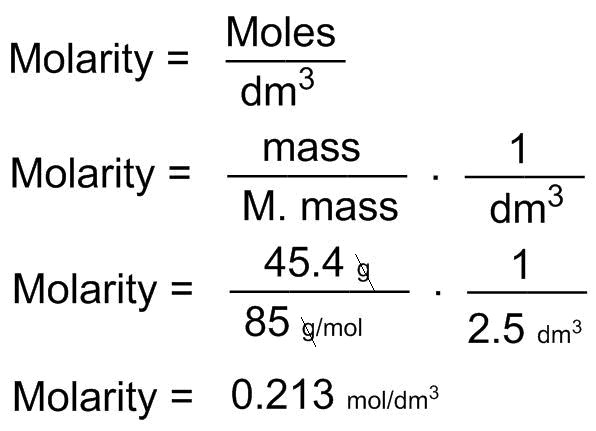
Calculate the molarity of a solution made by adding 45.4 g of nano3 to a flask and dissolving it with water to create a total vo
aleksandr82 [10.1K]
Solutions are made up of two non reacting species called solute and solvent. The amount of solute in solvent is known as concentration of that solute. Concentration is often measured in Molarity. Molarity is the amount of solute dissolved in 1 dm3 of solution. Answer to your question is as follow;

3 0
2 years ago
Read 2 more answers
Consider four sealed, rigid containers with the following volumes: 50 mL, 100 mL, 250 mL, and 500 mL. If each of these contains
dsp73
First, we assume that helium behaves as an ideal gas such that the ideal gas law is applicable.
                                     PV = nRT
where P is pressure, V is volume, n is number of moles, R is universal gas constant, and T is temperature. From the equation, if n, R, and T are constant, there is an inverse relationship between P and V. From the given choices, the container with the greatest pressure would be the 50 mL. 
5 0
2 years ago
in collecting the precipitate, why would it be inappropriate to heat the reacted mixture and evaporate off the water?
djverab [1.8K]
In collecting the precipitate, it is inappropriate to heat <span>the reacted mixture and evaporate off the water because it is possible that the mixture contains other substances that precipitates as well when the mixture is being heated so you will not be able to collect what you want.</span>
6 0
2 years ago
Other questions:
  • According to reference table J, which of these metals would react most readily with 1.0 M HCl to produce H2(g)
    10·1 answer
  • A biology student wants to conduct a study of how the amount of food affects weight gain for mice. He sets up four cages with a
    12·1 answer
  • Write the electronic configurations for mn, mn2+, mn4+, mn6+, and mn7+
    13·1 answer
  • How many moles of Cu are needed to react with 5.8 moles of AgNO3?<br> Cu + 2 AgNO3 → Cu(NO3)2 + 2 Ag
    8·1 answer
  • What qualities of a chemical reaction are affected by enzymes? select all that apply. the speed of the reaction the products of
    6·2 answers
  • Phosphorous and chlorine gases combine to produce phosphorous trichloride: P2(g)+3Cl2(g)→2PCl3(g) ΔG∘ at 298K for this reaction
    14·1 answer
  • When a sample of oxygen gas in a closed container of constant volume is heated until its absolute temperature is doubled, which
    13·1 answer
  • A student is doing an experiment to determine the effects of temperature on an object. He writes down that the initial temperatu
    11·1 answer
  • A food substance kept at 0°C becomes rotten (as determined by a good quantitative test) in 8.3 days. The same food rots in 10.6
    14·1 answer
  • A 5-column table with 2 rows. Column 1 is labeled number of protons, with entries A and D; column 2 is number of neutrons, with
    8·1 answer
Add answer
Login
Not registered? Fast signup
Signup
Login Signup
Ask question!