answer.
Ask question
Login Signup
Ask question
All categories
  • English
  • Mathematics
  • Social Studies
  • Business
  • History
  • Health
  • Geography
  • Biology
  • Physics
  • Chemistry
  • Computers and Technology
  • Arts
  • World Languages
  • Spanish
  • French
  • German
  • Advanced Placement (AP)
  • SAT
  • Medicine
  • Law
  • Engineering
Setler [38]
2 years ago
11

What is the value of the rate constant k for this reaction?When entering compound units, indicate multiplication of units explic

itly using a multiplication dot (multiplication dot in the menu). For example, M−1⋅s−1.Express your answer to two significant figures and include the appropriate units. Indicate the multiplication of units explicitly either with a multiplication dot or a dash.

Chemistry
1 answer:
vekshin12 years ago
4 0

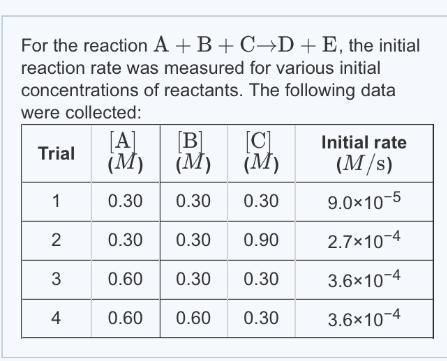
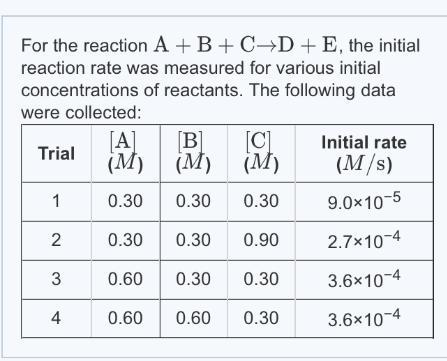
The table with the data is in the picture attached.

Answer:

  • k=0.0033M^{-2}.s^{-1}

Explanation:

The reaction equation suggests that the law could have this form:

  • rate=k[A]^a[B]^b[C]^c

Then, the work is to find the values of the exponents that satisfy the initial rate data.

A first glance shows that for the third and fourth trials the initial rates are the same. Since for these two trials only the initial concentration of substance B changed (A and C were kept equal), you conclude that the reaction rate does not depend on B, and ist exponent (lower b) is 0.

Then, so far you can say:

  • rate=k[A]^a[C]^c

When you use trials 1 and 2, you get:

\frac{r_2}{r_1}=\frac{27M/s}{9M/s}=\frac{(0.3M)^a(0.3M)^b(0.9M)^c}{(0.3M)^a(0.3M)^b(0.3M)^c}=3^c\\\\ 3=3^c\\ \\ 1=c

Now, you can use trials 1 and 3 to determine the other exponent:

\frac{r_3}{r_1}=\frac{36M/s}{9M/s}=\frac{(0.6M)^a(0.3M)^b(0.3M)^c}{(0.3M)^a(0.3M)^b(0.3M)^c}=2^a\\\\ 4=2^a\\ \\ 2^2=2^a\\ \\ 2=a

Thus, you have the rate law:

  • r=k[A]^2[C]

Now, you just use any trial to obtain k. Using trail 1:

  • k(0.3M)^2(0.3M)=9.10^{-5}M/s

Which yields:

  • k=0.0033M^{-2}.s^{-1}

You might be interested in
The equilibrium constant, Kc, for the reaction H2 (g) + I2 (g) ⇄ 2HI (g) at 425°C is 54.8. A reaction vessel contains 0.0890 M H
Mars2501 [29]

Answer: The reaction is not at equilibrium and will proceed to make more products to reach equilibrium.

Explanation:  

Equilibrium constant is defined as the ratio of concentration of products to the concentration of reactants each raised to the power their stoichiometric ratios. It is expressed as K_{eq}

K is the constant of a certain reaction when it is in equilibrium, while Q is the reaction  quotient of activities of products and reactants at any stage other than equilibrium of a reaction.

For the given chemical reaction:

H_2(g)+I_2(g)\rightarrow 2HI(g)

The expression for Q is written as:

Q=\frac{[HI]^2}{[H_2]^1[I_2]^1}

Q=\frac{[0.0890]^2}{[0.215]^1[0.498]^1}

Q=0.074

Given : K_{eq} = 54.8

Thus as Q, the reaction will shift towards the right i.e. towards the product side.

4 0
2 years ago
Which compound has the lowest vapor pressure at 50°C?
Mnenie [13.5K]

Answer : Option A) Ethanoic Acid


Explanation : Ethanoic acid has the lowest vapor pressure i.e 0.08 atm at the temperature of 50°C compared to the other given options.


The vapour pressure of propanone at 50°C is 0.84 atm

Ethanol has vapour pressure as 0.30 atm at 50°C

water has vapour pressure of 0.12 atm at 50°C.


7 0
2 years ago
Read 2 more answers
The double bond between carbon and oxygen is similar to an alkene C-C, except that C o is: a) shorter and weaker. b) shorter and
mina [271]

Answer:

the double bond between c and o is shorter and weaker

Explanation:

this is because the bond between c and o involves unequal sharing of electrons whole c and c involves hybridization sp2 of orbitals and also catenation phenomenon in which carbon could form long chain with it's other carbon

5 0
2 years ago
(14.1.50) 0.03 mol of helium are enclosed in a cylinder with a piston which maintains a constant pressure in the helium. Initial
icang [17]

Answer:

a) 0.210 j /k

b) 0.032 j/k

Explanation:

Find the attachment for solution

3 0
2 years ago
Calculate the pka of hypochlorous acid. The ph of a 0.015 m solution of hypochlorous acid has a ph of 4.64.
o-na [289]

Answer:

  • pKa = 7.46

Explanation:

<u>1) Data:</u>

a) Hypochlorous acid = HClO

b) [HClO} = 0.015

c) pH = 4.64

d) pKa = ?

<u>2) Strategy:</u>

With the pH calculate [H₃O⁺], then use the equilibrium equation to calculate the equilibrium constant, Ka, and finally calculate pKa from the definition.

<u>3) Solution:</u>

a) pH

  • pH = - log [H₃O⁺]

  • 4.64 = - log [H₃O⁺]

  • [H_3O^+]= 10^{-4.64} = 2.29.10^{-5}

b) Equilibrium equation: HClO (aq) ⇄ ClO⁻ (aq) + H₃O⁺ (aq)

c) Equilibrium constant: Ka =  [ClO⁻] [H₃O⁺] / [HClO]

d) From the stoichiometry: [CLO⁻] = [H₃O⁺] = 2.29 × 10 ⁻⁵ M

e) By substitution: Ka = (2.29 × 10 ⁻⁵ M)² / 0.015M = 3.50 × 10⁻⁸ M

f) By definition: pKa = - log Ka = - log (3.50 × 10 ⁻⁸) = 7.46

5 0
2 years ago
Other questions:
  • Concentration of 10.00 mL of HBr if it takes 5 mL of a 0.253 M LiOH solution to<br> neutralize it?
    6·1 answer
  • Write one scientific question about the organism in the photo
    8·2 answers
  • Compare and contrast the outer core and the inner core.
    8·2 answers
  • Explain why neither the oil nor the glass fiber interferes with the diffraction pattern of the crystal.
    13·1 answer
  • The mass of a solid copper penny is 3.46 g. how many copper atoms are in the penny?
    9·2 answers
  • How many grams of antifreeze C2H4(OH)2 would be required per 500 g of water to prevent the water from freezing at a temperature
    6·1 answer
  • How is a yeast cell different from an onion skin cell? Yeast can reproduce by budding. Onion cells do not reproduce by budding.
    8·2 answers
  • At 25 °C, an aqueous solution has an equilibrium concentration of 0.00253 M for a generic cation, A2+(aq), and 0.00506 M for a g
    12·2 answers
  • A chunk of ice breaks off a glacier and falls 30.0 m before it hits the water. Assuming it falls freely (there is no air resista
    9·1 answer
  • A sample of gas has a volume of 5.79 L at 25C and 518. What will be the volume of this gas at STP
    11·1 answer
Add answer
Login
Not registered? Fast signup
Signup
Login Signup
Ask question!