answer.
Ask question
Login Signup
Ask question
All categories
  • English
  • Mathematics
  • Social Studies
  • Business
  • History
  • Health
  • Geography
  • Biology
  • Physics
  • Chemistry
  • Computers and Technology
  • Arts
  • World Languages
  • Spanish
  • French
  • German
  • Advanced Placement (AP)
  • SAT
  • Medicine
  • Law
  • Engineering
kodGreya [7K]
2 years ago
3

The second part of the lab procedure focused on particle size and also involved several factors. Label each factor listed below

as “variable” or “constant.”
Amount of water:
Reaction rate:
Temperature:
Initial amount of tablet:
Particle size:
Chemistry
2 answers:
Leto [7]2 years ago
6 0

Answer:

•Amount of water: constant

•Reaction rate: variable

•Temperaturas: variable

•Initial amount of tablet: constant

•Particle size: constant

Explanation:

e2020 ‍♀️

Andrew [12]2 years ago
6 0

Answer:

Amount of water is constant

Reaction rate is variable

Temperature is constant

Initial amount of table is constant

Particle size is variable

Explanation:

I already take the lab :)

You might be interested in
What is the pH of a solution made by mixing 15.00 mL of 0.100 M HCl with 50.00 mL of 0.100 M KOH? Assume that the volumes of the
denis23 [38]

Answer:

The correct answer is: pH = 12.73

Explanation:

The <em>neutralization reaction</em> between HCl and KOH is given by the following chemical equation:

HCl + KOH ⇒ KCl + H₂O

Since HCl is a strong acid and KOH is a strong base, HCl is completely dissociated into H⁺ and Cl⁻ ions, whereas KOH is dissociated completely into K⁺ and OH⁻ ions.

For acids, the number of equivalents is given by the moles of H⁺ ions (in this case: 1 equivalent per mol of HCl). For bases, the number of equivalents is given by the moles of OH⁻ ions (in this case: 1 equivalent per mol of KOH).

The H⁺ ions from HCl will react with OH⁻ ions of KOH to give H₂O. The pH is calculated from the difference between the equivalents of H⁺ and OH⁻:

equivalents of H⁺= volume HCl x Molarity HCl

                            = (15.0 mL x 1 L/1000 mL) x 0.100 mol/L

                            = 1.5 x 10⁻³ eq H⁺

equivalents of OH⁻= volume KOH x Molarity KOH

                               = (50.0 mL x 1 L/1000 mL) X 0.100 mol/L

                               = 5 x 10⁻³ eq OH⁻

There are more OH⁻ ions than H⁺ ions. The excess of OH⁻ (that did not react with H⁺ ions) is calculated as follows:

OH⁻ ions= (5 x 10⁻³ eq OH⁻) -  (1.5 x 10⁻³ eq H⁺) = 3.5 x 10⁻³ eq OH⁻= 3.5 x 10⁻³ moles OH⁻  

As the volumes of the solutions are additive, the total volume of the solution is:

V= 15.0 mL + 50.0 mL = 65.0 mL= 0.065 L

So, the concentration of OH⁻ ions in the solution is given by:

[OH⁻] = moles OH⁻/V= (3.5 x 10⁻³ moles OH⁻)/0.065 L = 0.054 mol/L = 0.054 M  

From  [OH⁻], we can calculate pOH:

pOH = -log [OH⁻] = -log (0.054) = 1.27

Finally, we know that pH + pOH= 14; so we calculate pH:

pH= 14 - pOH = 14 - 1,27 =  12.73                                                            

8 0
3 years ago
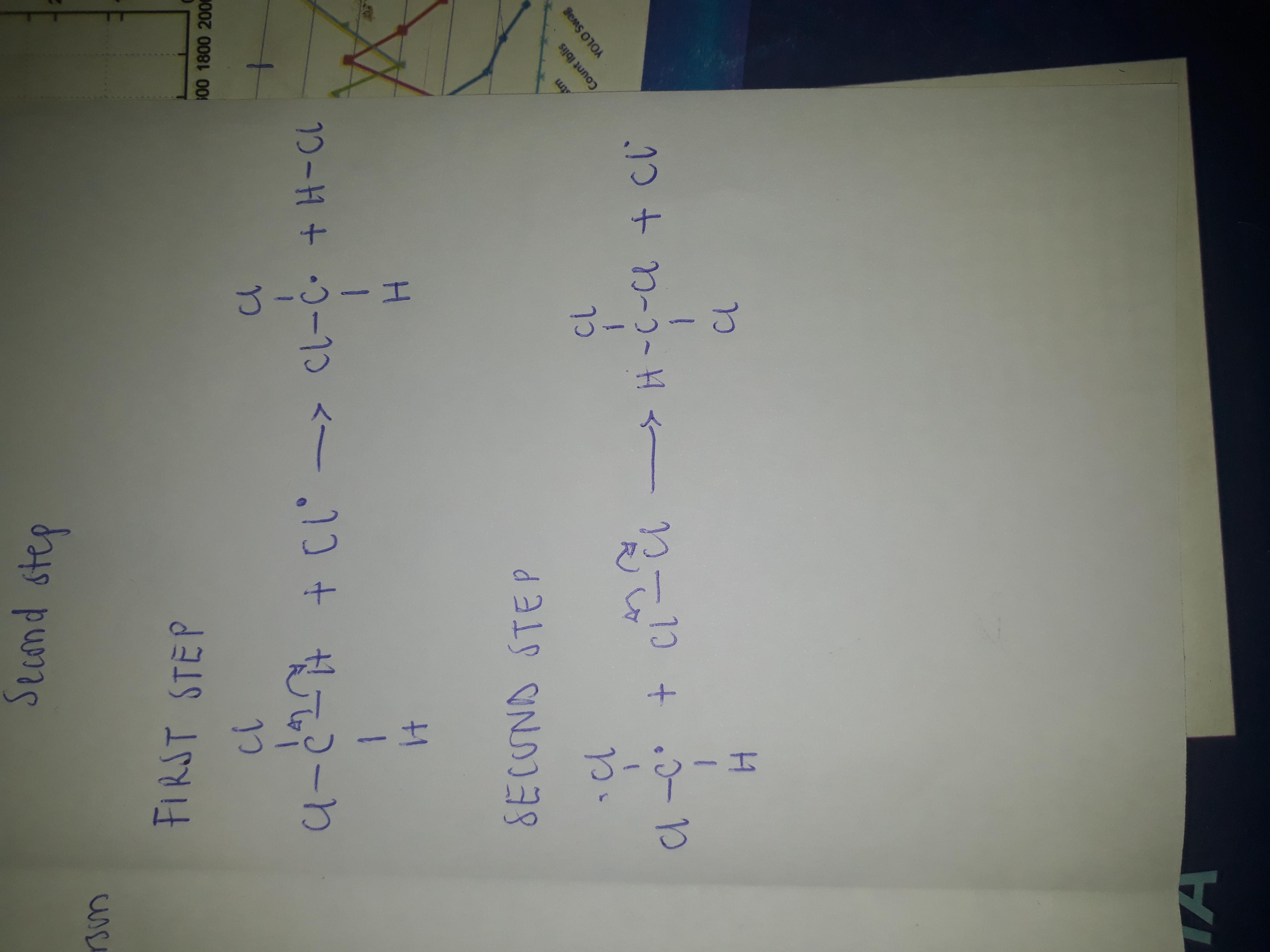
Which of the following represents a propagation step in the monochlorination of methylene chloride (CH2Cl2)?a. CHCl3 + Cl. Right
svetlana [45]

Answer:

B = CHCl2 + Cl2 --> CHCl3 + Cl

Explanation:

Free radical halogenation is a chlorination reaction on Alkane hydrocarbons. This involves the splitting of molecules into radicals/ unstable molecules in the presence of sunlight/ U.V light which ensures bonding of the molecules.

Free radical chlorination is divided into 3 steps which are:

The initiation step

The propagation step

The termination step

So in reference to the question, propagation step involves two steps.

The first step is where the molecule in this case the methylene chloride(CH2Cl2) loses a hydrogen atom and then bond with a chlorine atom radical to give a nethylwnw chloride radical and HCl.

The second step involves the reaction of this methylene chloride got in the first step with chlorine molecule to form trichloride methane and a chlorine radical.

You would find in the attachment the 2 step mechanism.

3 0
2 years ago
In every balanced chemical equation, each side of the equation has the same number of _____.
Ber [7]

The correct answer is option d, that is, atoms of the element.  

As the atoms are neither destroyed nor created in a chemical reaction, the sum of the mass of the products in a reaction must be equivalent to the sum of the mass of the reactants.  

The chemical reactions must be balanced, they must exhibit a similar number of atoms of each element on both the sides of the equation. As a consequence, the mass of the reactants must be equivalent to the mass of the products of the reaction.  


7 0
2 years ago
Read 2 more answers
If an ionic compound were composed of a4+ and b−, which unit cell structure would give a neutral compound?
Ymorist [56]
<span>biological reactions that happen within cells while reducing the complex interactions found in a whole cell. Eukaryotic and prokaryotic cells have been used for creation of these simplified environments[1]. Subcellular fractions can be isolated by ultracentrifugation to provide molecular machinery that can be used in reactions in the absence of many of the other cellular components. Cell-free biosystems can be prepared by mixing a number of purified enzymes and coenzymes. Cell-free biosystems are proposed as a new low-cost biomanufacturing platform compared to microbial fermentation used for thousands of years. Cell-free biosystems have several advantages suitable in industrial applications</span>
4 0
2 years ago
A 0.2-mm-thick wafer of silicon is treated so that a uniform concentration gradient of antimony is produced. One surface contain
krek1111 [17]

Answer:

- 0.0249% Sb/cm

-1.2465 * 10^9 \frac{atoms}{cm^3.cm}

Explanation:

Given that:

One surface contains 1 Sb atom per  10⁸  Si atoms and the other surface contains 500 Sb atoms per  10⁸ Si atoms.

The concentration gradient in atomic percent (%) Sb  per cm can be calculated as follows:

The difference in concentration = \delta_c

The distance \delta_x = 0.2-mm = 0.02 cm

Now, the concentration of silicon at one surface containing  1 Sb atom per 10⁸ silicon atoms and at the outer surface that has 500 Sb atom per   10⁸ silicon atoms can be calculated as follows:

\frac{\delta_c}{\delta_c} = \frac{(1/10^8 -500/10^8)}{0.02cm} *100%

= - 0.0249% Sb/cm

b) The concentration (c_1) of Sb in atom/cm³ for the surface of 1 Sb atoms can be calculated by using the formula:

c_1 = \frac{(8 si atoms/unit cells)(1/10^3)}{(lattice parameter)^3/unit cell}

Lattice parameter = 5.4307 Å;  To cm ; we have

= 5.4307A^0* \frac{10^{-8}cm}{ A^0}

c_1 = \frac{(8 si atoms/unit cells)(1/10^8)}{(5.4307*10^{-8}cm)^3/unit cell}

= 0.00499*10^{17}atoms/cm^3

The concentration (c_2) of Sb in atom/cm³ for the surface of 500 Sb can be calculated as follows:

c_1 = \frac{(8 si atoms/unit cells)(500/10^8)}{(5.4307*10^{-8}cm)^3/unit cell}

   =  \frac{4*10^{-3}}{1.601*10^{-22}}

   = 2.4938*10^{17}atoms/cm^3

Finally, to calculate the concentration gradient

(\frac{\delta _c}{\delta_ x}) = \frac{c_1-c_2}{\delta_x}

(\frac{\delta _c}{\delta_ x}) = \frac{0.00499*10^{17}-2.493*10^{17}}{0.02}

= -1.2465 * 10^9 \frac{atoms}{cm^3.cm}

8 0
2 years ago
Other questions:
  • How many grams of antifreeze C2H4(OH)2 would be required per 500 g of water to prevent the water from freezing at a temperature
    6·1 answer
  • Which of the following steps correctly converts 6 grams of fluorine to an equivalent number of moles of fluorine?
    7·2 answers
  • In a hospital laboratory, a 10.0 mL sample of gastric juice (predominantly HCl), obtained several hours after a meal, was titrat
    13·1 answer
  • A fossil is found to have a 14 C 14C level of 70.0 70.0 % compared to living organisms. How old is the fossil?
    12·1 answer
  • Calculate the moles of camphor dissolved in 1.32 L of phenol. The molar mass of camphor is 152 g/mol and the molarity of phenol
    11·1 answer
  • In your body, carbon dioxide, CO2, dissolves in the blood to form carbonic acid, H2CO3 as follows:
    12·1 answer
  • What are the 3 critical components of an electromagnet and what purpose do they each serve?
    9·1 answer
  • What information about a chemical solution can be inferred from knowing its pH value?
    10·1 answer
  • Which natural polymers are involved with making clothing?
    9·2 answers
  • A student is trying to classify an unidentified, solid gray material as a metal or a nonmetal. Which question will best help the
    6·1 answer
Add answer
Login
Not registered? Fast signup
Signup
Login Signup
Ask question!