answer.
Ask question
Login Signup
Ask question
All categories
  • English
  • Mathematics
  • Social Studies
  • Business
  • History
  • Health
  • Geography
  • Biology
  • Physics
  • Chemistry
  • Computers and Technology
  • Arts
  • World Languages
  • Spanish
  • French
  • German
  • Advanced Placement (AP)
  • SAT
  • Medicine
  • Law
  • Engineering
LiRa [457]
2 years ago
15

Problem 5 A block of mass 3 kg slides on a horizontal, rough surface towards a spring with k = 500 N/m. The kinetic friction coe

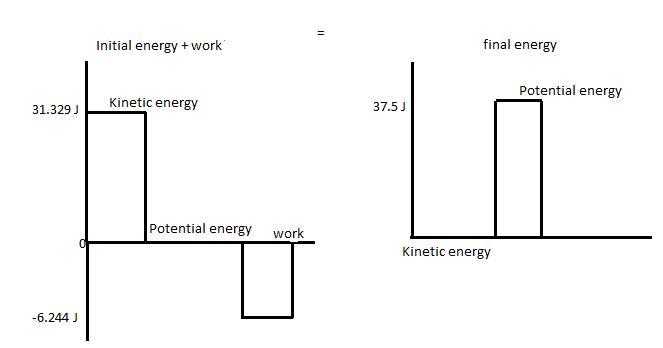
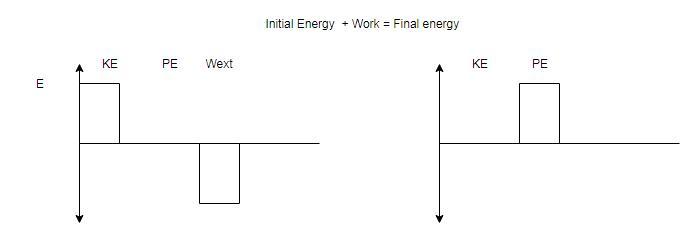
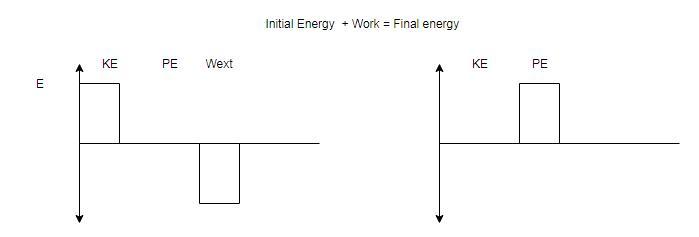
fficient between the block and the surface is µk = 0.6. If the block’s speed is 5 m/s at the instant it first makes contact with the spring, (a) Find the maximum compression of the spring. (b) Draw work-energy bar diagrams for the process of the block coming to a halt, taking the system to be the block and the surface only

Physics
2 answers:
erastova [34]2 years ago
6 0

Explanation:

Given that,

Mass of block = 3 kg

Spring constant k=500 N/m

Friction coefficient = 0.6

Speed = 5 m/s

(a). We need to calculate the maximum compression of the spring

Using work energy theorem

\dfrac{1}{2}mv^2+\mu\times mgx=\dfrac{1}{2}kx^2

Put the value into the formula

\dfrac{1}{2}\times3\times(5)^2+0.6\times3\times9.8\times x=\dfrac{1}{2}\times500\times x^2

250x^2-17.64x-37.5=0

x=-0.354\ m

Negative sign shows the compression.

The maximum compression of the spring is 0.354 m.

(b). We need to draw the bar diagram

We need to calculate the initial energy

E_{i}=\dfrac{1}{2}kx^2

Put the value into the formula

E_{i}=\dfrac{1}{2}\times500\times(0.354)^2

E_{i}=31.329\ J

We need to calculate the final energy

Using formula of final energy

E_{f}=\dfrac{1}{2}mv^2

E_{f}=\dfrac{1}{2}\times3\times(5)^2

E_{f}=37.5\ J

We need to calculate the work

Using formula of work

W=Fx

W=\mu mg\times x

Put the value into the formula

W=0.6\times3\times9.8\times(-0.354)

W=-6.244\ J

Hence, This is the required solution.
Maurinko [17]2 years ago
5 0

Answer:

Explanation:

given,

mass of block = 3 kg

spring constant k = 500 N/m

kinetic friction coefficient µk = 0.6

speed of block = 5 m/s

F = µk  N

F = 0.6 x 3 x 9.8

F = 17.64 N

using energy conservation

\dfrac{1}{2}mv^2=\dfrac{1}{2}kx^2+Fx

\dfrac{1}{2}\times 3 \times 5^2=\dfrac{1}{2}\times 500 \times x^2+17.64\times x

250 x² + 17.64 x - 37.5 = 0

on solving

x = 0.354 m

graph is attached below

You might be interested in
A semi is traveling down the highway at a velocity of v = 26 m/s. The driver observes a wreck ahead, locks his brakes, and begin
Dovator [93]

Answer:

fcosθ + Fbcosθ  =Wtanθ

Explanation:

Consider the diagram shown in attachment

fx= fcosθ (fx: component of friction force in x-direction ; f: frictional force)

Fbx= Fbcosθ ( Fbx: component of braking force in x-direction ; Fb: braking force)

Wx= Wtanθ (Wx: component of weight in x-direction ; W: Weight of semi)

sum of x-direction forces = 0

fx+ Fbx=Wx

fcosθ + Fbcosθ  =Wtanθ

7 0
2 years ago
The pull of the moon on Earth's tidal bulge is causing _____. the earth to gradually rotate faster the earth to slowly expand in
MAVERICK [17]
Not 100% but i think it'll cause the earth to rotate slightly slower, its definitely not the last one though
5 0
2 years ago
Read 2 more answers
A planar loop consisting of seven turns of wire, each of which encloses 200 cm2, is oriented perpendicularly to a magnetic field
PtichkaEL [24]

Answer:

The induced current is 0.084 A

Explanation:

the area given by the exercise is

A = 200 cm^2 = 200x10^-4 m^2

R = 5 Ω

N = 7 turns

The formula of the emf induced according to Faraday's law is equal to:

ε = (-N * dφ)/dt = (N*(b2-b1)*A)/dt

Replacing values:

ε = (7*(38 - 14) * (200x10^-4))/8x10^-3 = 0.42 V

the induced current is equal to:

I = ε /R = 0.42/5 = 0.084 A

3 0
2 years ago
Read 2 more answers
The U.S. Department of Energy had plans for a 1500-kg automobile to be powered completely by the rotational kinetic energy of a
navik [9.2K]

Answer:

230

Explanation:

\omega = Rotational speed = 3600 rad/s

I = Moment of inertia = 6 kgm²

m = Mass of flywheel = 1500 kg

v = Velocity = 15 m/s

The kinetic energy of flywheel is given by

K=\dfrac{1}{2}I\omega^2\\\Rightarrow K=\dfrac{1}{2}6\times 3600^2\\\Rightarrow K=38880000\ J

Energy used in one acceleration

K=\dfrac{1}{2}mv^2\\\Rightarrow K=\dfrac{1}{2}1500\times 15^2\\\Rightarrow K=168750\ J

Number of accelerations would be given by

n=\dfrac{38880000}{168750}\\\Rightarrow n=230.4

So the number of complete accelerations is 230

8 0
2 years ago
A rocket moves upward, starting from rest with an acceleration of +29.4 for 3.98 s. it runs out of fuel at the end of the 3.98 s
topjm [15]
U = 0, initial upward speed
a = 29.4 m/s², acceleration up to 3.98 s
a = -9.8 m/s², acceleration after 3.98s

Let h₁ =  the height at time t, for t ≤ 3.98 s
Let h₂ =  the height at time t > 3.98 s

Motion for  t ≤ 3.98 s:
h₁ = (1/2)*(29.4 m/s²)*(3.98 s)² = 232.854 m
Calculate the upward velocity at t = 3.98 s
v₁ = (29.4 m/s²)*(3.98 s) = 117.012 m/s

Motion for t  > 3.98 s
At maximum height, the upward velocity is zero.
Calculate the extra distance traveled before the velocity is zero.
(117.012 m/s)² + 2*(-9.8 m/s²)*(h₂ m) = 0
h₂ = 698.562 m

The total height is
h₁ + h₂ = 232.854 + 698.562 = 931.416 m

Answer: 931.4 m (nearest tenth)

6 0
2 years ago
Read 2 more answers
Other questions:
  • The picture below shows the position of Earth and two stars.
    11·2 answers
  • The force diagram represents a girl pulling a sled with a mass of 6.0 kg to the left with a force of 10.0 N at a 30.0 degree ang
    13·2 answers
  • A 7.0-kilogram cart, A, and a 3.0-kilogram cart, B, are initially held together at rest on a horizontal, frictionless surface. W
    7·1 answer
  • An overhang hollow shaft carries a 900 mm diameter pulley, whose centre is 250 mm from the centre of the nearest bearing. The we
    10·1 answer
  • A wave travels through a medium at 251 m/s and has a wavelength of 5.10 cm. What is its frequency? What is its angular frequency
    14·1 answer
  • A man runs at a velocity of 4.5 m/s for 15.0 min. When going up an increasingly steep hill, he slows down at a constant rate of
    11·1 answer
  • An object is attached to a hanging unstretched ideal and massless spring and slowly lowered to its equilibrium position, a dista
    14·1 answer
  • A 20~\mu F20 μF capacitor has previously charged up to contain a total charge of Q = 100~\mu CQ=100 μC on it. The capacitor is t
    10·1 answer
  • A charge of 4.9 x 10⁻¹¹ C is to be stored on each plate of a parallel-plate capacitor having an area of 150 mm2 and a plate sepa
    5·1 answer
  • The energy transfer diagram shows energy transfer in an MP3 player. Useful energy is transferred away from the MP3 player by lig
    12·1 answer
Add answer
Login
Not registered? Fast signup
Signup
Login Signup
Ask question!