answer.
Ask question
Login Signup
Ask question
All categories
  • English
  • Mathematics
  • Social Studies
  • Business
  • History
  • Health
  • Geography
  • Biology
  • Physics
  • Chemistry
  • Computers and Technology
  • Arts
  • World Languages
  • Spanish
  • French
  • German
  • Advanced Placement (AP)
  • SAT
  • Medicine
  • Law
  • Engineering
g100num [7]
2 years ago
7

A piece of metal with a specific heat capacity of 0.460 J/gC at a temperature of 100.0C is dropped into an insulated container

of water. The mass of water is 140.0 g and its temperature before adding the metal is 16.0C. The final temperature of the water is 17.6C. What is the mass of the metal?

Chemistry
1 answer:
riadik2000 [5.3K]2 years ago
5 0

Answer:

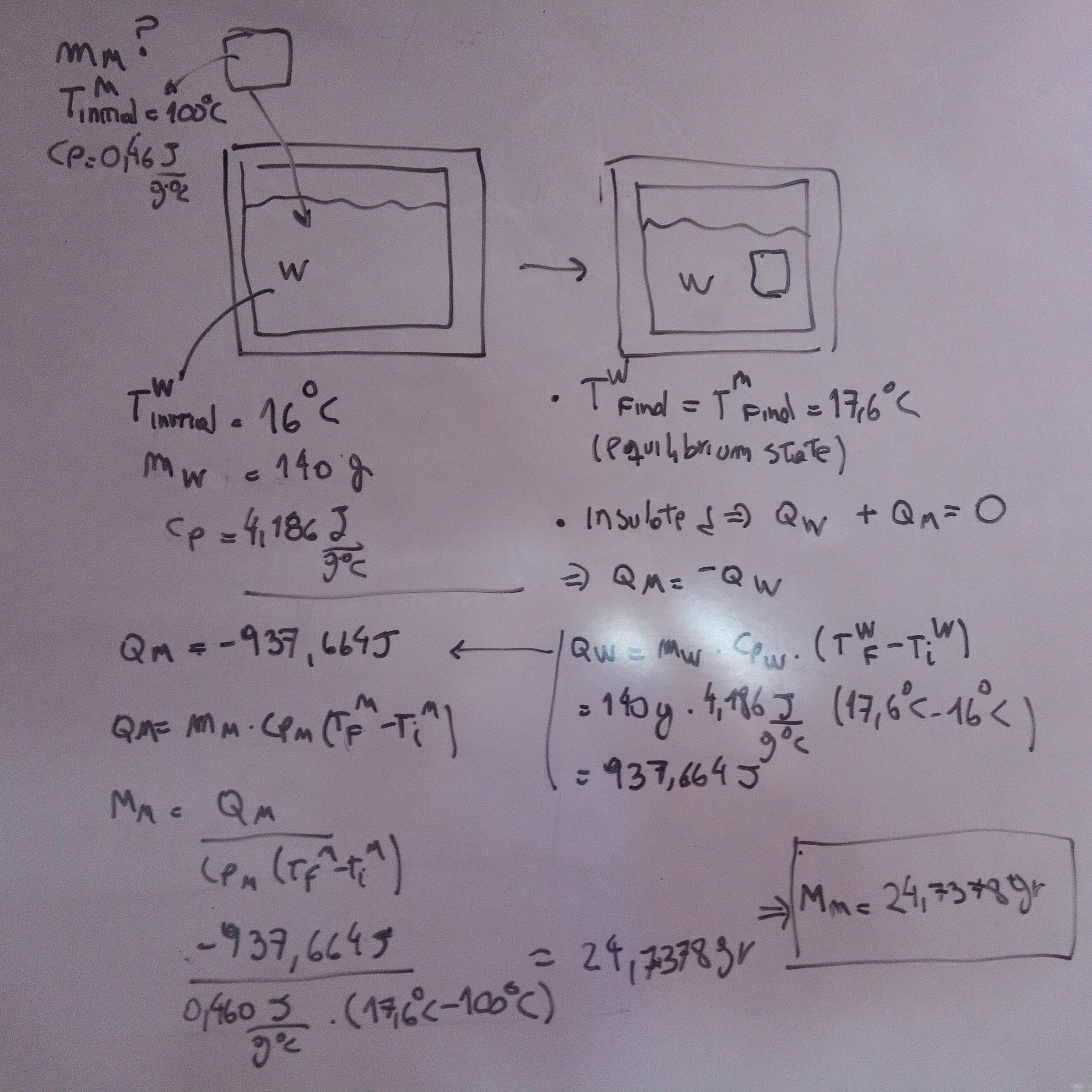
the mass of the metal is

Mm=24,7378 grams

Explanation

the explanation can be found in the attached picture.

The mass of the metal was calculated under the assumption that

- the heat capacity of the water and the metal do not change with temperature

- the metal does not react with the water

You might be interested in
Directions: Select the choice that best fits each statement. The following questions(s) refer to the following elements. (A) Car
Illusion [34]

Answer:

sulfur

Explanation:

During mining, sulfur from pyrite contributes to acid-mine drainage.

3 0
2 years ago
An enzyme with molecular weight of 310 kDa undergoes a change in shape when the substrate binds. This change can be characterize
oee [108]

Answer:

(a) r = 6.26 * 10⁻⁷cm

(b) r₂ = 6.05 * 10⁻⁷cm

Explanation:

Using the sedimentation coefficient formula;

s =  M(1-Vρ) / Nf ; where s is sedimentation coefficient, M is molecular weight, V is specific volume of protein, p is density of the solvent, N is Avogadro number, f if frictional force = 6πnr, n is viscosity of the medium, r is radius of particle

s = M ( 1 - Vρ) / N*6πnr

making r sbjct of formula, r =  M (1 - Vρ) / N*6πnrs

Note: S = 10⁻¹³ sec, 1 KDalton = 1 *10³ g/mol, I cP = 0.01 g/cm/s

r = {(3.1 * 10⁵ g/mol)(1 - (0.732 cm³/g)(1 g/cm³)} / { (6.02 * 10²³)(6π)(0.01 g/cm/s)(11.7 * 10⁻¹³ sec)

r = 6.26 * 10⁻⁷cm

b. Using the formula r₂/r₁ = s₁/s₂

s₂ = 0.035 + 1s₁ = 1.035s₁

making r₂ subject of formula; r₂ = (s₁ * r₁) / s₂ = (s₁ * r₁) / 1.035s₁

r₂ = 6.3 * 10⁻⁷cm / 1.035

r₂ = 6.05 * 10⁻⁷cm

8 0
2 years ago
A fatty acid which contains only single covalent bonds between its carbon atoms is unsaturated.
Veronika [31]
Saturated fats have single bond between the carbon atoms, this makes them a solid at room temperature. Unsaturated fats have at least one double bond between the carbon atoms, which makes them liquid in room temperature.
7 0
2 years ago
Cobalt-60 is produced by a three reaction process involving neutron capture, beta-emission, and neutron capture. The initial rea
Dima020 [189]

Answer : The correct option is, (C) ^{58}\textrm{Fe}

Explanation :

Neutron capture : In this decay process, an atomic nucleus and one or more number of neutrons collide and combine to form a heavier nucleus. The mass number changes in this process.

The neutron capture equation is represented as,

_Z^A\textrm{X}+_{0}^1\textrm{n}\rightarrow _{Z}^{A+1}\textrm{X}+\gamma

(A is the atomic mass number and Z is the atomic number)

Beta emission or beta minus decay : It is a type of decay process, in which a neutrons gets converted to proton, an electron and anti-neutrino. In this the atomic mass number remains same.

The beta minus decay equation is represented as,

_Z^A\textrm{X}\rightarrow _{Z+1}^A\textrm{Y}+_{-1}^0e

(A is the atomic mass number and Z is the atomic number)

As per question, the cobalt-60 is produced by a three reaction process involving neutron capture, beta-emission, and neutron capture.

Process 1 : Neutron capture.

_{26}^{58}\textrm{Fe}+_{0}^1\textrm{n}\rightarrow _{26}^{59}\textrm{Fe}+\gamma

Process 2 : Beta emission.

_{26}^{59}\textrm{Fe}\rightarrow _{27}^{59}\textrm{Co}+_{-1}^0e

Process 3 : Neutron capture.

_{27}^{59}\textrm{Co}+_{0}^1\textrm{n}\rightarrow _{26}^{60}\textrm{Co}+\gamma

From this we conclude that, the initial reactant in the production of cobalt-60 is _{26}^{58}\textrm{Fe}

Hence, the correct option is, (C) ^{58}\textrm{Fe}

7 0
2 years ago
Carbon dioxide, CO₂, changes from the solid phase to the gas phase at 1 atm and 194.5 K. In the solid phase, CO₂ is often called
FinnZ [79.3K]

Answer:

1. From water vapor to the dry ice;

2. The potential energy is higher before the water vapor condenses;

3. The thermal energy is higher in the 2.0 kg block.

Explanation:

1. The heat flows from the system with high temperature to the system with low temperature. The water vapor is at 298 K, and the dry ice is at 194.5 K.

2. The energy of the molecules is related to the temperature and the physics state. At the gas state, the molecules are more agitated, and the energy is higher than the liquid state. So, when the vapor condenses to a liquid, the energy decreases.

3. The thermal energy can be calculated by:

Q = m*c*ΔT

Where m is the mass, c is the specific heat, and ΔT the variation in the temperature. So, when the mass increase, thermal energy also increases.

5 0
2 years ago
Other questions:
  • Which statement describes the general trends in electronegativity and first ionization energy as the elements in Period 3 are co
    15·2 answers
  • Which property to put in which
    14·1 answer
  • A chemical reaction in which bonds are broken is usually associated with ________. a synthesis forming a larger molecule the rel
    15·1 answer
  • What is the poh of an aqueous solution at 25.0 °c that contains 1.35 × 10⁻⁸ m hydroxide ion?
    9·1 answer
  • Water is sometimes removed from the products of a reaction by placing the products in a closed container with excess P4O10. Wate
    9·2 answers
  • A gaseous compound is 30.4% nitrogen and 69.6% oxygen. a 6.06-gram sample of gas occupies a volume of 1.00 liter and exerts a pr
    14·1 answer
  • If 5.0 g of each reactant were used for the the following process, the limiting reactant would be: 2KMnO4 + 5Hg2Cl2 + 16HCl -&gt
    14·1 answer
  • g In the absence of allosteric effectors, the enzyme phosphofructokinase displays Michaelis–Menten kinetics (see Fig. 7.15). The
    12·1 answer
  • Dalton’s theory states that atoms are the smallest possible parts of elements. In a chemical reaction, atoms will rearrange and
    15·2 answers
  • An earthquake on the ocean floor produced a giant wave called a tsunami. The tsunami traveled through the ocean and hit a remote
    8·1 answer
Add answer
Login
Not registered? Fast signup
Signup
Login Signup
Ask question!