answer.
Ask question
Login Signup
Ask question
All categories
  • English
  • Mathematics
  • Social Studies
  • Business
  • History
  • Health
  • Geography
  • Biology
  • Physics
  • Chemistry
  • Computers and Technology
  • Arts
  • World Languages
  • Spanish
  • French
  • German
  • Advanced Placement (AP)
  • SAT
  • Medicine
  • Law
  • Engineering
sattari [20]
2 years ago
13

Percentage yield of sodium peroxide if 5 g of sodium oxide produces 5.5 g of sodium peroxide

Chemistry
1 answer:
Rama09 [41]2 years ago
8 0
<h3>Answer:</h3>

87.40 %

<h3>Explanation:</h3>

Concept being tested: Percent yield of a product

We are given;

Mass of Sodium oxide 5 g

Experimental or Actual yield of sodium peroxide IS 5.5 g

We are required to calculate the percent yield of sodium peroxide;

The equation for the reaction that forms sodium peroxide is

2Na₂O + O₂ → 2Na₂O₂

<h3>Step 1; moles of sodium oxide</h3>

Moles = mass ÷ molar mass

Molar mass of sodium oxide is 61.98 g/mol

Therefore;

Moles = 5 g ÷ 61.98 g/mol

          = 0.0807 moles

<h3>Step 2: Theoretical moles of sodium peroxide produced </h3>

From the equation, 2 moles of sodium oxide produces 1 mole of sodium peroxide.

Thus, moles of sodium peroxide used is 0.0807 moles

<h3>Step 3: Theoretical mass of sodium peroxide used</h3>

Mass = Number of moles × Molar mass

Molar mass of sodium peroxide = 77.98 g/mol

Therefore;

Theoretical mass = 0.0807 moles × 77.98 g/mol

                            = 6.293 g

Theoretical mass of Na₂O₂ is 6.293 g

<h3>Step 4: Percent yield of Na₂O₂</h3>
  • We know that percent yield is given by the ratio of actual yield to theoretical yield expressed as a percentage.

Percent yield=(\frac{Actual yield}{theoretical yield})100

Percent yield(Na_{2}O_{2})=(\frac{5.5g}{6.293g})100

                       = 87.40 %

Therefore, the percentage yield of sodium peroxide is 87.4%

You might be interested in
Question 4: Which members of an ecosystem are part of the energy flow?
Vanyuwa [196]

Answer:

The answer is A (number 1)

5 0
2 years ago
Calculate the amount, in moles, of PO43- present at equilibrium when excess Sr3(PO4)2 is added to 750. mL 1.2 M Sr(NO3)2(aq). As
Crank

Answer:

1.8 × 10⁻¹⁶ mol  

Explanation:

(a) Calculate the solubility of the Sr₃(PO₄)₂

Let s = the solubility of Sr₃(PO₄)₂.

The equation for the equilibrium is

Sr₃(PO₄)₂(s) ⇌ 3Sr²⁺(aq) + 2PO₄³⁻(aq); Ksp = 1.0 × 10⁻³¹

                         1.2 + 3s          2s

K_{sp} =\text{[Sr$^{2+}$]$^{3}$[PO$_{4}^{3-}$]$^{2}$} = (1.2 + 3s)^{3}\times (2s)^{2} =  1.0 \times 10^{-31}\\\text{Assume } 3s \ll 1.2\\1.2^{3} \times 4s^{2} = 1.0 \times 10^{-31}\\6.91s^{2} = 1.0 \times 10^{-31}\\s^{2} = \dfrac{1.0 \times 10^{-31}}{6.91} = 1.45 \times 10^{-32}\\\\s = \sqrt{ 1.45 \times 10^{-32}} = 1.20 \times 10^{-16} \text{ mol/L}\\

(b) Concentration of PO₄³⁻

[PO₄³⁻] = 2s = 2 × 1.20× 10⁻¹⁶ mol·L⁻¹ = 2.41× 10⁻¹⁶ mol·L⁻¹

(c) Moles of PO₄³⁻

Moles = 0.750 L × 2.41 × 10⁻¹⁶ mol·L⁻¹ = 1.8 × 10⁻¹⁶ mol

7 0
2 years ago
Quinine, an antimalarial drug, is 8.63% nitrogen. There are two nitrogen atoms per molecule. What is the molecular weight of qui
Furkat [3]

Answer:

324.18 g/mol

Explanation:

Let the molecular mass of the antimalarial drug, Quinine is x g/mol

According to question,

Nitrogen present in the drug is 8.63% of x

So, mass of nitrogen = \frac {8.63}{100}\times x

Also, according to the question,

2 atoms are present in 1 molecule of the drug.

Mass of nitrogen = 14.01 amu = 14.01 g/mol (grams for 1 mole)

So, mass of nitrogen = 14.01×2 = 28.02

These 2 must be equal so,

\frac {8.63}{100}\times x=28.02

solving for x, we get:

<u>x = 324.18 g/mol</u>

6 0
2 years ago
n the diagram shown, when an object ‘X’ is brought near the ring shaped magnet, the magnet moves away from it. Four friends are
kati45 [8]

Answer:

Akash

Explanation:

it could be a magnet with the same poles facing eachoher

6 0
2 years ago
A mysterious white powder could be powdered sugar (C12H22O11), cocaine (C17H21NO4), codeine (C18H21NO3), norfenefrine (C8H11NO2)
rodikova [14]

Norfenefrine (C₈H₁₁NO₂).

<h3>Further explanation</h3>

We will solve a case related to one of the colligative properties, namely freezing point depression.

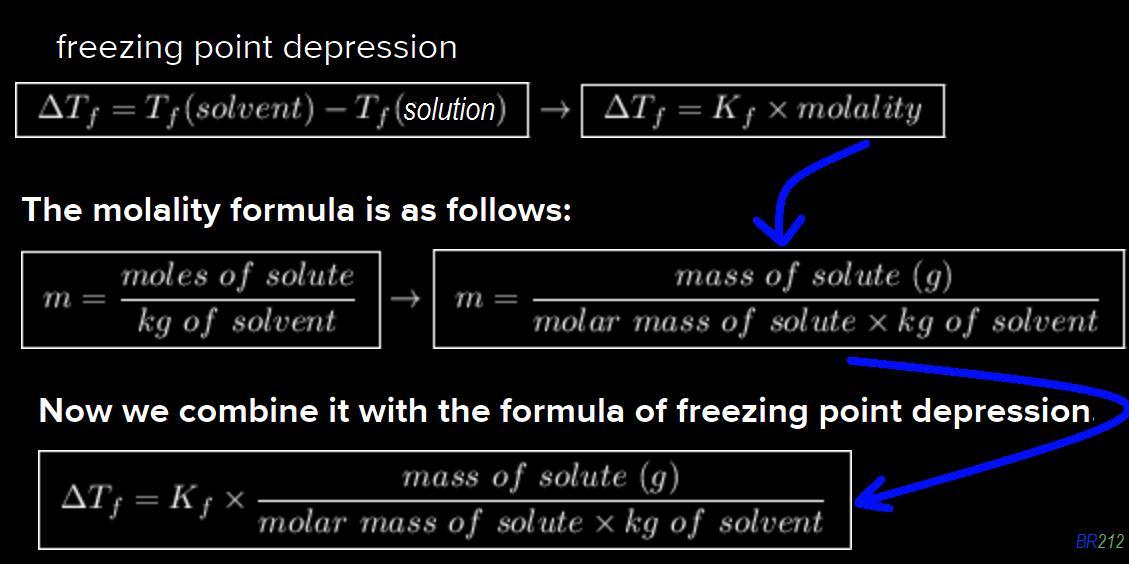
The freezing point of the solution is the temperature at which the solution begins to freeze. The difference between the freezing point of the solvent and the freezing point of the solution is called freezing point depression.

\boxed{ \ \Delta T_f = T_f(solvent) - T_f(solution) \ } \rightarrow \boxed{ \ \Delta T_f = K_f \times molality \ }

<u>Given:</u>

A mysterious white powder could be,

  • powdered sugar (C₁₂H₂₂O₁₁) with a molar mass of 342.30 g/moles,
  • cocaine (C₁₇H₂₁NO₄) with a molar mass of 303.35 g/moles,
  • codeine (C₁₈H₂₁NO₃) with a molar mass of 299.36 g/moles,
  • norfenefrine (C₈H₁₁NO₂) with a molar mass of 153.18 g/moles, or
  • fructose (C₆H₁₂O₆) with a molar mass of 180.16 g/moles.

When 82 mg of the powder is dissolved in 1.50 mL of ethanol (density = 0.789 g/cm³, normal freezing point −114.6°C, Kf = 1.99°C/m), the freezing point is lowered to −115.5°C.

<u>Question: </u>What is the identity of the white powder?

<u>The Process:</u>

Let us identify the solute, the solvent, initial, and final temperatures.

  • The solute = the powder
  • The solvent = ethanol
  • The freezing point of the solvent = −114.6°C
  • The freezing point of the solution = −115.5°C

Prepare masses of solutes and solvents.

  • Mass of solute = 82 mg = 0.082 g
  • Mass of solvent = density x volume, i.e., \boxed{ \ 0.789 \ \frac{g}{cm^3} \times 1.50 \ cm^3 = 1.1835 \ g = 0.00118 \ kg  \ }

We must prepare the solvent mass unit in kg because the unit of molality is the mole of the solute divided by the mass of the solvent in kg.

The molality formula is as follows:

\boxed{ \ m = \frac{moles \ of \ solute}{kg \ of \ solvent} \ } \rightarrow \boxed{ \ m = \frac{mass \ of \ solute \ (g)}{molar \ mass \ of \ solute \times kg \ of \ solvent} \ }

Now we combine it with the formula of freezing point depression.

\boxed{ \ \Delta T_f =  K_f \times \frac{mass \ of \ solute \ (g)}{molar \ mass \ of \ solute \times kg \ of \ solvent} \ }

It is clear that we will determine the molar mass of the solute (denoted by Mr).

We enter all data into the formula.

\boxed{ \ -114.6^0C - (-115.5^0C) = 1.99 \frac{^0C}{m} \times \frac{0.082 \ g}{Mr \times 0.00118 \ kg} \ }

\boxed{ \ 0.9 = \frac{1.99 \times 0.082}{Mr \times 0.00118} \ }

\boxed{ \ Mr = \frac{0.16318}{0.9 \times 0.00118} \ }

We get \boxed{ \ Mr = 153.65 \ }

These results are very close to the molar mass of norfenefrine which is 153.18 g/mol. Thus the white powder is norfenefrine.

<h3>Learn more</h3>
  1. The molality and mole fraction of water brainly.com/question/10861444
  2. About the mass and density of ethylene glycol as an  antifreeze brainly.com/question/4053884
  3. About the solution as a homogeneous mixture  brainly.com/question/637791

Keywords: a mysterious white powder, sugar, cocaine, codeine, norfenefrine, fructose, the solute, the solvent, dissolved, ethanol, normal freezing point, the freezing point depression, the identity

7 0
2 years ago
Read 2 more answers
Other questions:
  • if the solubility of a gas is 7.5 g/L at 404 pressure, what is the solubility of the gas when the pressure is 202 kPa?
    9·2 answers
  • X-ray photons with a wavelength of 0.135 nm . express the energy numerically in kilojoules per mole.
    7·2 answers
  • The half-life of C-14 is 5470 years. If a particular archaeological sample has one-quarter of its original radioactivity remaini
    15·2 answers
  • Hydrogen gas reacts rapidly with oxygen gas in the presence of a platinum catalyst. Which equation correctly represents this
    13·2 answers
  • A chemist mixes two liquids A and B to form a homogeneous mixture. The densities of the liquids are 2.0514 g/mL for A and 2.6678
    8·1 answer
  • A sodium ion, Na+, with a charge of 1.6×10⁻¹⁹C and a chloride ion, Cl− , with charge of −1.6×10⁻¹⁹C, are separated by a distance
    5·1 answer
  • Gasoline has a density of 0.749 g/mL. There are 454 grams in a pound and 3.7854 litres in a gallon. How many pounds does 19.2 ga
    15·1 answer
  • A car uses 12.5 L of gasoline to travel a distance of 275 km. Convert this into units of miles per gallon (mi/gal).
    14·1 answer
  • A gas of 3.4 moles occupies a volume of 0.046 L at 298 K. What is the pressure in kPa?
    11·1 answer
  • A 14.3-cm3 sample of tin has a mass of 0.104 kg.
    14·1 answer
Add answer
Login
Not registered? Fast signup
Signup
Login Signup
Ask question!