answer.
Ask question
Login Signup
Ask question
All categories
  • English
  • Mathematics
  • Social Studies
  • Business
  • History
  • Health
  • Geography
  • Biology
  • Physics
  • Chemistry
  • Computers and Technology
  • Arts
  • World Languages
  • Spanish
  • French
  • German
  • Advanced Placement (AP)
  • SAT
  • Medicine
  • Law
  • Engineering
Veseljchak [2.6K]
2 years ago
8

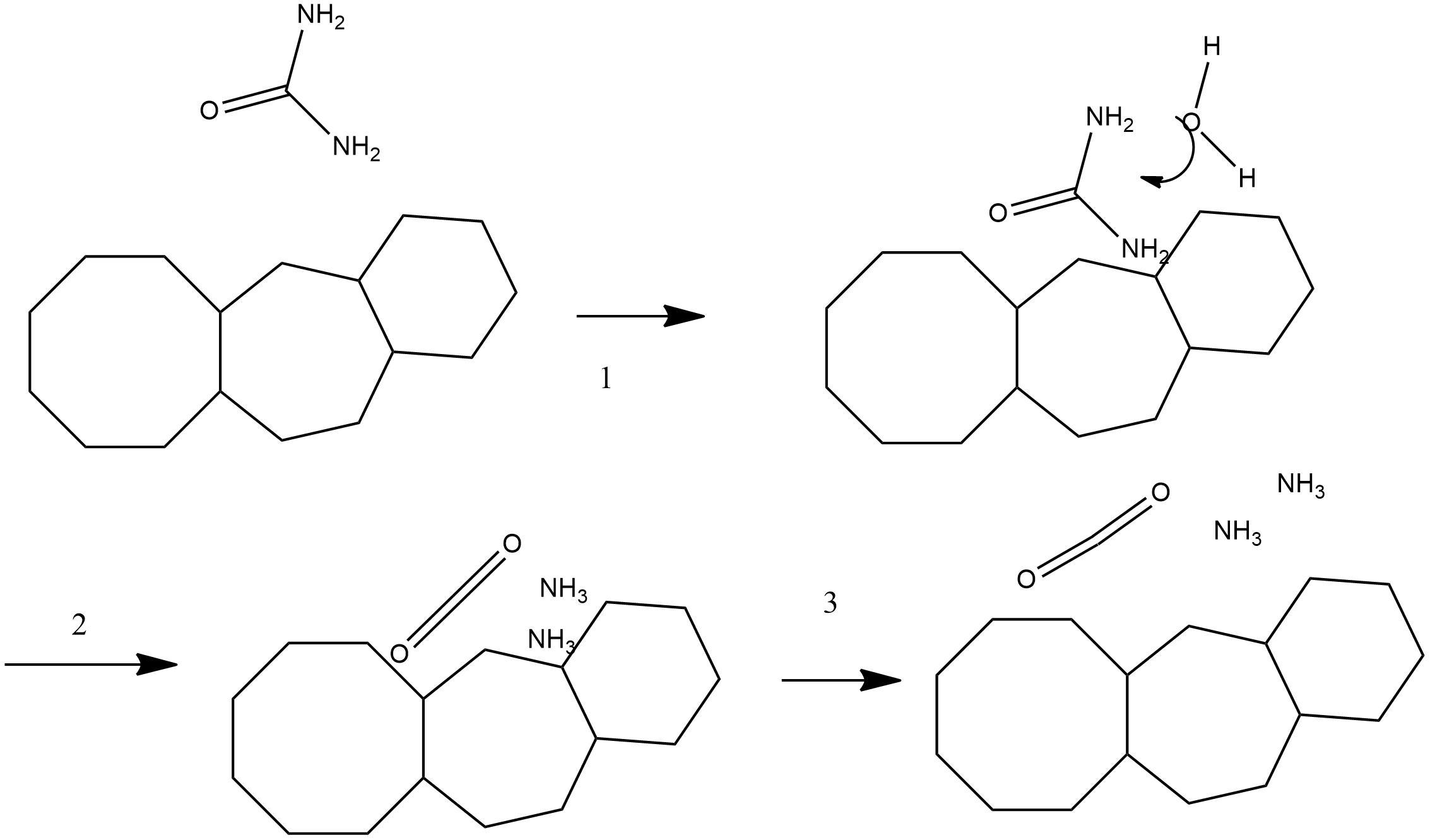
The enzyme urease catalyzes the breakdown of urea in the body. Urease breaks urea down to 2NH3+CO2. This is an example of a hydr

olysis reaction (urea plus water). For each equivalent of carbon dioxide (CO2), two equivalents of ammonia (NH3) are produced.Label the enzyme, substrate, enzyme

Chemistry
1 answer:
Alika [10]2 years ago
8 0

Answer:

Look at the picture.

Explanation:

On stage one binding of a substrate occurs (and also the geometry of active site may change) and water comes to the site. On stage two the hydrolisis takes place and on stage 3 products deabsorb from the enzyme.

You might be interested in
A column is filled with four different liquids of different densities. A red liquid, a blue liquid, a green liquid, and a purple
Svet_ta [14]

<em>Answer:</em>

The order of liquid from top to bottom is as follow

  •        Purple, green, red, blue

<em>Explanation:</em>

Chart of densities:

  •   Red = 1.2 g/cm∧3
  •   Blue = 1.6 g/cm∧3
  •   green = 0.8 g/cm∧3
  •   Purple = 0.1 g/cm∧3

<em>Density:   </em>

Density is the ratio of mass and volume as follow

                             d = m/v

<em>Summary:</em>

  • Greater the density, it will be at bottom and vice versa.
  • Blue liquid has greater density so it will be at bottom
  • Purple liquid has low density, so it will be at top.
5 0
2 years ago
Read 2 more answers
A sample of an unknown compound was decomposed and found to be composed of 1.36 mol oxygen, 4.10 mol hydrogen, and 2.05 mol carb
Flura [38]

Answer:

C3H6O2

Explanation:

To find the empirical formula of the compound, we divide the amount in moles of each of the elements by the amount in mole of the element with the smallest number of mole. In this question, the element with the smallest number of moles is oxygen with 1.36 mole. Hence, we divide the number of moles of each element by this.

H = 4.10/1.36 = 3

O = 1.36/1.36 = 1

C = 2.05/1.36 = 1.5

We then multiply through by 2 to yield the compound with the empirical formula C3H6O2

7 0
2 years ago
The reaction between sulfur dioxide and oxygen is reversible.
RUDIKE [14]

Explanation:

the correct answer is

D) 0.636 mol/dm³

3 0
2 years ago
2KOH+H2SO4=k2SO4+2H2O Is a balanced equation, displaying the combination of potassium hydroxide with sulfuric acid increase pota
Lerok [7]

Answer:

The number of moles of potassium hydroxide, KOH required to make 4 moles of K₂SO₄ is 8 moles of KOH

Explanation:

2KOH + H₂SO₄ → K₂SO₄ + 2H₂O

From the above reaction, we have 2 moles of KOH combining with 1 mole of H₂SO₄ to produce 1 mole of K₂SO₄  and 2 moles of H₂O.

Therefore the number of moles of potassium hydroxide that will be needed to make 4 moles of K₂SO₄ is;

8KOH + 4H₂SO₄ → 4K₂SO₄ + 8H₂O

8 moles of KOH is required to make 4 moles of K₂SO₄.

6 0
2 years ago
Please help!!
Sati [7]

In a chemical reaction, the limiting reagent is the chemical being used up while the excess reactant is the chemical left after the reaction process.

Before calculating the limiting and excess reactant, it is important to balance the equation first by stoichiometry.

C25N3H30Cl + NaOH = C25N3H30OH + NaCl

Since the reaction is already balanced, we can now identify which is the limiting and excess reagent.

First, we need to determine the number of moles of each chemical in the equation. This is crucial for determining the limiting and excess reagent.

<span>Assuming that there is the same amount  of solution X for each reactant</span>

1.0 M NaOH ( X ) = 1.0 moles NaOH

1.00 x 10⁻⁵ M C25N3H30Cl ( X ) = 1.00 x 10⁻⁵ moles C25N3H30Cl

<span>The result showed that the crystal violet has lesser amount than NaOH. Thus, the limiting reactant in this chemical reaction is crystal violet and the excess reactant is NaOH.</span>

3 0
2 years ago
Other questions:
  • The half life of a certain radioactive element is 1,250 years what percent of the atoms remain after 7500 years
    8·2 answers
  • What is the formal charge on the nitrogen in hydroxylamine, h2noh?
    8·1 answer
  • * will mark you brainliest + 18 points *
    15·1 answer
  • Iron-59 is used in medicine to diagnose blood circulation disorders. The half life of iron-59 is 44.5 days. How much of a 2.000
    5·1 answer
  • One of the commercial uses of sulfuric acid is the production of calcium sulfate and phosphoric acid. If 19.9 g of Ca₃(PO₄)₂ rea
    8·1 answer
  • When filling a burette for a titration, adjust the burette so that______, preferably over a sink. Then,_______to add the titrant
    10·1 answer
  • Sugar is easily soluble in water and has a molar mass of 342.30 g/mol. What is the molar concentration of a 259.8 mL aqueous sol
    15·1 answer
  • A cylinder container can hold 2.45 L of water. It’s radius is 4.00 cm. What is the volume of it in cubic centimeters?
    7·1 answer
  • Why is it important to have regular supervision of the weight and measurements in the market
    10·1 answer
  • Natasha and Reanna observe a large airplane in the troposphere. Which experimental setup below would best determine how changing
    6·2 answers
Add answer
Login
Not registered? Fast signup
Signup
Login Signup
Ask question!