answer.
Ask question
Login Signup
Ask question
All categories
  • English
  • Mathematics
  • Social Studies
  • Business
  • History
  • Health
  • Geography
  • Biology
  • Physics
  • Chemistry
  • Computers and Technology
  • Arts
  • World Languages
  • Spanish
  • French
  • German
  • Advanced Placement (AP)
  • SAT
  • Medicine
  • Law
  • Engineering
Ivenika [448]
2 years ago
15

Match each of the unknown ions to its appropriate description. Match Term Definition a V3− A) A metal that lost three electrons

d X− B) A nonmetal that gained one electron c Y+ C) A metal that lost one electron b Z3+ D) A nonmetal that gained three electrons
Chemistry
1 answer:
Lorico [155]2 years ago
3 0

Answer:

(A) A metal that lost three electrons - (b) Z³⁺

(B) A nonmetal that gained one electron - (d) X⁻  

(C) A metal that lost one electron - (c) Y⁺

(D) A nonmetal that gained three electrons - (a) V³⁻

Explanation:

Oxidation is described as the <u><em>loss of electrons</em></u> by a species. Oxidation <em>i</em><u><em>ncreases the oxidation number of the species.</em></u>

Reduction is described as the <u><em>gain of electrons</em></u> by a species. Reduction <u><em>decreases the oxidation number of the species.</em></u>

The oxidation number of an ionic species is equal to the charge on that ionic species.

<u>Therefore, when a neutral atom gains electrons, its oxidation state is negative, and when it loses electrons, its oxidation state is positive.</u>

(A) A metal that lost three electrons - (b) Z³⁺

When a neutral metal (Z) loses three electrons and gets oxidized, the metal gets oxidized from 0 to +3 oxidation state.

Z → Z³⁺ + 3 e⁻

(B) A nonmetal that gained one electron - (d) X⁻  

When a neutral metal (X) gains one electron and gets reduced, the metal gets reduced from 0 to -1 oxidation state.

X + e⁻ → X⁻

(C) A metal that lost one electron - (c) Y⁺

When a neutral metal (Y) loses one electron and gets oxidized, the metal gets oxidized from 0 to +1 oxidation state.

Y → Y⁺ + e⁻

(D) A nonmetal that gained three electrons - (a) V³⁻

When a neutral metal (V) gains three electrons and gets reduced, the metal gets reduced from 0 to -3 oxidation state.

V + 3 e⁻ → V³⁻

You might be interested in
If PbI2(s) is dissolved in 1.0MNaI(aq) , is the maximum possible concentration of Pb2+(aq) in the solution greater than, less th
fredd [130]

Answer:

\mathbf{s =\sqrt [3]{\dfrac{K_{sp}}{4}}}

Less than the concentration of Pb2+(aq) in the solution in part ( a )

Explanation:

From the question:

A)

We assume that s to be  the solubility of PbI₂.

The equation of the reaction is given as :

PbI₂(s) ⇌ Pb²⁺(aq) + 2I⁻(aq); Ksp = 7 × 10⁻⁹

 [Pb²⁺] =   s

Then [I⁻] = 2s

K_{sp} =\text{[Pb$^{2+}$][I$^{-}$]}^{2} = s\times (2s)^{2} =  4s^{3}\\s^{3} = \dfrac{K_{sp}}{4}\\\\s =\mathbf{ \sqrt [3]{\dfrac{K_{sp}}{4}}}\\\\\text{The mathematical expressionthat can be used to determine the value of  }\mathbf{s =\sqrt [3]{\dfrac{K_{sp}}{4}}}

B)

The Concentration of Pb²⁺  in water is calculated as :

\mathbf{s =\sqrt [3]{\dfrac{K_{sp}}{4}}}

\mathbf{s =\sqrt [3]{\dfrac{7*10^{-9}}{4}}}

\mathbf{s} =\sqrt[3]{1.75*10^{-9}}

\mathbf{s} =\mathbf{1.21*10^{-3}  \ mol/L }

The Concentration of Pb²⁺  in 1.0 mol·L⁻¹ NaI

\mathbf{PbCl{_2}}  \leftrightharpoons    \ \ \ \ \ \ \  \mathbf{Pb^{2+}}   \ \ \ \  \ +   \ \  \ \ \ \ \ \mathbf{2 I^-}

                             \ \ \ \ \ \ \  \ \   \ \  \ \ \ \ \ \ \  \mathbf0}   \ \ \ \  \ \ \ \ \ \   \ \ \ \ \ \mathbf{1.0}

                            \ \ \ \ \ \ \ \ \ \ \ \ \ \    \ \ \ \ \  \mathbf{+x}   \ \ \ \  \    \ \  \ \ \ \ \ \mathbf{+2x}

                            \ \ \ \ \ \ \ \ \ \ \ \ \ \    \ \ \ \ \  \mathbf{+x}   \ \ \ \  \    \ \  \ \ \ \ \ \mathbf{1.0+2x}

The equilibrium constant:

K_{sp} =[Pb^{2+}}][I^-]^2 \\ \\ K_{sp} = s*(1.0*2s)^2 =7*1.0^{-9} \\ \\ s = 7*10^{-9} \ \  m/L

It is now clear that maximum possible concentration of Pb²⁺ in the solution is less than that in the solution in part (A). This happens due to the  common ion effect. The added iodide ion forces the position of equilibrium to shift to the left, reducing the concentration of Pb²⁺.

3 0
2 years ago
Why does 5060 have three significant figures?
Morgarella [4.7K]
<h2>5060 have three significant figures : Explanation given below </h2>

Explanation:

Significant figures

The significant figures (also known as the significant digits and decimal places) of a number are digits that possess certain  meaning .

It  includes all digits except: zeros

Rules to find significant figures

1.All non-zero digits are considered significant. For example, 23  has two significant figures.

2.Zeros in between two non-zero digits are significant: like in 202.1201  has seven significant figures.

3.Zeros to the left of the significant figures are not significant. For example, .000021 has two significant figures, zeros have no value .

4.Zeros to the right of the significant figures are significant.

That is the reason in number 5060 , it has 3 significant figures .

3 0
2 years ago
An oxygen atom has a mass of and a glass of water has a mass of . Use this information to answer the question below. Be sure you
MariettaO [177]

Answer:

Number of moles of oxygen atoms having equal mass as  glass of water = 3.12 moles

<em>Note: The given question is missing some figures. Here is a complete similar question below.</em>

<em>An oxygen atom has a mass of 2.66*10^-23 g and a glass of water has a mass of 0.050 kg. What is the mass of 1 mole of oxygen atoms? Round your answer to 3 significant digits. How many moles of oxygen atoms have a mass equal to the mass of a glass of water? Round your answer to 2 significant digits.</em>

Explanation:

A mole of a substance contains the Avogadro number of particles = 6.02 * 10²³

Therefore a mole of oxygen atoms contains 6.02*10²³ atoms.

mass of 1 atom of oxygen = 2.66*10⁻²³ g

Mass of 1 mole of oxygen atoms = mass of 1 atom * number of atoms in 1 mole

Mass of 1 mole of oxygen atoms = 2.66*10⁻²³ g * 6.02*10²³  = 16. 01 g

Mass of a glass of water = 0.050 Kg or 50 g

To determine the number of moles of oxygen atoms that have a mass equal to a glass of water i.e. 50 g, the formula below is used;

<em>number of moles = mass/molar mass</em>

mass of oxygen atoms= 50 g, molar mass or mass of one mole of oxygen atoms = 16.01 g

Therefore, number of moles of oxygen atoms = 50 g / 16.01 g = 3.12 moles

4 0
2 years ago
What is the concentration of a solution made with 0.150 moles of KOH in 400.0 mL of solution?
otez555 [7]

Answer:

concentration = \frac{0.15}{0.4}=0.375 mol/L

Explanation:

Concentration: i is defined as the mole per litre.

concentration = \frac{mole}{volume in L}

mole=0.15

volume=400 ml=0.4 litre

concentration = \frac{0.15}{0.4}=0.375 mol/L

6 0
2 years ago
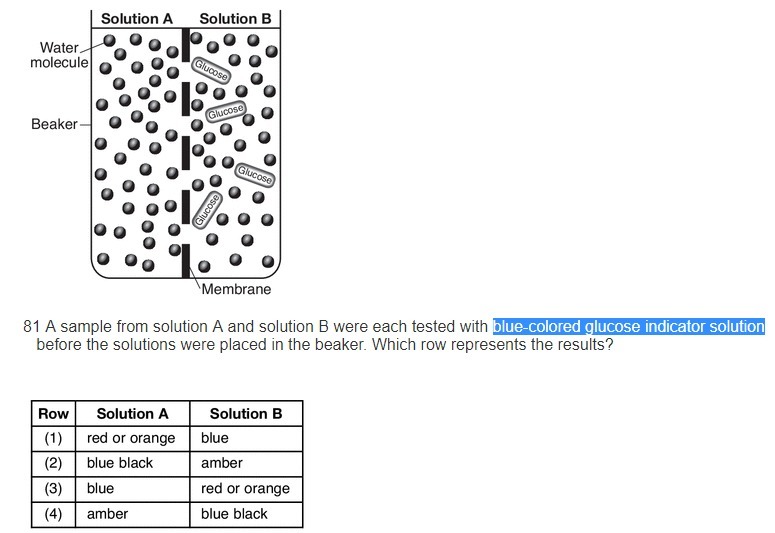
A sample from solution a and solution b were each tested with blue colored glucose indicator solution before the solutions were
vova2212 [387]
With the given problem you gave here, I can't answer the question because I need more details. Luckily, I found a similar problem that's provided with a diagram and a table shown in the attached picture.

This test is called the Benedict's test which is used as test for presence of sugars. If the solution contains sugar, like glucose, the solution would turn from blue to red. If not, it would stay blue. <em>Therefore, the correct results would be that in row 3.</em>

3 0
2 years ago
Other questions:
  • What is the main difference between the alpine tundra and the arctic tundra? a. The alpine tundra includes trees. b. The alpine
    10·2 answers
  • Why does silver iodide have a higher melting point than vanillin
    7·1 answer
  • A chemist requires 5.00 liters of 0.420 M H2SO4 solution. How many grams of H2SO4 should the chemist dissolve in water? 129 gram
    8·1 answer
  • Which of the samples described below contains the FEWEST atoms? No calculation is needed to answer this question.
    13·1 answer
  • Mercury and bromine willreact with each other to produce mercury (II) bromide:Hg(l)+Br2(l)--&gt;HgBr2(s)Consider an experimentwh
    5·2 answers
  • Air in a 0.3 m3 cylinder is initially at a pressure of 10 bar and a temperature of 330K. The cylinder is to be emptied by openin
    11·1 answer
  • Which statement accurately compares ionic and covalent bonding?
    8·2 answers
  • Hydrogen peroxide, H2O2, is common in many households and is used as a bleaching agent. It usually comes in a dark, opaque bottl
    5·1 answer
  • 3. Which of these statements is an accurate description of the ionization energies of elements in the periodic table?
    15·1 answer
  • To calculate the relative age of rocks, geologists use the rate of radioactive decay of isotopes present in their samples. What
    6·1 answer
Add answer
Login
Not registered? Fast signup
Signup
Login Signup
Ask question!