answer.
Ask question
Login Signup
Ask question
All categories
  • English
  • Mathematics
  • Social Studies
  • Business
  • History
  • Health
  • Geography
  • Biology
  • Physics
  • Chemistry
  • Computers and Technology
  • Arts
  • World Languages
  • Spanish
  • French
  • German
  • Advanced Placement (AP)
  • SAT
  • Medicine
  • Law
  • Engineering
masha68 [24]
2 years ago
8

A chemistry teacher carried out several demonstrations, and students recorded their observations. For one of the demonstrations,

a student concluded that a physical change took place, but not a chemical change. Which of the following observations could the student have made of the results of the demonstration?
Chemistry
2 answers:
PIT_PIT [208]2 years ago
4 0

Answer:

It demonstrates that it a physical change because you can't see nothing happening but something happening

Sry if it doesn't make sense

taurus [48]2 years ago
3 0

The given question is incomplete. The complete question is:

A chemistry teacher carried out several demonstrations, and students recorded their observations. For one of the demonstrations, a student concluded that a physical change took place, but not a chemical change. Which of the following observations could the student have made of the results of the demonstration?

a) Two colorless solutions were combined, and the resulting solution was pink.

b)  When a solid was added to a liquid, sparks were produced.

c) One piece of solid substance was changed into small pieces.

d) When two solutions were combined, a precipitate formed.

Answer: One piece of solid substance was changed into small pieces.

Explanation:

Physical change is defined as the change in which shape and size of a substance changes, There is no change in the composition of the substance as no new substance is forming. It is usually an reversible reaction.

Chemical change is defined as the change in which a change is the chemical composition takes place resulting in the formation of new substance. It is usually an irreversible reaction.

Indicators showing chemical changes are :

Color change

Characteristic odor

Formation of bubbles

Formation of precipitate

Thus the given change is a physical change as only the physical state i.e. size of solid substance was changed into small pieces.


You might be interested in
Washing soda is a hydrate of sodium carbonate. Elemental analysis of a sample of washing soda gave 4.20% C and 7.05% H. What is
kozerog [31]

Answer:

Na₂CO₃ · 10H₂O

Explanation:

The formula for sodium carbonate hydrate is:

Na₂CO₃ · xH₂O

The unknown "x" is the number of water molecules contained in the hydrate.

To find "x" we have to use the hydrogen percentage in the sample, 7.05 % H.

First we calculate the molecular weight of Na₂CO₃ · xH₂O:

molecular weight of Na₂CO₃ · xH₂O = 23 × 2 + 12 + 16 × 3 + 18x

molecular weight of Na₂CO₃ · xH₂O = 106 + 18x  g/mole

Now we devise the fallowing reasoning tanking in account 1 mole of Na₂CO₃ · xH₂O:

if in        106 + 18x grams of Na₂CO₃ · xH₂O we have 2x grams of hydrogen

then in  100 grams of Na₂CO₃ · xH₂O we have 7.05 grams of hydrogen

106 + 18x = (100 × 2x) / 7.05

106 + 18x = 28.4x

106 = 28.4x - 18x

106 = 10.4x

x = 106 / 10.4

x = 10.2 ≈ 10

The formula for the washing soda is Na₂CO₃ · 10H₂O.

5 0
2 years ago
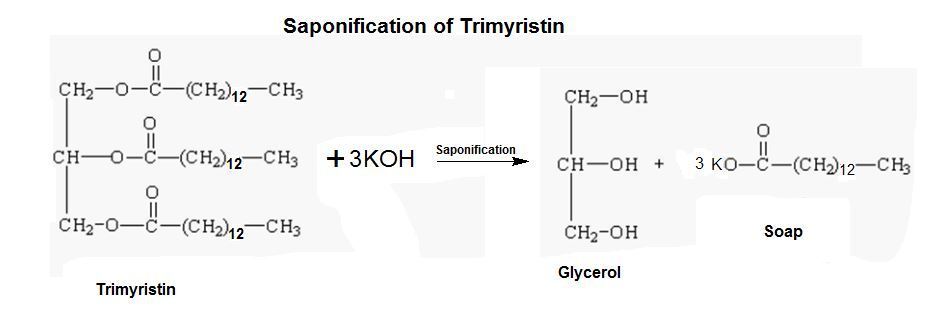
Draw the condensed structural formula in the equation for the saponification of trimyristin with koh
Ludmilka [50]

Explanation: Saponification reaction is a reaction in which hydrolysis of fats takes place under basic conditions giving glycerol and a salt of corresponding fatty acid.

We are given a Fatty acid called as Trimyristin.

Its reaction with KOH leads to the formation of soap and is given by the equation:

Trimyristin+3 KOH\rightarrow Glycerol+Soap

C_{45}H_{86}O_6+3KOH\rightarrow C_3H_5(OH)_3+3CH_3(CH_2)_{12}CO_2K

The condensed structural formula for the equation is given in the image attached.

4 0
2 years ago
Read 2 more answers
The number of sp2 hybrid orbitals on the carbon atom in CO32– is
Vladimir79 [104]
The number of sp2 hybrid orbitals on the carbon atom in CO32– is 3. Because hybrids = combination of 2 different types of orbitals
sp2 = 1/3 s character + 2/3 p character
7 0
2 years ago
Read 2 more answers
Based on the products obtained, rank the functional groups (acetamido, amino, and methoxy) in order of increasing ability to act
I am Lyosha [343]

Answer:

Amino >Methoxy > Acetamido

Explanation:

Bromination is of aromatic ring is an electrophilic substitution reaction. The attached functional group to the benzene ring activates or deactivate the aromatic ring towards electrophilic substitution reaction.

The functional group which donates electron to the benzene ring through inductive effect or resonance effect activates the ring towards electrophilic substitution reaction.

The functional group which withdraws electron to the benzene ring through inductive effect or resonance effect deactivates the ring towards electrophilic substitution reaction.

Among given, methoxy and amino are electron donating group. Amino group are stronger electron donating group than methoxy group. Acetamido group because of presence of carbonyl group becomes electron withdrawing group.

Therefore, decreasing order will be as follows:

Amino >Methoxy > Acetamido

7 0
2 years ago
Determine the number of moles in 4.21 x 10^23 molecules of CaCl2
Paha777 [63]
<h3>Answer:</h3>

0.699 mole CaCl₂

<h3>Explanation:</h3>

To get the number of moles we use the Avogadro's number.

Avogadro's number is 6.022 x 10^23.

But, 1 mole of a compound contains  6.022 x 10^23 molecules

In this case;

we are given 4.21 × 10^23 molecules of CaCl₂

Therefore, to get the number of moles

Moles = Number of molecules ÷ Avogadro's constant

          = 4.21 × 10^23 molecules ÷  6.022 x 10^23 molecules/mole

          = 0.699 mole CaCl₂

Hence, the number of moles is 0.699 mole of CaCl₂

7 0
2 years ago
Other questions:
  • Consider the reaction cacn2 3 h2o → caco3 2 nh3 . how much nh3 is produced if 187 g of caco3 are produced?
    9·1 answer
  • If the coefficient 2 is placed in front of the product tetraiodine nonaoxide (I4O9), then, how many atoms of each element must b
    14·1 answer
  • A fictional element has two isotopes and an atomic mass of 87.08 amu. if the first isotope is 86 amu and the second isotope has
    8·1 answer
  • How does a conductivity apparatus test whether a solution has ionic or covalent substances in it? It fails to light up except in
    8·2 answers
  • A common reaction is the formation of butyric acid from butyl alcohol. butyric acid is what causes the odor of rancid butter. ba
    14·2 answers
  • If a 300.0 ml sample of a gas is heated at constant pressure from 25.0ºc to 55.0ºc, its new volume is _____ ml?
    5·1 answer
  • List the number of each type of atom on the left side of the equation 2C10H22(l)+31O2(g)→20CO2(g)+22H2O(g)
    14·1 answer
  • Robyn has been working on developing a new task to test the reaction time of athletes. As she begins to test athletes using her
    8·1 answer
  • A solution of sodium hydroxide was titrated against a solution of sulfuric acid. How many moles of sodium hydroxide would react
    15·1 answer
  • Which of the following are true of phases?Check all that apply.A.The particles in a liquid are in a fixed location.B.Gases have
    6·1 answer
Add answer
Login
Not registered? Fast signup
Signup
Login Signup
Ask question!