answer.
Ask question
Login Signup
Ask question
All categories
  • English
  • Mathematics
  • Social Studies
  • Business
  • History
  • Health
  • Geography
  • Biology
  • Physics
  • Chemistry
  • Computers and Technology
  • Arts
  • World Languages
  • Spanish
  • French
  • German
  • Advanced Placement (AP)
  • SAT
  • Medicine
  • Law
  • Engineering
Vsevolod [243]
2 years ago
3

A 12-nC charge is distributed uniformly along the y axis from y = 0 to y = 4 m. Which of the following integrals is correct for

the x component of the electric field at x = 2 m on the x axis?

Physics
1 answer:
Aneli [31]2 years ago
3 0

Answer:

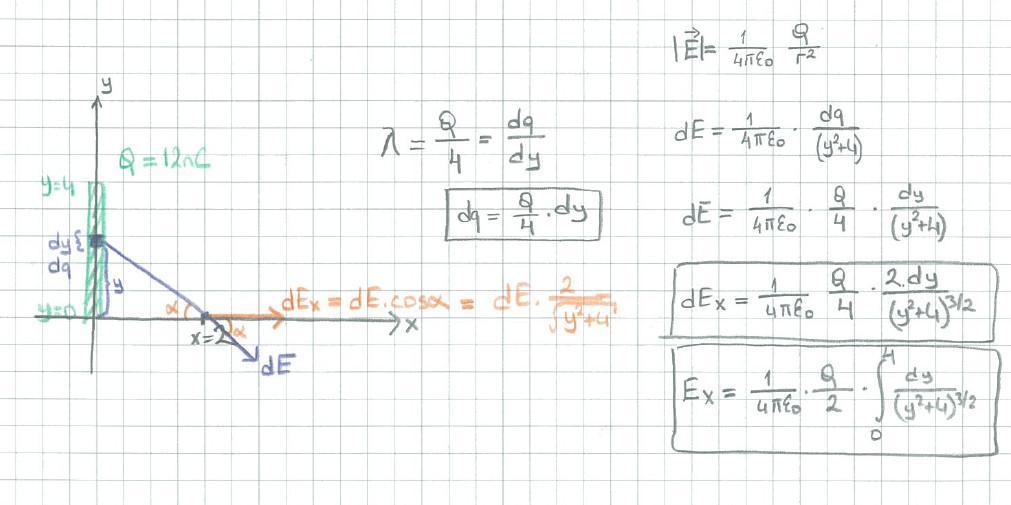
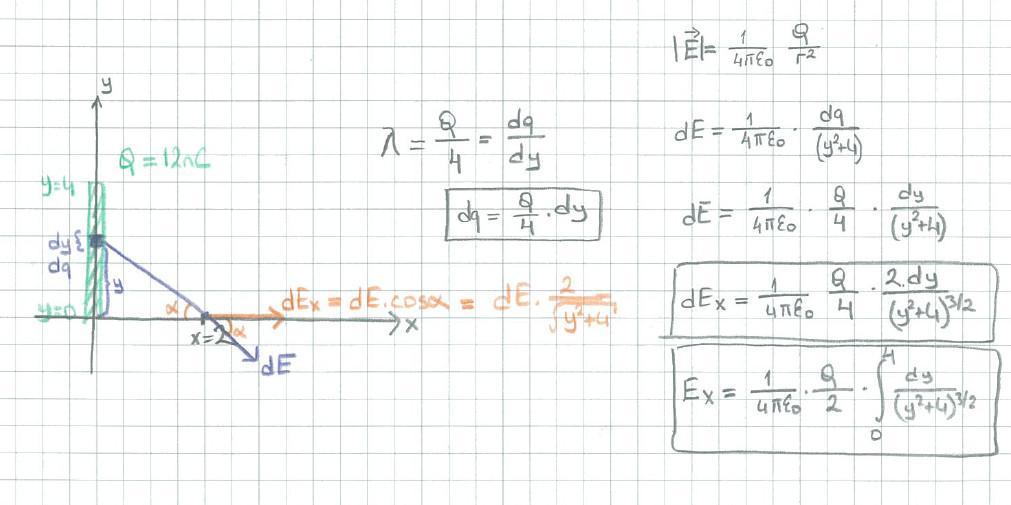
Please refer to the figure.

We will use the following formula for the electric field:

|E| = \frac{1}{4\pi \epsilon_0} \frac{Q}{r^2}.

Since this is not a point source, but a uniformly distributed charge, we will use the method of integration.

We will first choose an infinitesimal (very very small) point on the distribution.

The infinitesimal length of the point is denoted as dy, and the charge of this point is denoted as dQ.

Since the whole distribution is uniform, we can write the charge density as follows: \lambda = \frac{Q}{Length} = \frac{Q}{4}.

The small fraction (dQ) of this distribution should have the same charge density (E.g.: a bucket of water and a glass of the same water have the same mass density). \lambda = \frac{dQ}{dy}.

This yields

dQ = \frac{Q}{4} dy

Now we can ignore the rest of the distribution and focus only the point charge (dQ) and plug this into the electric field equation:

dE = \frac{1}{4\pi\epsilon_0}\frac{dQ}{(y^2 + 4)}

where (y^2 + 4) is the distance from the charge to the x = 2 on the x-axis.

dE = \frac{1}{4\pi\epsilon_0}\frac{Q}{4}\frac{dy}{(y^2+4)}

x-component of dE is dE_{x} = dE*\cos(\alpha) = dE*\frac{2}{\sqrt(y^2+4))}

dE_{x} = \frac{1}{4\pi\epsilon_0}\frac{Q}{4}\frac{2dy}{(y^2+4)^{3/2} }

This is the x component of the point charge (dQ).

Now we will integrate this quantity over the whole distribution to obtain the x component of the electric field at x = 2m on the x axis:

E_{x} = \frac{1}{4\pi\epsilon_0}\frac{Q}{2} \int\limits^4_0 {\frac{1}{(y^2+4)^{3/2}}} \, dy.

Since Q = 12nC;

The answer should look like

E_{x} = \frac{1}{4\pi\epsilon_0} \int\limits^4_0 {\frac{6}{(y^2+4)^{3/2}}} \, dy

Explanation:

The only equation we know regarding this question is the electric field equation, but that equation is only valid for point charges. However, this question proposes a uniformly distributed charge, so all we have to do is to adapt the given system to what we know: Point charge equation of electric field.

The way to do this is to use this useful information: A line is consist of the sum of infinitely many points. We can use integral to sum over all points, so we just have to choose a representative point, and apply the electric field equation to that point.  
You might be interested in
a cylinder has a radius of 2.1cm and a length of 8.8cm .total charge 6.1 x 10^-7C is distributed uniformly throughout. the volum
7nadin3 [17]

The answer for the following problem is explained below.

Therefore the volume charge density of a substance (ρ) is 0.04 × 10^{-1} C.

Explanation:

Given:

radius (r) =2.1 cm = 2.1 ×10^{-2} m

height (h) =8.8 cm = 8.8 ×10^{-2} m

total charge (q) =6.1×10^{-7} C

To solve:

volume charge density (ρ)

We know;

<u> ρ =q ÷ v</u>

volume of cylinder = π ×r  × r × h

volume of cylinder =3.14 × 2.1 × 2.1 ×10^{-4} × 8.8 ×10^{-2}

volume of cylinder (v) = 122.23 ×10^{-6}

<u> ρ =q ÷ v</u>

ρ = 6.1×10^{-7} ÷   122.23 ×10^{-6}

<u>ρ = 0.04 × </u>10^{-1}<u> C</u>

Therefore the volume charge density of a substance (ρ) is 0.04 × 10^{-1} C.

3 0
2 years ago
Intensity: Radiation of a single frequency reaches the upper atmosphere of the earth with an intensity of 1350 W/m2. What is the
sesenic [268]

Answer:

The right answer is "1010 V/m".

Explanation:

The given values are:

Intensity,

I=1350 \ W/m^2

c = 3.00\times 108 \ m/s

\mu_0= 4\pi\times 10^{-7} \ T.m/A

Now,

The electric field's maximum value will be:

=  \sqrt{2\times u\times c\times I}

On substituting the values in the above formula, we get

=  \sqrt{2\times 4\times \pi\times 10^{-7}\times 3\times 10^8\times 1350}

=  \sqrt{32400\times 3.14\times 10^{-7}\times 10^8}

=  1010 \ V/m

3 0
1 year ago
The submarine sends out a sound wave that returns in 1.08 seconds. If this sound wave has a frequency of 2.50 × 10⁶ Hz and a wav
Shtirlitz [24]

Answer:

1620

Explanation:

....................

5 0
2 years ago
The largest single publication in the world is the 1112-volume set of British Parliamentary Papers for 1968 through 1972. The co
Marat540 [252]

Answer:

m_l=550\ kg is the mass of librarian.

Explanation:

Given:

  • mass of the system, m_s=3.3\times 10^{3}\ kg
  • velocity of librarian relative to the ground, v_l=2.5\ m.s^{-1}
  • velocity of the cart relative to the ground, v_c=0.5\ m.s^{-1}

N<u>ow using the principle of elastic collision:</u>

Net momentum of the system is zero.

m_l\times v_l=(3300-m_l)\times v_c

m_l\times 2.5=(3300-m_l)\times 0.5

m_l=550\ kg is the mass of librarian.

6 0
2 years ago
Read 2 more answers
The graph indicates Linda’s walk.
Sedaia [141]
I think the right answer is the first one. If she stops moving her Position does not change any more-and the Graph Shows that after 6 seconds she stays at the Position of 5 m. If she Went Back to the start point the Graph would have Developed Back to 0m(decreased).
3 0
2 years ago
Read 2 more answers
Other questions:
  • Before a collision, the x-momentum of an object is 8.0 × 10³ kilogram meters/second, and its y-momentum is 1.2 × 10⁴ kilogram me
    9·2 answers
  • The short vertical parts adjacent to it also reach into the magnetic field and should experience forces. why can we neglect them
    7·1 answer
  • When a resistor with resistance R is connected to a 1.50-V flashlight battery, the resistor consumes 0.0625 W of electrical powe
    7·1 answer
  • Let A be the last two digits and let B be the sum of the last three digits of your 8-digit student ID. (Example: For 20245347, A
    6·1 answer
  • three point charges are positioned on the x-axis 64 uc at x=ocm , 80uc at x=25cm, and -160 uc at x=50 cm. what is the magnitude
    11·1 answer
  • Charge Q is distributed uniformly throughout the volume of an insulating sphere of radius R = 4.00 cm. At a distance of r = 8.00
    11·1 answer
  • Solar wind particles can be captured by the Earth's magnetosphere. When these particles spiral down along the magnetic field int
    5·1 answer
  • Kevin is a black high school senior. While walking home from a sporting event at school, he sees a police car and decides to tak
    14·1 answer
  • Which of the following has a particles in most irregular pattern​
    10·1 answer
  • ery large accelerations can injure the body, especially if they last for a considerable length of time. One model used to gauge
    8·1 answer
Add answer
Login
Not registered? Fast signup
Signup
Login Signup
Ask question!