answer.
Ask question
Login Signup
Ask question
All categories
  • English
  • Mathematics
  • Social Studies
  • Business
  • History
  • Health
  • Geography
  • Biology
  • Physics
  • Chemistry
  • Computers and Technology
  • Arts
  • World Languages
  • Spanish
  • French
  • German
  • Advanced Placement (AP)
  • SAT
  • Medicine
  • Law
  • Engineering
Nonamiya [84]
2 years ago
11

Show how you might synthesize this compound from an alkyl bromide and a nucleophile in an SN2 reaction. Use the wedge/hash bond

tools to indicate stereochemistry where it exists. Only draw the reactants. Separate multiple reactants using the + sign from the drop-down menu. If there is more than one possible combination of alkyl bromide and nucleophile, draw only one combination. Do not include counter-ions, e.g., Na+, I-, in your answer.

Chemistry
1 answer:
PolarNik [594]2 years ago
6 0

Answer:

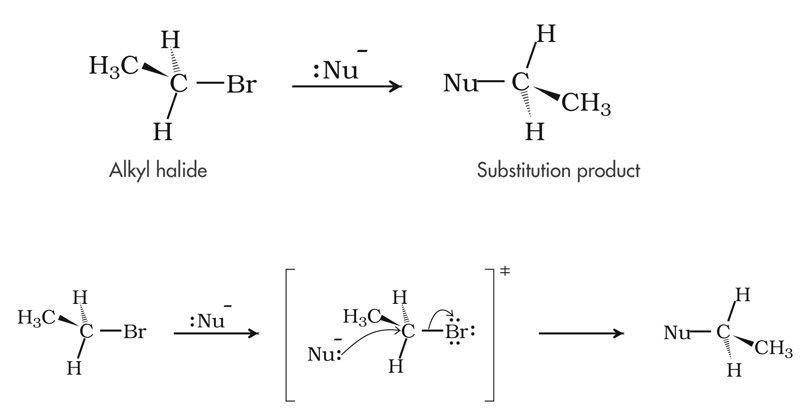
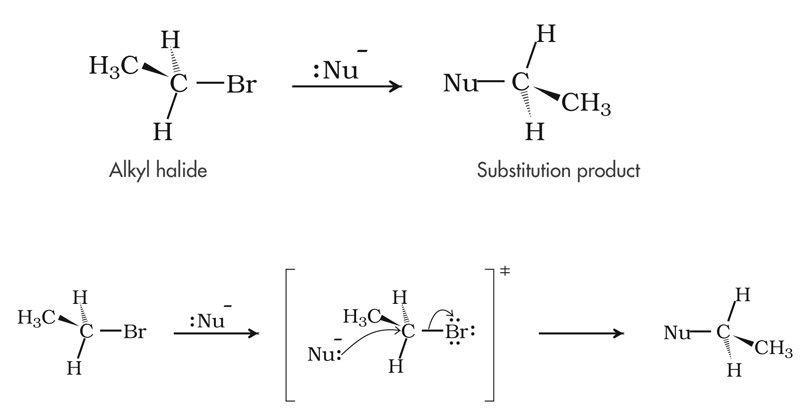
See the image 1

Explanation:

If you look carefully at the progress of the SN2 reaction, you will realize something very important about the outcome. The nucleophile, being an electron-rich species, must attack the electrophilic carbon from the back side relative to the location of the leaving group. Approach from the front side simply doesn't work: the leaving group - which is also an electron-rich group - blocks the way. (see image 2)

The result of this backside attack is that the stereochemical configuration at the central carbon inverts as the reaction proceeds. In a sense, the molecule is turned inside out. At the transition state, the electrophilic carbon and the three 'R' substituents all lie on the same plane. (see image 3)

What this means is that SN2 reactions whether enzyme catalyzed or not, are inherently stereoselective: when the substitution takes place at a stereocenter, we can confidently predict the stereochemical configuration of the product.

You might be interested in
What mass of ammonium thiocyanate (nh4scn) must be used if it is to react completely with 5.7 g barium hydroxide octahydrate?
bija089 [108]
The balanced chemical equation is represented as:

<span>Ba(OH)2·8 H2O + 2 NH4SCN = Ba(SCN)2 + 10 H2O + 2 NH3

To determine the mass of </span>ammonium thiocyanate needed completely react, we use the amount given of the other reactant. Then, convert to moles by the molar mass. And using the relations of the substances in the reaction, we can determine the amount of <span>ammonium thiocyanate.

moles </span>Ba(OH)2·8 H2O = 5.7 g Ba(OH)2·8 H2O ( 1 mol / 315.46 g ) = 0.0181 mol Ba(OH)2·8 H2O
moles NH4SCN  = 0.0181 mol Ba(OH)2·8 H2O ( 2 mol NH4SCN / 1 mol Ba(OH)2·8 H2O ) = 0.0361 mol NH4SCN
mass NH4SCN = 0.0361 mol NH4SCN ( 76.122 g / 1 mol ) = 2.75 g NH4SCN
8 0
2 years ago
Abdul swabs one of his sister’s arms with water. He swabs her other arm with rubbing alcohol.
slamgirl [31]

Answer:

B. The amounts of water and alcohol are not the same

Explanation:

5 0
2 years ago
A 100 mL reaction vessel initially contains 2.60×10^-2 moles of NO and 1.30×10^-2 moles of H2. At equilibrium the concentration
Sliva [168]

Answer:

<h2>The equilibrium constant Kc for this reaction is 19.4760</h2>

Explanation:

The volume of vessel used= 100 ml

Initial moles of NO= \frac{2.60}{10^2} moles

Initial moles of H2= \frac{1.30}{10^2} moles

Concentration of NO at equilibrium= 0.161M

Concentration(in M)=\frac{moles}{volume(in litre)}

Moles of NO at equilibrium= 0.161(\frac{100}{1000})

                                            =\frac{1.61}{10^2} moles


                    2H2 (g)        +    2NO(g) <—>    2H2O (g) +    N2 (g)

<u>Initial</u>          :1.3*10^-2          2.6*10^-2                0                   0        moles

<u>Equilibrium</u>:1.3*10^-2 - x     2.6*10^-2-x              x                   x/2     moles

∴\frac{2.60}{10^2}-x=\frac{1.61}{10^2}

⇒x=\frac{0.99}{10^2}

Kc=\frac{[H2O]^2[N2]}{[H2]^2[NO]^2} (volume of vesselin litre)

<u>Equilibrium</u>:0.31*10^-2      1.61*10^-2          0.99*10^-2        0.495*10^-2  moles

⇒Kc=\frac{(0.0099)^2(0.00495)}{(0.0031)^2(0.0161)^2}  (0.1)

⇒Kc=19.4760

3 0
2 years ago
Refer to the map of "The Major North American Land Biomes" to answer the question.
Misha Larkins [42]

Answer:

all i can help you with is one of them is Canada. If im

wrong i am sorry.

8 0
2 years ago
What volume of water should be used to dissolve 19.6 g of LiF to create a 0.320 M solution?
USPshnik [31]

Answer:

2.4 litters of water are required.

Explanation:

Given data:

Mass of LiF = 19.6 g

Molarity of solution = 0.320 M

Volume of water used = ?

Solution:

Number of moles = mass/molar mass

Number of moles = 19.6 g/ 26 g/mol

Number of moles = 0.75 mol

Volume required:

Molarity = number of moles/ volume in L

Now we will put the values in above given formula.

0.320 M = 0.75 mol /  volume in L

Volume in L = 0.75 mol  /0.320 M

     M = mol/L

Volume in L = 2.4 L
4 0
2 years ago
Other questions:
  • Are the particles in a solid motionless ?
    9·1 answer
  • How many grams of Cl are in 38.0 g of each sample of chlorofluorocarbons (CFCs)?
    15·1 answer
  • A 37.2-g sample of lead (Pb) pellets at 20°C is mixed with a 62.7-g sample of lead pellets at the same temperature. What are th
    10·1 answer
  • What is the best explanation for the fact that a solution of NaNO2(aq) is basic?NO2– is hydrolyzed with the formation of OH –(aq
    9·1 answer
  • CuSO4 absorbs light strongly at a wavelength of 635 nm. Consider that you measure the initial intensity of light, Io, entering t
    5·1 answer
  • A student had 1.00 L of a 1.00 M acid solution. Much to the surprise of the student, it took 2.00 L of 1.00 M NaOH solution to r
    10·1 answer
  • Logic Puzzle: Determine the concentration in the eye dropper. Write the steps below. What is the concentration of the solution i
    10·1 answer
  • When 200g of AgNO3 solution mixes with 150 g of NaI solution, 2.93 g of AgI precipitates, and the temperature of the solution ri
    13·1 answer
  • Identify the true statements regarding alpha-1,6 linkages in glycogen.
    11·1 answer
  • A chef takes four pans from different parts of her kitchen and puts them in two stacks. The diagram above shows the pans before
    12·2 answers
Add answer
Login
Not registered? Fast signup
Signup
Login Signup
Ask question!