answer.
Ask question
Login Signup
Ask question
All categories
  • English
  • Mathematics
  • Social Studies
  • Business
  • History
  • Health
  • Geography
  • Biology
  • Physics
  • Chemistry
  • Computers and Technology
  • Arts
  • World Languages
  • Spanish
  • French
  • German
  • Advanced Placement (AP)
  • SAT
  • Medicine
  • Law
  • Engineering
Vikki [24]
2 years ago
4

A Geiger–Muller tube is a type of gas‑filled radiation detector. It can detect particles like X‑rays, alpha particles, and beta

rays (electrons). This is useful in quantizing the activity of a radioactive source or determining if an area containing radioactive material is safe to enter. Assuming that you have 1 mol of gas, if a Geiger counter is filled with 9846 Pa of argon gas at room temperature ( T = 21.1 °C ) , what is the density, rho , of the gas in this Geiger tube?
Physics
1 answer:
stich3 [128]2 years ago
5 0

Answer:

0.16098\times 10^{-3}\ g/cm^3

Explanation:

P =Pressure = 9846 Pa

V = Volume

n = Amount of substance = 1

T = Temperature = 21.1°C

\rho = Density

R = Gas constant = 8.314 J/mol K

M = Molar mass of argon = 40 g/mol

From ideal gas law we have the relation

PV=nRT

Multiply density on both sides

PV\rho=nR\rho T\\\Rightarrow PM=nR\rho T\\\Rightarrow \rho=\dfrac{PM}{nRT}\\\Rightarrow \rho=\dfrac{9846\times 40\times 10^{-3}}{8.314\times (21.1+273.15)}\\\Rightarrow \rho=0.16098\ kg/m^3\\\Rightarrow \rho=0.16098\times 10^{-3}\ g/cm^3

The density of argon gas is 0.16098\times 10^{-3}\ g/cm^3

You might be interested in
A large crate sits on the floor of a warehouse. Paul and Bob apply constant horizontal forces to the crate. The force applied by
Delicious77 [7]

Answer:

W = -510.98J

Explanation:

Force = 43N, 61° SW

Displacement = 12m, 22° NE

Work done is given as:

W = F*d*cosA

where A = angle between force and displacement.

Angle between force and displacement, A = 61 + 90 + 22 = 172°

W = 43 * 12 * cos172

W = -510.98J

The negative sign shows that the work done is in the opposite direction of the force applied to it.

6 0
2 years ago
A potential difference of 10.0 volts exists between two points, A and B, within an electric field. What is the
Viefleur [7K]

Answer:

1. 5.0 x 10^2 C

Explanation:

V=W/Q

10 = 2.0 x 10^-2/Q

Q = 2.0 x 10^-2/ 10

Q = 5.0 x 10^2 C

7 0
2 years ago
A 2.0-cm-diameter parallel-plate capacitor with a spacing of 0.50 mm is charged to 200 V. What are (a) the total energy stored i
Debora [2.8K]

Answer:

(A) Total energy will be equal to 0.044\times 10^{-5}J

(b) Energy density will be equal to 0.0175J/m^3

Explanation:

We have given diameter of the plate d = 2 cm = 0.02 m

So area of the plate A=\pi r^2=3.14\times 0.02^2=0.001256m^2

Distance between the plates d = 0.50 mm = 0.50\times 10^{-3}m

Permitivity of free space \epsilon _0=8.85\times 10^{-12}F/m

Potential difference V =200 volt

Capacitance between the plate is equal to C=\frac{\epsilon _0A}{d}=\frac{8.85\times 10^{-12}\times 0.001256}{0.50\times 10^{-3}}=0.022\times 10^{-9}F

(a) Total energy stored in the capacitor is equal to

E=\frac{1}{2}CV^2

E=\frac{1}{2}\times 0.022\times 10^{-9}\times 200^2=0.044\times 10^{-5}J

(b) Volume will be equal to V=Ad, here A is area and d is distance between plates

V=0.001256\times 0.02=2.512\times 10^{-5}m^3

So energy density =\frac{Energy}{volume}=\frac{0.044\times 10^{-5}}{2.512\times 10^{-5}}=0.0175J/m^3

7 0
2 years ago
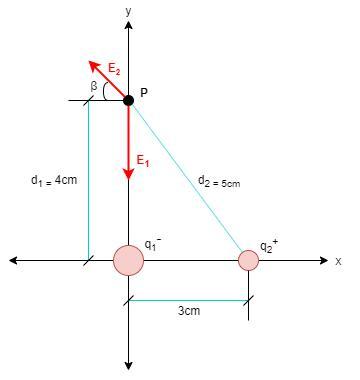
Fields of Point Charges Two point charges are fixed in the x-y plane. At the origin is q1 = -6.00 nC . and at a point on the x-a
My name is Ann [436]

Answer:

Part A) Electric fields at the point due to q₁ and q₂:

E₁ = 33.75*10³ N/C (-j) , E₂= ( 6.48 (-i) + 8.64 (+j) )*10³ N/C

Part B) Net electric field at P (Ep)

Ep=   (6.48*10³ (-i)+25.11 10³ (-j) )N/C

Explanation:

Conceptual analysis

The electric field at a point P due to a point charge is calculated as follows:

E = k*q/d²

E: Electric field in N/C

q: charge in Newtons (N)

k: electric constant in N*m²/C²

d: distance from charge q to point P in meters (m)

Equivalence

1nC= 10⁻⁹C

1cm= 10⁻²m

Data

k= 9*10⁹ N*m²/C²

q₁ = -6.00 nC = -6 *10⁻⁹C

q₂ = +3.00 nC = +3*10⁻⁹C

d₁ = 4cm = 4 *10⁻²m

d_{2} =\sqrt{(4*10^{-2})^{2}+((3*10^{-2})^{2} }

d₂ = 5 *10⁻²m

Part A) Calculation of the electric fields at the point due to q₁ and q₂

Look at the attached graphic:

E₁: Electric Field at point  P(0,4) cm due to charge q₁. As the charge q₁ is negative (q₁-), the field enters the charge

E₂: Electric Field at point  P(0,4) cm  due to charge q₂. As the charge q₂ is positive (q₂+) ,the field leaves the charge

E₁ = k*q₁/d₁² = 9*10⁹ *6 *10⁻⁹/ (4 *10⁻²)² = 33.75*10³ N/C

E₂ = k*q₂/d₂²= 9*10⁹ *3*10⁻⁹/(5 *10⁻²)² =  10.8*10³ N/C

E₁ = 33.75*10³ N/C (-j)

E₂x=E₂cosβ = 10.8*(3/5) = 6.48*10³ N/C

E₂y=E₂sinβ = 10.8*(4/5) =  8.64*10³ N/C

E₂= ( 6.48 (-i) + 8.64 (+j) )*10³ N/C

Part B) Calculation of the net electric field at P (Ep)

The electric field at a point P due to several point charges is the vector sum of the electric field due to individual charges.

Ep=Epx (i) + Epy (j)

Epx= E₂x= 6.48*10³ N/C (-i)

Epy= E₁y+E₂y= (33.75*10³ (-j) + 8.64*10³ (+j) ) N/C=25.11 10³ (-j) N/C

Ep=   (6.48*10³ (-i)+25.11 10³ (-j) )N/C

Ep=   (6.48*10³ (-i)+25.11 10³ (-j) )N/C

3 0
2 years ago
A toy plane has a mass of 2.5 kg and is 18 m above the ground. It is moving at 4.5 m/s. How much mechanical energy does the toy
sleet_krkn [62]
Mechanical energy is the sum of kinetic energy and potential energy, or E=Ek+Ep. So Ek=(1/2)*m*v² where m is the mass of the object and v is it's velocity. Mp=m*g*h where m is the mass, g=9.81 m/s² and h is the height of the object. So after we input the numbers the total mechanical energy is
E=(1/2)*2.5*(4.5²) + 2.5*9.81*18 = 25.3125 J + 441.45 J = 466.7625 J. The correct answer is E= 466 J. 
4 0
2 years ago
Read 2 more answers
Other questions:
  • A boy throws a steel ball straight up. consider the motion of the ball only after it has left the boy's hand but before it touch
    11·2 answers
  • In a simple electric circuit, ohm's law states that v=irv=ir, where vv is the voltage in volts, ii is the current in amperes, an
    15·1 answer
  • You are conducting an experiment inside a train car that may move along level rail tracks. A load is hung from the ceiling on a
    5·1 answer
  • Ugonna stands at the top of an incline and pushes a 100−kg crate to get it started sliding down the incline. The crate slows to
    7·1 answer
  • What makes the subject of star formation so difficult and complex? Star formation is too expensive to study in detail. Stars liv
    12·1 answer
  • A truck of mass 1800kg is moving with a speed 54km/h. When brakes are applied, it
    12·1 answer
  • A force of 16.88 n is applied tangentially to a wheel of radius 0.340 m and causes an angular acceleration of 1.20 rad/s2. What
    15·1 answer
  • What happens when Dr. Hewitt places a current- carrying wire between the poles of the magnet for the first time?
    11·1 answer
  • A front wheel drive car starts from rest and accelerates to the right. Knowing that the tires do not slip on the road, what is t
    9·1 answer
  • A solar-powered car has a kinetic energy of 110250 J. Its mass is 180 kg. Work out how fast the car is travelling.
    9·2 answers
Add answer
Login
Not registered? Fast signup
Signup
Login Signup
Ask question!