answer.
Ask question
Login Signup
Ask question
All categories
  • English
  • Mathematics
  • Social Studies
  • Business
  • History
  • Health
  • Geography
  • Biology
  • Physics
  • Chemistry
  • Computers and Technology
  • Arts
  • World Languages
  • Spanish
  • French
  • German
  • Advanced Placement (AP)
  • SAT
  • Medicine
  • Law
  • Engineering
Anestetic [448]
2 years ago
11

Give one fragment in the mass spectrum and one peak in the IR spectrum that could be used to distinguish between these two isome

rs: (Designate which compound will show that diagnostic fragment or peak by preceding the value with the letter of the compound, i.e. "a47" or "b1730". Do not include any units.)

Chemistry
1 answer:
SCORPION-xisa [38]2 years ago
4 0

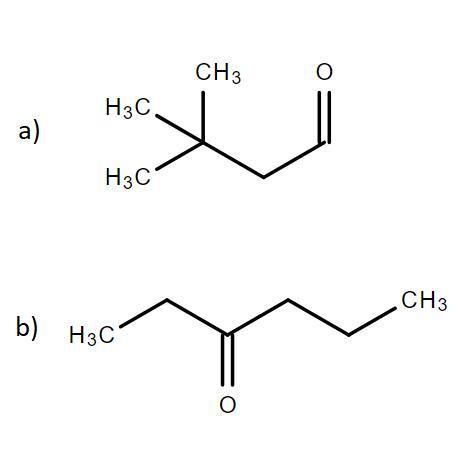
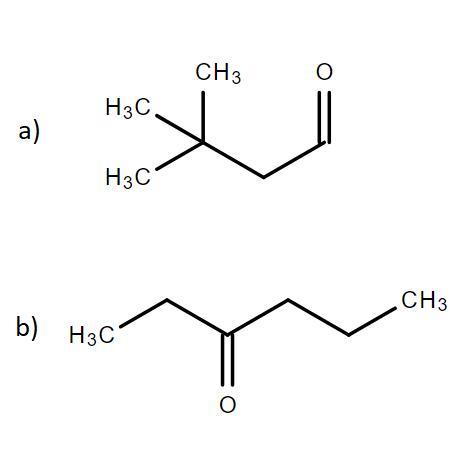
The question does not contain the structures of the isomers.  The complete question is below (the structures are also in attachment)

Question:

Give one fragment in the mass spectrum and one peak in the IR spectrum that could be used to distinguish between these two isomers: (Designate which compound will show that diagnostic fragment or peak by preceding the value with the letter of the compound, i.e. "a47" or "b1730". Do not include any units.)

a) CC(CC=O)(C)C

b) C(C)C(=O)CCC

Answer:

a1730

b43

Explanation:

These two isomers a and b contain different functional groups viz., aldehyde and ketone respectively. They show different signals in their mass and IR spectra, hence, can be distinguished.

In mass spectrometer analysis, both species will undergo α-cleavage, i.e., carbonyl group will lose alkyl group next to it. Only the mass spectra of compound b will show a peak at 43 due to the loss of propyl carbocation. This peak is not observable in the mass spectra of compound a, although a peak at 44 might appear due to the McLafferty rearrangement of compound a.

IR spectra of both species contain characteristics peaks of their functional group. Ketone shows its C=O stretching peak at 1715 cm⁻¹, while aldehyde shows its C=O stretching peak at 1730 cm⁻¹ along with a should peak near 2830 to 2695 cm⁻¹ due to O=C-H stretching.

You might be interested in
When 13.6 g of calcium chloride, CaCl2, was dissolved in 100.0 mL of water in a coffee cup calorimeter, the temperature rose fro
DanielleElmas [232]

Answer:

THE ENTHALPY OF SOLUTION IS 3153.43 J/MOL OR 3.15 KJ/MOL.

Explanation:

1. write out the variables given:

Mass of Calcium chloride = 13.6 g

Change in temperature = 31.75°C - 25.00°C = 6.75 °C

Density of the solution = 1.000 g/mL

Volume = 100.0 mL = 100.0 mL

Specific heat of water = 4.184 J/g °C

Mass of the water = unknown

2. calculate the mass of waterinvolved:

We must first calculate the mass of water in the bomb calorimeter

Mass = density  * volume

Mass = 1.000 * 100

Mass = 0.01 g

3. calculate the quantity of heat evolved:

Next is to calculate the quantity of heat evolved from the reaction

Heat = mass * specific heat of water * change in temperature

Heat = mass of water * specific heat *change in temperature

Heat = 13.6 g * 4.184 * 6.75

Heat = 13.6 g * 4.184 J/g °C * 6.75 °C

Heat = 384.09 J

Hence, 384.09J is the quantity of heat involved in the reaction of 13.6 g of calcium chloride in the calorimeter.

4. calculate the molar mass of CaCl2:

Next is to calculate the molar mas of CaCl2

Molar mass = ( 40 + 35.5 *2) = 111 g/mol

The number of moles of 13.6 g of CaCl2 is then:

Number of moles of CaCl2 = mass / molar mass

Number of moles = 13.6 g / 111 g/mol

Number of moles = 0.1225 mol

So 384.09 J of heat was involved in the reaction of 1.6 g of CaCl2 in a calorimter which translates to 0.1225 mol of CaCl2..

5. Calculate the enthalpy of solution in kJ/mol:

If 1 mole of CaCl2 is involved, the heat evolved is therefore:

Heat per mole = 384.09 J / 0.1225 mol

Heat = 3 135.43 J/mol

The enthalpy of solution is therefore 3153.43 J/mol or 3.15 kJ/mol.
5 0
2 years ago
How to correctly solve this problem : 4.05Kg+567.95g+100.1g correct and best way
VARVARA [1.3K]
Check attached file for the answer.

7 0
2 years ago
For a solar eclipse to occur which of the following alignments is necessary? A. The moon is located along a straight line betwee
svlad2 [7]

A. I'm pretty sure, could be C though..

8 0
2 years ago
Which statements are true of the electron cloud model? Check all that apply. It is also known as the planetary model. It is cons
barxatty [35]

Answer:

-It is considered the modern atomic model.

-It describes the probable locations of the electrons

Explanation:

edge 2020

8 0
2 years ago
Read 2 more answers
A birthday balloon had a volume of 14.1 L when the gas inside was at a temperature of 13.9 °C. Assuming no gas escapes, what is
bixtya [17]

Answer:

14.5L

Explanation:

The following data were obtained from the question:

V1 = 14.1L

T1 = 13.9°C = 13.9 + 273 = 286.9K

T2 = 22°C = 22 + 273 = 295K

V2 =?

Using charles' law: V1/T1 = V2 /T2, we can obtain the new volume as follows:

14.1/286.9 = V2 /295

Cross multiply to express in linear form

286.9 x V2 = 14.1 x 295

Divide both side by 286.9

V2 = (14.1 x 295) / 286.9

V2 = 14.5L

Therefore, the new volume = 14.5L

8 0
3 years ago
Other questions:
  • If a large marshmallow has a volume of 2.75 in3 and density of 0.242 g/cm3, how much would it weigh in grams? 1 in3=16.39 cm3.
    9·1 answer
  • A stone of mass 0.55 kilograms is released and falls to the ground. Measurements show that the stone has a kinetic energy of 9.8
    6·2 answers
  • Match the correct properties and characteristics of each type of rock?
    11·2 answers
  • The nucleus of a neutral potassium atom is "surrounded" by
    14·2 answers
  • Which of these is a trace fossil : shrimp burrow, seashell, dinosaur egg, shark tooth
    8·2 answers
  • A solution of SO2 in water contains 0.00023 g of SO2 per liter of solution. What is the concentration of SO2 in ppm? in ppb?
    7·2 answers
  • Which of the following solutions is a buffer? Check all that apply. Check all that apply. a solution made by mixing 100 mL of 0.
    12·2 answers
  • Part A Name the complex ion [Fe(CN)6]^3- . The oxidation number of iron is +3. Part B Name the complex ion [Cu(NH3)2(H2O)4]^2+ .
    15·1 answer
  • What is the volume, in liters, occupied by 1.73 moles of N2 gas at 0.992 atm pressure and a temperature of 75º C? (R value- 0.08
    6·1 answer
  • The mass of an atom comes from _____. A. the nucleus B. the neutrons C. the electro​​​​ns D. the protons
    15·1 answer
Add answer
Login
Not registered? Fast signup
Signup
Login Signup
Ask question!