answer.
Ask question
Login Signup
Ask question
All categories
  • English
  • Mathematics
  • Social Studies
  • Business
  • History
  • Health
  • Geography
  • Biology
  • Physics
  • Chemistry
  • Computers and Technology
  • Arts
  • World Languages
  • Spanish
  • French
  • German
  • Advanced Placement (AP)
  • SAT
  • Medicine
  • Law
  • Engineering
Hatshy [7]
2 years ago
10

Determine the tension developed in cables OD and OB and the strut OC, required to support the 500-lb crate. The spring OA has an

unstretched length of 0.2 ft and a stiffness of kOA

Physics
1 answer:
natali 33 [55]2 years ago
6 0

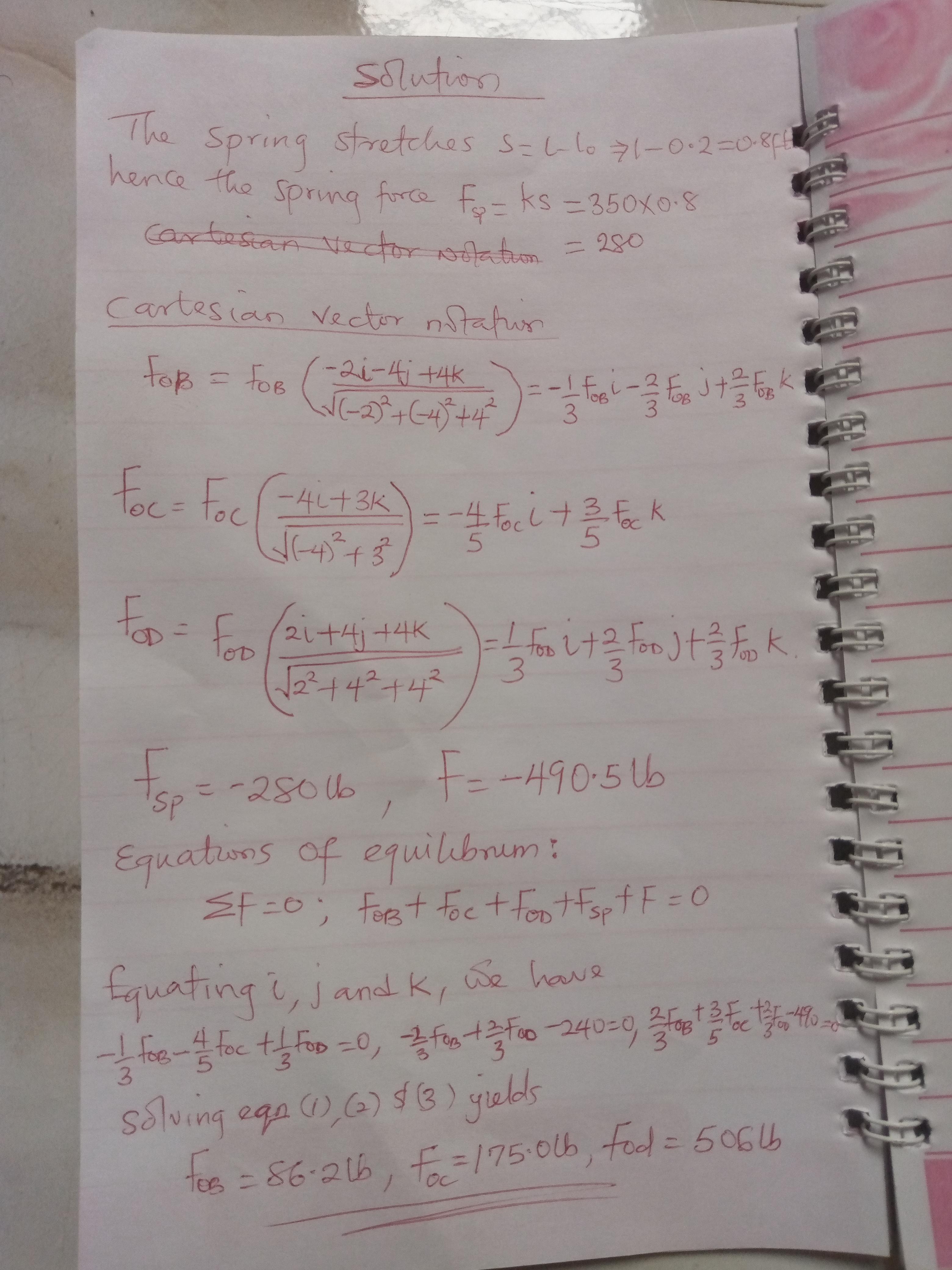
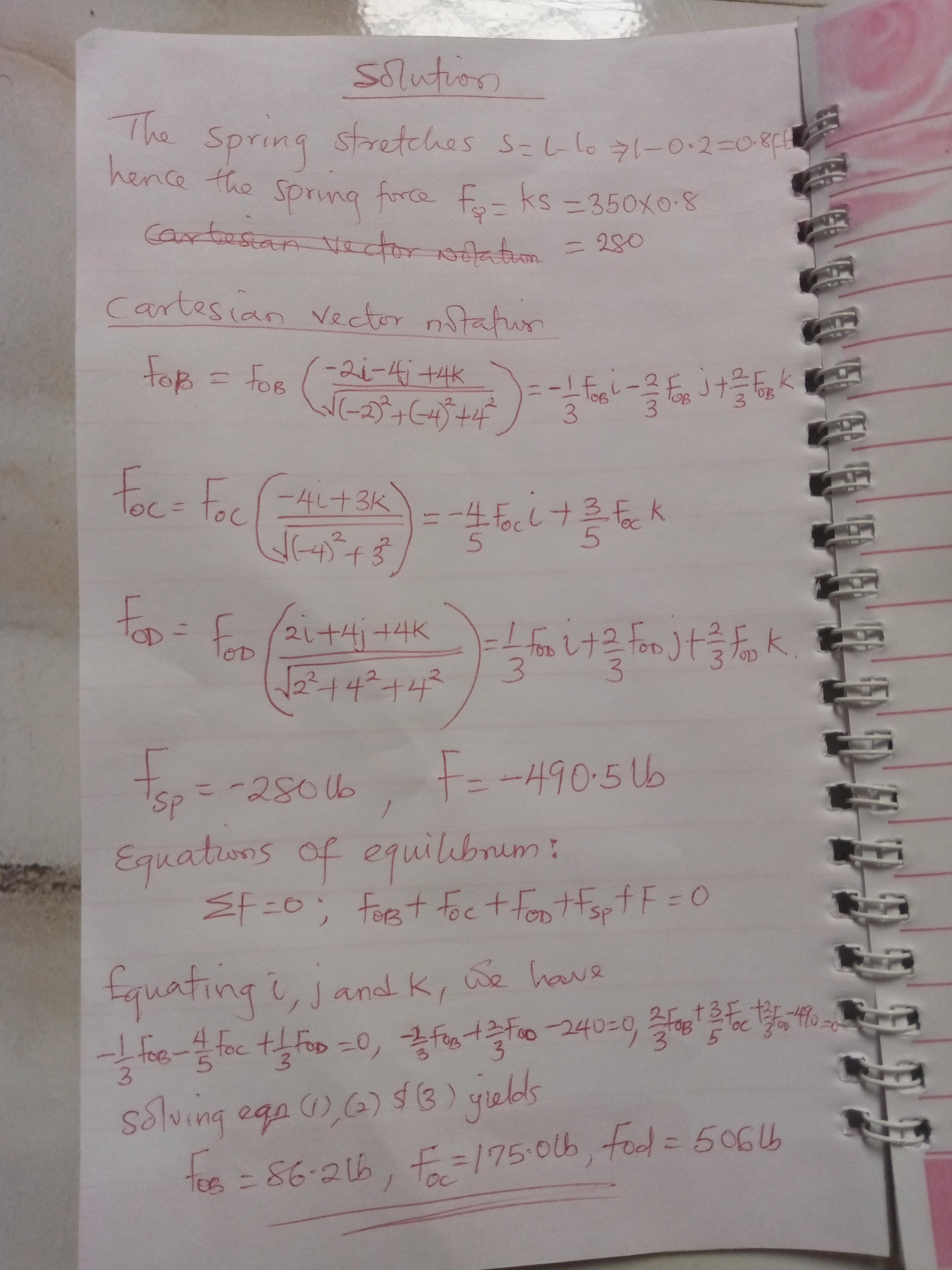
Answer:Fob= 86.2 lb, Foc= 175 lb, Fod= 506 lb

Explanation:firstly we need to get the spring stretch by subtracting the unstretched length from 1. The result will be (1-0.2=0.8ft). We then get the spring force by multiplying kOA by 0.8ft. therefore the spring force will be {350x0.8}= 280 lb. After that we can resolve each force as shown in the attachment.

You might be interested in
High-speed stroboscopic photographs show that the head of a 200 g golf club is traveling at 43.7 m/s just before it strikes a 45
Helga [31]

Answer:

41.27m/s

Explanation:

According to law of conservation of momentum

m1u1+m2u2 = (m1+m2)v

m1 and m2 are the masses

u1 and u2 are the initial velocities

v is the velocity after impact

Given

m1 = 0.2kg

u1 = 43.7m/s

m2 = 45.9g = 0.0459kg

u2 = 30.7m/s

Required

Velocity after impact v

Substitute the given parameters into the formula

0.2(43.7)+0.0459(30.7) = (0.2+0.0459)v

8.74+1.409 = 0.2459v

10.149 = 0.2459v

v = 10.149/0.2459

v = 41.27m/s

Hence the speed of the golf ball immediately after impact is 41.27m/s

8 0
2 years ago
How far must 5N force pull a 50g toy car if 30J of energy are transferred?​
Alborosie

Answer: 6 m

Explanation:

30 = 5 * d

d = 30/5

d = 6 m

7 0
2 years ago
A proton initially moves left to right along the x-axis at a speed of 2.00 x 10³ m/s. It moves into an uniform electric field, w
FinnZ [79.3K]

Answer:

E = 1.04*10⁻¹ N/C

Explanation:

Assuming no other forces acting on the proton than the electric field, as this is uniform, we can calculate the acceleration of the proton, with the following kinematic equation:

vf^{2} -vo^{2} = 2*a*x

As the proton is coming at rest after travelling 0.200 m to the right,  vf = 0, and x = 0.200 m.

Replacing this values in the equation above, we can solve for a, as follows:

a = \frac{vo^{2}*mp}{2*x} = \frac{(2.00e3m/s)^{2}}{2*0.2m} = 1e7 m/s2

According to Newton´s 2nd Law, and applying the definition of an electric field, we can say the following:

F = mp*a = q*E

For a proton, we have the following values:

mp = 1.67*10⁻²⁷ kg

q = e = 1.6*10⁻¹⁹ C

So, we can solve for E (in magnitude) , as follows:

E = \frac{mp*a}{e} =\frac{1.67e-27kg*1e7m/s2}{1.6e-19C} = 1.04e-1 N/C

⇒ E = 1.04*10⁻¹ N/C

5 0
2 years ago
(b) If the straight-line distance from her home to the university is 10.3 km in a direction 25.0° south of east, what was her av
svet-max [94.6K]

Answer:

The time taken is missing in the question. The time is 18 minutes.

The answer is 34.3 km/hr

Explanation:

Average velocity is the speed or the velocity which is required to cover a distance in a time interval.

The time taken is = 18 min

                            = 18/60 hours

The distance from the university to her home is = 10.3 km

Therefore, the average velocity is = displacement/time taken

                                                         = 10.3 / (18/60) km/hr

                                                         = 34.3 km/hr

Hence, the average velocity is 34.3 km/hr

7 0
2 years ago
One of the largest barometers ever built was an oil-filled barometer constructed in Leicester, England in 1991. The oil had a he
ZanzabumX [31]

Answer:

ρ = 830.32 kg/m³

Explanation:

Given that

Oil head = 12.2 m

h= 12.2 m

Pressure P = 1.013 x 10⁵ Pa

Lets take density of the liquid =ρ

The pressure due to liquid P given as

P = ρ g h

Now by putting the all values in the above equation

1.013 x 10⁵ Pa = ρ x 10 x 12.2                 ( take g =10 m/s²)

ρ = 830.32 kg/m³

Therefore the density of oil is 830.32  kg/m³
5 0
2 years ago
Other questions:
  • What is the mass of an object weighing 63 N on Earth?
    13·1 answer
  • What is the magnitude of the force a 1.5 x 10⁻³ C charge exerts on a 3.2 x 10⁻⁴ C charge located 1.5 m away?
    8·1 answer
  • two students are on a balcony 19.6 m above the street. one student throws a ball vertically downward at 14.7 m:ds. at the same i
    12·1 answer
  • The gravitational force between two asteroids is 6.2 × 10⁸ n. asteroid y has three times the mass of asteroid z. if the distance
    6·2 answers
  • What is the porosity of the sand sample?(The sediment volume for each sample is 400ml.) a. 90.25% b. 72.00% c. 25.50% d. 16.75%
    15·2 answers
  • B. A hydraulic jack has a ram of 20 cm diameter and a plunger of 3 cm diameter. It is used for lifting a weight of 3 tons. Find
    13·1 answer
  • A transverse wave is traveling on a string stretched along the horizontal x-axis. The equation for the
    15·1 answer
  • If a freely suspended vertical spring is pulled in downward direction and then released, which type of wave is produced in the s
    9·2 answers
  • an object having a core temperature of 1700 is removed from a furnace and placed in an environment having a constant temperature
    8·1 answer
  • On James’s MP3 player, he has 12 sad songs and 40 upbeat songs that he wants to put into playlists. He wants to have the same nu
    7·2 answers
Add answer
Login
Not registered? Fast signup
Signup
Login Signup
Ask question!