answer.
Ask question
Login Signup
Ask question
All categories
  • English
  • Mathematics
  • Social Studies
  • Business
  • History
  • Health
  • Geography
  • Biology
  • Physics
  • Chemistry
  • Computers and Technology
  • Arts
  • World Languages
  • Spanish
  • French
  • German
  • Advanced Placement (AP)
  • SAT
  • Medicine
  • Law
  • Engineering
Pavel [41]
2 years ago
11

Lucy boards a crowded bus as it sits in the station. There are no available seats, so Lucy stands in the center aisle next to a

support pole. As the bus starts moving forward and picks up speed, Lucy holds the pole tightly to avoid falling over backward. While the bus is speeding up, what is the direction of the total force (if any) on Lucy?
Is it forward? baclwards? or the total force is zero?

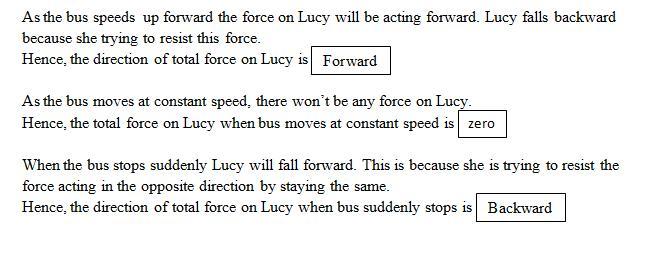
As the bus drives down a straight road at a constant speed, Lucy has no trouble keeping her balance. During this time, what is the direction of the total force (if any) on Lucy?

Is it forward? baclwards? or the total force is zero?
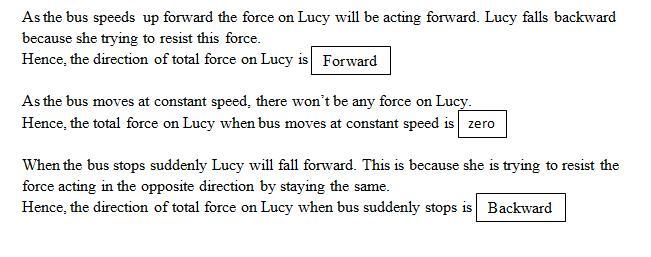
The bus comes to a sudden stop at a red light, and Lucy grips the pole tightly to avoid falling over forward. During this time, what is the direction of the total force (if any) on Lucy?

Is it forward? baclwards? or the total force is zero?

Physics
1 answer:
Gelneren [198K]2 years ago
3 0

Answer:

Check the attachment

Explanation:

You might be interested in
Which of the following best describes the dependant variable?
weeeeeb [17]
Hello!

The independent variable is the variable deliberately changed.

The dependent variable is the variable that responds to change. So the answer is A.

Hope this helps. Any questions please just ask! Thank you!
5 0
2 years ago
A DJ starts up her phonograph player. The turntable accelerates uniformly from rest, and takes t1 = 11.9 seconds to get up to it
Degger [83]

Answer:

a)\omega_1=8.168\,rad.s^{-1}

b)n_1=7.735 \,rev

c)\alpha_1 =0.6864\,rad.s^{-2}

d)\alpha_2=4.1454\,rad.s^{-2}

e)t_2=1.061\,s

Explanation:

Given that:

  • initial speed of turntable, N_0=0\,rpm\Rightarrow \omega_0=0\,rad.s^{-1}
  • full speed of rotation, N_1=78 \,rpm\Rightarrow \omega_1=\frac{78\times 2\pi}{60}=8.168\,rad.s^{-1}
  • time taken to reach full speed from rest, t_1=11.9\,s
  • final speed after the change,  N_2=120\,rpm\Rightarrow \omega_2=\frac{120\times 2\pi}{60}=12.5664\,rad.s^{-1}
  • no. of revolutions made to reach the new final speed,  n_2=11\,rev

(a)

∵ 1 rev = 2π radians

∴ angular speed ω:

\omega=\frac{2\pi.N}{60}\, rad.s^{-1}

where N = angular speed in rpm.

putting the respective values from case 1 we've

\omega_1=\frac{2\pi\times 78}{60}\, rad.s^{-1}

\omega_1=8.168\,rad.s^{-1}

(c)

using the equation of motion:

\omega_1=\omega_0+\alpha . t_1

here α is the angular acceleration

78=0+\alpha_1\times 11.9

\alpha_1 = \frac{8.168 }{11.9}

\alpha_1 =0.6864\,rad.s^{-2}

(b)

using the equation of motion:

\omega_1\,^2=\omega_0\,^2+2.\alpha_1 .n_1

8.168^2=0^2+2\times 0.6864\times n_1

n_1=48.6003\,rad

n_1=\frac{48.6003}{2\pi}

n_1=7.735\, rev

(d)

using equation of motion:

\omega_2\,^2=\omega_1\,^2+2.\alpha_2 .n_2

12.5664^2=8.168^2+2\alpha_2\times 11

\alpha_2=4.1454\,rad.s^{-2}

(e)

using the equation of motion:

\omega_2=\omega_1+\alpha_2 . t_2

12.5664=8.168+4.1454\times t_2

t_2=1.061\,s

4 0
2 years ago
A particle with a charge of 3.00 elementary charges moves through a potential difference of 4.50 volts. What is the change in el
ollegr [7]
The answer:
the relationship between elementary charge, potential difference and electrical potential energy is given by 
   E= qV
E:  lectrical potential energy
q:   elementary charge
V:   potential difference

but we have  e=abs val(q)=3 
so we have E= qV=3ex4.5V=<span>13.5 eV
</span>
the answer is <span>(4)13.5 eV</span>

8 0
2 years ago
Janes car uses 1 gallon of petrol for each 40 miles. A gallon of petrol costs 3.20. Work out the cost of petrol for Jane's 320 k
kramer
320 Kilometers = 198.8 miles
                      I
1 gallon of Petrol = 40 Miles
                      I
198.8/40 = 4.95 Gallons of Petrol
                      I
Cost of Petrol = 3:20 (per Gallon) x 4.95 Gallons = 15.84
3 0
2 years ago
Read 2 more answers
The pupil of the human eye can vary in diameter from 2.00 mm in bright light to 8.00 mm in dim light. The eye has a focal length
Zarrin [17]

The indicated data are of clear understanding for the development of Airy's theory. In optics this phenomenon is described as an optical phenomenon in which The Light, due to its undulatory nature, tends to diffract when it passes through a circular opening.

The formula used for the radius of the Airy disk is given by,

y_r=1.22\frac{\lambda f}{d}

Where,

y_r = Range of the radius

\lambda = wavelength

f= focal length

Our values are given by,

State 1:

d=2.00mm = 2*10^{-3}m

f= 25mm = 25*10^{-3}m

\lambda = 750nm = 750*10^{-9}m

State 2:

d=8.00mm = 8*10^{-3}m

f= 25mm = 25*10^{-3}m

\lambda = 390nm = 390*10^{-9}

Replacing in the first equation we have:

y_{r1} = 1.22\frac{(750*10^{-9})(25*10^{-3})}{2*10^{-3}}

y_{r1}= 11.4\mu m

And also for,

y_{r2} =1.22\frac{(390*10^{-9})(25*10^{-3})}{8*10^{-3}}

y_{r2} = 1.49\mu m

Therefor, the airy disk radius ranges from 1.49\mu m to 11.4\mu m

7 0
2 years ago
Other questions:
  • Sebuah benda dijatuhkan bebas dari ketinggian 200 m jika grafitasi setempat 10 m/s maka hitunglah kecepatan dan ketinggian benda
    7·1 answer
  • The pencil rotates about an axis perpendicular to the plane of the figure. which of the labeled points is the point that the axi
    9·2 answers
  • in physics lab, a cube slides down a frictionless incline as shown in the figure below, and elastically strikes another cube at
    12·1 answer
  • You are standing 10 meters from a light source. Then, you back away from the light source until you are 20 meters away from it.
    6·1 answer
  • The curved section of a horizontal highway is a circular unbanked arc of radius 740m. If the coefficient of static friction betw
    15·2 answers
  • Two identical carts travel at the same speed toward each other, and then a collision occurs. The graphs show the momentum of eac
    14·1 answer
  • Rock X is released from rest at the top of a cliff that is on Earth. A short time later, Rock Y is released from rest from the s
    5·1 answer
  • The potential energy for a certain mass moving in one dimension is given by U(x)=(2.0J/m3)x3−(15J/m2)x2+(36J/m)x−23JU(x)=(2.0J/m
    11·1 answer
  • You decide to work at a heart rate of 150 instead of 120. What area of F.I.T.T. did you change?
    12·1 answer
  • When you are standing on Earth, orbiting the Sun, and looking at a broken cell phone on the ground, there are gravitational pull
    9·1 answer
Add answer
Login
Not registered? Fast signup
Signup
Login Signup
Ask question!