answer.
Ask question
Login Signup
Ask question
All categories
  • English
  • Mathematics
  • Social Studies
  • Business
  • History
  • Health
  • Geography
  • Biology
  • Physics
  • Chemistry
  • Computers and Technology
  • Arts
  • World Languages
  • Spanish
  • French
  • German
  • Advanced Placement (AP)
  • SAT
  • Medicine
  • Law
  • Engineering
rewona [7]
2 years ago
14

Water flows steadily through a horizontal nozzle, discharging to the atmosphere. At the nozzle inlet the diameter is D1; at the

nozzle outlet the diameter is D2. i) Derive an expression for the minimum gage pressure required at the nozzle inlet to produce a given flow rate, Q. Evaluate the inlet gage pressure if D1
Engineering
1 answer:
Papessa [141]2 years ago
4 0

Complete question:

Water flows steadily through a horizontal nozzle, discharging to the atmosphere. At the nozzle inlet, the diameter is D1, at the nozzle outlet the diameter is D2. i) Derive an expression for the minimum gauge pressure required at the inlet to produce a given volume flow rate Q.

ii) Evaluate the inlet gauge pressure if D1=3.0in, D2=1.0in and the desired flow rate is 0.7 ft³/sec. Assume density of water is 1.94 slug/ft³.

Answer:

Part (i) P_1 = \frac{16\rho Q^2D_2^4}{2\pi^2 } - \frac{16\rho Q^2D_1^4}{2\pi^2 }

part (ii) the inlet gauge pressure is 61.627 Psi

Explanation:

Applying Bernoulli's equation

P_1 + \rho gZ_1 +\frac{\rho U_1^2}{2} = P_2 + \rho gZ_2 +\frac{\rho U_{2}^2}{2} +P_L

Where;

P₁ is the gauge pressure at the inlet nozzle

Z₁ is the vertical height above ground

U₁ is the inlet velocity

P₂ is the gauge pressure at the outlet nozzle

Z₂ is the vertical height above ground

U₂ is the outlet velocity

ρ is the density of water

PL is the pressure of water at the outlet nozzle

Assumptions

for a horizontal flow that discharges to the atmosphere;

  • the potential is zero and there is no loss of energy due to height.
  • the gauge pressure at the outlet nozzle is zero

The equation reduces to;

P_1  +\frac{\rho U_1^2}{2} = \frac{\rho U_{2}^2}{2}

Part(i)

And minimum gauge pressure at the inlet nozzles becomes;

P_1   = \frac{\rho U_{2}^2}{2} -\frac{\rho U_1^2}{2}

Substituting for flow rate Q; from continuity equation

U = Q/A

A = \frac{\pi D^2}{4}

U =\frac{4Q}{\pi D^2}, Substitute this for U in the minimum gauge pressure equation above.

P_1   = \frac{\rho (\frac{4Q}{\pi } D^2 _{2})^2}{2} -\frac{\rho (\frac{4Q}{\pi } D^2 _{1})^2}{2}\\\\

The equation for the minimum gauge pressure required at the nozzle inlet to produce a given flow rate, Q, becomes;

P_1 = \frac{16\rho Q^2D_2^4}{2\pi^2 } - \frac{16\rho Q^2D_1^4}{2\pi^2 }

Part (ii)

given;

inlet diameter D₁ = 3.0 in

outlet diameter D₂ = 1.0 in

water flow rate Q = 0.7 ft³/sec

density of water ρ = 1.94 slug/ft³

Substitute these values in the equation above and evaluate P₁

P_1 = \frac{16\rho Q^2D_2^4}{2\pi^2 } - \frac{16\rho Q^2D_1^4}{2\pi^2 }\\\\P_1 = \frac{16*1.94* (0.7)^2(3)^4}{2\pi^2 } - \frac{16*1.94* (0.7)^2(1)^4}{2\pi^2 }\\\\P_1 =62.397 - 0.77 = 61.627 psi

You might be interested in
49. A solenoid coil with a resistance of 30 ohms and an inductance of 200 milli-henrys, is connected to a 230VAC, 50Hz supply. D
Leya [2.2K]

Answer:

69.59 ohms

Explanation:

Given that

L=200\ mH

F=50\ hZ

R=30\ ohms

For inductance

X_L=2\times \pi\times f \times LX_L\\=2\times \pi \times 50\times 200\times 10^{-3}\\=62.8\ ohm

R=30\ ohmsImpedance\\Z=\sqrt{R^2+X_L^2}\\Z=\sqrt{30^2+62.8^2}\ ohms\\Z =69.59\ ohms

8 0
2 years ago
Consider insulation on a circular pipe For the same thickness and type of insulation, the thermal resistance of the insulation i
leonid [27]

Answer:

b). The same for all pipes independent of the diameter

Explanation:

We know,

R_{conduction}=\frac{ln(\frac{r_{2}}{r_{1}})}{2\pi LK}

R_{convection}=\frac{1}{h(2\pi r_{2}L)}

From the above formulas we can conclude that the thermal resistance of a substance mainly depends upon heat transfer coefficient,whereas radius has negligible effects on heat transfer coefficient.

We also know,

Factors on which thermal resistance of insulation depends are :

1. Thickness of the insulation

2. Thermal conductivity of the insulating material.

Therefore from above observation we can conclude that the thermal resistance of the insulation is same for all pipes independent of diameter.

5 0
2 years ago
A platinum resistance temperature sensor has a resistance of 120 Ω at 0℃ and forms one arm of a Wheatstone bridge. At this tempe
oksian1 [2.3K]

Answer : 9.36ohms/ temperature

Explanation:

Expression for the variation of resistance of platinum with temperature

Rt= Ro(1+*t)

Rt= resistance @ t°C

Ro= resistance @ 0°C

*= temperature coefficient of resistance

Calculate the change in resistance by putting 120ohms for Ro,

0.0039/K for *

20°C for t

Using this formula:

Rt = Ro(1+*t)

Rt- Ro = Ro*t

= (120ohms)(0.0039/K)(20°C)

= 9.36ohms/K

8 0
2 years ago
A 60-kg woman holds a 9-kg package as she stands within an elevator which briefly accelerates upward at a rate of g/4. Determine
Anuta_ua [19.1K]

Answer:

force R = 846.11 N

lifting force L = 110.36 N

if cable fail complete both R and L will be zero

Explanation:

given data

mass woman mw = 60 kg

mass package mp = 9 kg

accelerates rate a = g/4

to find out

force R and lifting force L and if cable fail than what values would R and L acquire

solution

we calculate here first reaction R force

we know elevator which accelerates upward

so now by direction of motion , balance the force that is express as

R - ( mw + mp ) × g = ( mw + mp ) × a

here put all these value and a = g/4 and use g = 9.81 m/s²

R - ( 60 + 9 ) × 9.81 = ( 60 + 9  ) × g/4

R = ( 69  ) × 9.81/4  + ( 69 ) 9.81

R = 69  ( 9.81 + 2.4525 )

force R = 846.11 N

and

lifting force is express as here

lifting force = mp ( g + a)

put here value

lifting force = 9 ( 9.81 + 9.81/4)

lifting force L = 110.36 N

and

we know if cable completely fail than body move free fall and experience no force

so both R and L will be zero

5 0
2 years ago
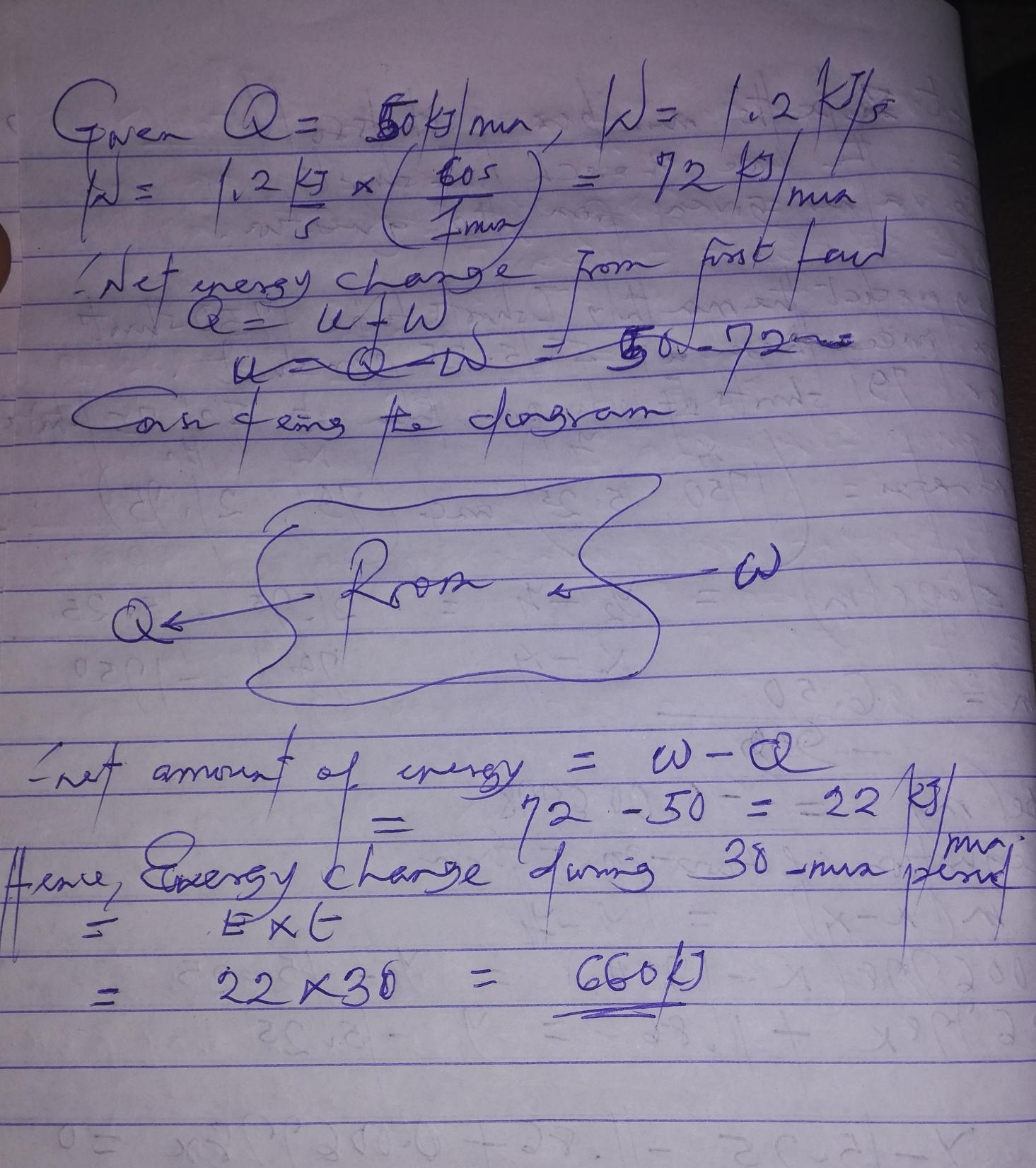
The air contained in a room loses heat to the surroundings at a rate of 50 kJ/min while work is supplied to the room by computer
Artemon [7]

Answer:

net amount of energy change of the air in the room during a 30-min period = 660KJ

Explanation:

The detailed calculation is as shown in the attached file.

4 0
2 years ago
Read 2 more answers
Other questions:
  • A hydrogen-filled balloon to be used in high altitude atmosphere studies will eventually be 100 ft in diameter. At 150,000 ft, t
    7·1 answer
  • 3. (20 points) Suppose we wish to search a linked list of length n, where each element contains a key k along with a hash value
    7·1 answer
  • The four-wheel-drive all-terrain vehicle has a mass of 320 kg with center of mass G2. The driver has a mass of 82 kg with center
    15·1 answer
  • Plastic parts produced by an injection-molding operation are checked for conformance to specifications. Each tool contains 11 ca
    12·1 answer
  • Water flows downward through a vertical 10-mm-diameter galvanized iron pipe with an average velocity for 5.0 m/s and exits as a
    5·1 answer
  • Consider the following class definitions: class smart class superSmart: public smart { { public: public: void print() const; voi
    6·1 answer
  • An equation used to evaluate vacuum filtration is Q = ΔpA2 α(VRw + ARf) , Where Q ≐ L3/T is the filtrate volume flow rate, Δp ≐
    13·1 answer
  • Consider the time domain waveforms below on the left. Match waveforms (a) - (e) to their respective frequency spectrum represent
    11·1 answer
  • Consider a steady developing laminar flow of water in a constant-diameter horizontal discharge pipe attached to a tank. The flui
    14·1 answer
  • Water at 70 kPa and 1008C is compressed isentropically in a closed system to 4 MPa. Determine the final temperature of the water
    6·1 answer
Add answer
Login
Not registered? Fast signup
Signup
Login Signup
Ask question!