answer.
Ask question
Login Signup
Ask question
All categories
  • English
  • Mathematics
  • Social Studies
  • Business
  • History
  • Health
  • Geography
  • Biology
  • Physics
  • Chemistry
  • Computers and Technology
  • Arts
  • World Languages
  • Spanish
  • French
  • German
  • Advanced Placement (AP)
  • SAT
  • Medicine
  • Law
  • Engineering
Harrizon [31]
2 years ago
15

A particle (charge = +40 μC) is located on the x axis at the point x = –20 cm, and a second particle (charge = –50 μC) is placed

on the x axis at x = +30 cm. What is the magnitude of the total electrostatic force on a third particle (charge = –4.0 μC) placed at the origin (x = 0)?

Physics
1 answer:
anyanavicka [17]2 years ago
5 0

Answer:

56N

Explanation:

The magnitude of the total force on the third particle is equal to the resultant force on it due to the first and second particles. From Coulomb's law of electrostatic attraction, the following relationship holds;

F=\frac{kq_1q_2}{r^2}...................(1)

where k is the electrostatic constant whose value is 9 x 10^9Nm^2/C^2 and

r is the distance between the two charges q_1 and q_2.

According to the problem given, let the first charge be q_1, the second charge be q_2 and the third charge at the origin be q_o. Therefore;

q_1=+40\mu C\\q_2=-50\mu C\\q_o=-4\mu C\\

Also, let the force due to the first charge be F_1 and the force due to the second charge be F_2.

Hence, by equation (1); we can write the following;

F_1=\frac{kq_1q_o}{r_1^2}............(2)

F_2=\frac{kq_2q_o}{r_1^2}............(3)

where r_1=20cm =0.2m and r_2=30cm=0.3m

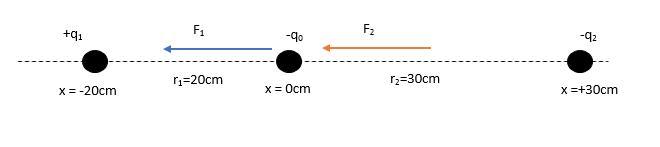
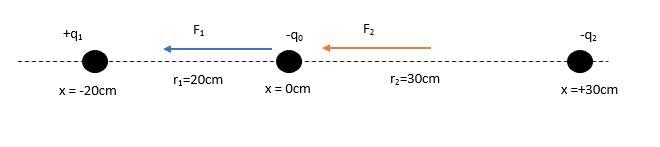
F_1 is attractive since q_1 and q_o are unlike charges while F_2 is repulsive since q_2 and q_o are like charges.

Substituting all values into equations (2) and (3) we obtain the following;

F_1=\frac{9*10^9*40*10^{-6}*4*10^{-6}}{0.2^2}=36N

F_2=\frac{9*10^9*50*10^{-6}*4*10^{-6}}{0.3^2}=20N

Both F_1 and F_2 point towards the left (see attached diagram), hence the resultant force on q_o becomes

F=F_1+F_2

F = 36 +20

F = 56N

You might be interested in
if a toaster transfers 100 joules of energy every ten seconds, what is the power rating of the toaster include the units in your
Mila [183]

Answer:

that is the solution to the question

8 0
2 years ago
Read 2 more answers
A small smooth object slides from rest down a smooth inclined plane inclined at 30 degrees to the horizontal. What is (i) the ac
Ganezh [65]
I believe it would be F*sin(30)/m
4 0
2 years ago
A 0.2-kg steel ball is dropped straight down onto a hard, horizontal floor and bounces straight up. The ball's speed just before
nadya68 [22]

Answer:

Explanation:

Given

mass of steel ball m=0.2\ kg

initial speed of ball u=10\ m/s

Final speed of ball v=-10\ m/s (in upward direction)

Impulse imparted is given by change in the momentum of object

therefore impulse J is given by

J=\Delta P

\Delta P=m(v-u)

\Delta P=0.2(-10-10)

\Delta =-4\ N-s

so magnitude of Impulse =4 N-s

7 0
2 years ago
Read 2 more answers
When Anna eats an apple, the sugars in that apple are broken down into the substance called glucose. Glucose is then burned in h
Alex777 [14]

Answer:

Chemical energy is converted to thermal energy and electrical energy.

Explanation:

The sugar present in the apple is broken down into Glucose. This is chemical energy stored in the apple which is broken down into energy which is utilized by body for everyday works. The chemical energy gets converted to thermal energy which warms the body and electrical energy due to which the heart beats.

7 0
2 years ago
Read 2 more answers
A disk rotates around an axis through its center that is perpendicular to the plane of the disk. The disk has a line drawn on it
natka813 [3]

Answer:

t = \frac{\sqrt{\omega0^2+2*\theta*\alpha} -\omega0}{\alpha}

Explanation:

The rotated angle is given by:

\theta=\omega0*t+1/2*\alpha*t^2

Since this is a quadratic equation it can be solved using:

x=\frac{-b \± \sqrt{b^2-4*a*c}  }{2*a}

Rewriting our equation:

1/2*\alpha*t^2+\omega0*t-\theta=0

t = \frac{\±\sqrt{\omega0^2+2*\theta*\alpha} -\omega0}{\alpha}

Since \sqrt{\omega0^2+2*\theta*\alpha} >\omega0 we discard the negative solution.

t = \frac{\sqrt{\omega0^2+2*\theta*\alpha} -\omega0}{\alpha}

8 0
2 years ago
Other questions:
  • Macy always thought there were only a few hair colors: blond, brown, and black. However, when she actually began looking around,
    12·2 answers
  • The strength of intermolecular forces between particles affects physical properties of substances such as boiling point, melting
    12·2 answers
  • A 0.5-kg ball accelerated at 50 m/s2<br> .<br><br> What force was applied?
    7·1 answer
  • Describing the motion of an object can be difficult to do and using graphs help make motion easier to understand. Motion is a ch
    15·2 answers
  • A short current element dl⃗ = (0.500 mm)j^ carries a current of 5.40 A in the same direction as dl⃗ . Point P is located at r⃗ =
    15·1 answer
  • A solid plate, with a thickness of 15 cm and a thermal conductivity of 80 W/m·K, is being cooled at the upper surface by air. Th
    5·1 answer
  • Given a 100-watt power source, what is the maximum allowable length for the 24-guage transmission media if a signal of 1 Watt is
    9·1 answer
  • A low-pressure sodium vapor lamp whose wavelength is 5.89 x 10⁻⁷ m passes through double-slits that are 6.7 x 10⁻⁴ m apart and p
    10·1 answer
  • In the sum of 54.34 and 45.66, the number of significant figure for the<br>answer is​
    5·1 answer
  • A positively-charged particle is released near the positive plate of a parallel plate capacitor. a. Describe its path after it i
    11·1 answer
Add answer
Login
Not registered? Fast signup
Signup
Login Signup
Ask question!