answer.
Ask question
Login Signup
Ask question
All categories
  • English
  • Mathematics
  • Social Studies
  • Business
  • History
  • Health
  • Geography
  • Biology
  • Physics
  • Chemistry
  • Computers and Technology
  • Arts
  • World Languages
  • Spanish
  • French
  • German
  • Advanced Placement (AP)
  • SAT
  • Medicine
  • Law
  • Engineering
IrinaVladis [17]
2 years ago
14

Carbon dioxide (CO2) gas in a piston-cylinder assembly undergoes three processes in series that begin and end at the same state

(a cycle).
Process 1-2: Expansion from State 1 where p1 = 10 bar, V1 = 1 m3 , to State 2 where V2 = 4 m3 . During the process, pressure and volume are related by pV1.5 = constant.
Process 2-3: Constant volume heating to State 3 where p3 = 10 bar.
Process 3-1: Constant pressure compression to State

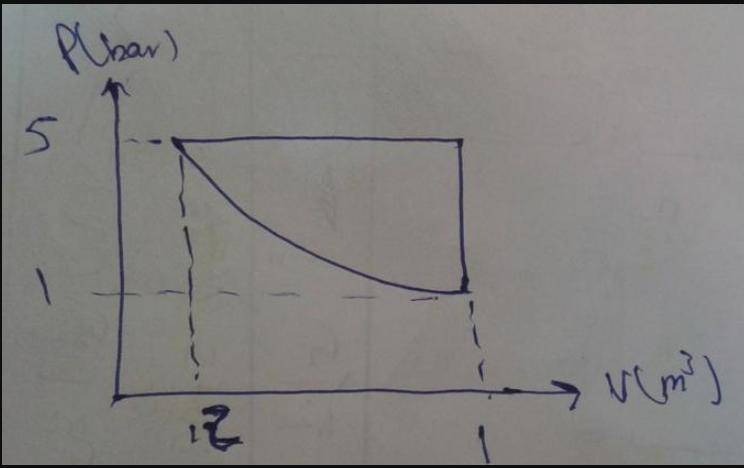
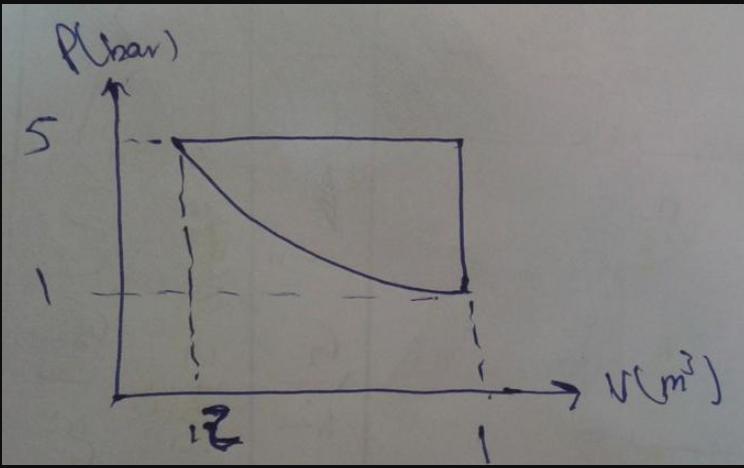
Sketch the processes on p-V coordinates and evaluate the work for each process, in kJ. What is net work for the cycle, in kJ?

Physics
1 answer:
topjm [15]2 years ago
5 0

Answer:

a) W =400 kJ

b) W = 0 kJ

c) W =-160.944 KJ

Explanation:

<u>Given  </u>

<u><em>Process 1 ---> 2 </em></u>

The relation of the process P = constant

Pressure of point (1) P1 =  10 bar = P2

Volume of point (1) V1   = 1 m^3

Volume of point (2) V2 =4 m^3

The relation of the process V = constant  

<u>Process 2 ---> 3 </u>

The relation of the process V = constant

V3 = V2

Pressure of point (3) P3 = 10 bar

Volume of point (3) V3 = 4 m^3

<u>Process 3 ---> 1 </u>

The relation of the process PV = constant  

<u>Required  </u>

Sketch the processes on the PV coordinates

The work for each process in kJ  

<u>Solution  </u>

The work is defined by  

W=\int\limits^a_b {x} \, dx

<em>a=V2</em>

<em>b=V1</em>

<em>x=P</em>

<em>dx=dV</em>

<u>Process 1 ---> 2  </u>

P3 = P4 = 5 bar  

W=\int\limits^a_b {x} \, dx

<em>a=V3</em>

<em>b=V2</em>

<em>x=4</em>

<em>dx=dV</em>

putting the value of a, b, x, dx in above integral

W=400 kJ

<u>Process 2 ---> 3 </u>

V = constant Then there is no change in the volume,hence W = 0 kJ  

<u>Process 3 ---> 1  </u>

By substituting with point (1) --> 5 x .2 = C ---> C = 1 P = 5V^-1  

 W=\int\limits^a_b {x} \, dx

a=V1

b=V3

x=1V^-1

dx=dV

putting the value of a, b, x, dx in above integral

W=| ln V | limit a and b

  = -160.944 KJ
You might be interested in
A 0.250 kgkg toy is undergoing SHM on the end of a horizontal spring with force constant 300 N/mN/m. When the toy is 0.0120 mm f
konstantin123 [22]

Answer:

(a) The total energy of the object at any point in its motion is 0.0416 J

(b) The amplitude of the motion is 0.0167 m

(c) The maximum speed attained by the object during its motion is 0.577 m/s

Explanation:

Given;

mass of the toy, m = 0.25 kg

force constant of the spring, k = 300 N/m

displacement of the toy, x = 0.012 m

speed of the toy, v = 0.4 m/s

(a) The total energy of the object at any point in its motion

E = ¹/₂mv² + ¹/₂kx²

E = ¹/₂ (0.25)(0.4)² + ¹/₂ (300)(0.012)²

E = 0.0416 J

(b) the amplitude of the motion

E = ¹/₂KA²

A = \sqrt{\frac{2E}{K} } \\\\A = \sqrt{\frac{2*0.0416}{300} } \\\\A = 0.0167 \ m

(c) the maximum speed attained by the object during its motion

E = \frac{1}{2} mv_{max}^2\\\\v_{max} = \sqrt{\frac{2E}{m} } \\\\v_{max} = \sqrt{\frac{2*0.0416}{0.25} } \\\\v_{max} = 0.577 \ m/s

8 0
2 years ago
The magnitude J(r) of the current density in a certain cylindrical wire is given as a function of radial distance from the cente
kipiarov [429]

Answer:

I=68.31\times 10^{-6}\ A

Explanation:

Given that

J(r) = Br

We know that area of small element

dA = 2 π dr

I = J A

dI = J dA

Now by putting the values

dI = B r . 2 π dr

dI= 2π Br² dr

Now by integrating above equation

\int_{0}^{I}dI= \int_{r_1}^{r_2}2\pi Br^2 dr

I={2\pi B}\times \dfrac{r_2^3-r_1^3}{3}

Given that

B= 2.35 x 10⁵ A/m³

r₁ = 2 mm

r₂ = 2+ 0.0115 mm

r₂ = 2.0115 mm

I={2\pi B}\times \dfrac{r_2^3-r_1^3}{3}

By putting the values

I={2\pi \times 2.35 \times 10^5 }\times \dfrac{(2.0115\times 10^{-3})^3-(2\times 10^{-3})^3}{3}\ A

I=68.31\times 10^{-6}\ A

7 0
2 years ago
Read 2 more answers
A flashlight beam makes an angle of 60 degrees with the surface of the water before it enters the water. in the water what angle
alexira [117]
<h3><u>Answer</u>;</h3>

= 22°

<h3><u>Explanation</u>;</h3>
  • According to Snell's law, the ratio of the sine of the angle of incidence to the sine of the angle of refraction is a constant. The constant value is called the refractive index of the second medium with respect to the first.
  • Therefore; Sin i/Sin r = η

In this case; Angle of incidence = 90° -60° =30°, angle of refraction =? and η = 1.33

Thus;

Sin 30 / Sin r = 1.33

Sin r = Sin 30°/1.33

       = 0.3759

r = Sin^-1 0.3759

   = 22.08

   <u>≈ 22°</u>

3 0
2 years ago
2.27 A gas is compressed from V1= 0.3 m3, p1=1 bar to V2= 0.1 m3, p2 =3 bar. The pressure and
Georgia [21]

Answer:

-40 kJ

80 kJ

Explanation:

Work is equal to the area under the pressure vs volume graph.

W = ∫ᵥ₁ᵛ² P dV

2.27) Pressure and volume are linearly related.  When we graph P vs V, the area under the line is a trapezoid.  So the work is:

W = ½ (P₁ + P₂) (V₂ − V₁)

W = ½ (100 kPa + 300 kPa) (0.1 m³ − 0.3 m³)

W = -40 kJ

2.29) Pressure and volume are inversely proportional:

pV = k

The initial pressure and volume are 500 kPa and 0.1 m³.  So the constant is:

(500) (0.1) = k

k = 50

The final pressure is 100 kPa.  So the final volume is:

(100) V = 50

V = 0.5

The work is therefore:

W = ∫ᵥ₁ᵛ² P dV

W = ∫₀₁⁰⁵ (50/V) dV

W = 50 ln(V) |₀₁⁰⁵

W = 50 (ln 0.5 − ln 0.1)

W ≈ 80 kJ

5 0
2 years ago
A coat rack weighs 65.0 lbs when it is filled with winter coats and 40.0 lbs when it is empty. The base of the coat rack has an
Whitepunk [10]

Answer:

0.056 psi more pressure is exerted by filled coat rack than an empty coat rack.

Explanation:

First we find the pressure exerted by the rack without coat. So, for that purpose, we use formula:

P₁ = F/A

where,

P₁ = Pressure exerted by empty rack = ?

F = Force exerted by empty rack = Weight of Empty Rack = 40 lb

A = Base Area = 452.4 in²

Therefore,

P₁ = 40 lb/452.4 in²

P₁ = 0.088 psi

Now, we calculate the pressure exerted by the rack along with the coat.

P₂ = F/A

where,

P₂ = Pressure exerted by rack filled with coats= ?

F = Force exerted by filled rack = Weight of Filled Rack = 65 lb

A = Base Area = 452.4 in²

Therefore,

P₂ = 65 lb/452.4 in²

P₂ = 0.144 psi

Now, the difference between both pressures is:

ΔP = P₂ - P₁

ΔP = 0.144 psi - 0.088 psi

<u>ΔP = 0.056 psi</u>

8 0
2 years ago
Other questions:
  • read the excerpt below and answer the question. "no roving foot shall crush thee here, no busy hand provoke a tear." what type o
    12·1 answer
  • Use the formula h = −16t2 + v0t. (if an answer does not exist, enter dne.) a ball is thrown straight upward at an initial speed
    11·1 answer
  • About three billion years ago, single-celled organisms called cyanobacteria lived in Earth’s oceans. They thrived on the ocean’s
    12·2 answers
  • A ball took 0.45s to hit the ground 0.72m from the table. What was the horizontal velocity of the ball as it rolled off the tabl
    8·1 answer
  • To determine the height of a flagpole, Abby throws a ball straight up and times it. She sees that the ball goes by the top of th
    10·1 answer
  • A plastic cube with a coin taped to its top surface is floating partially submerged in water. A student marks the level of the w
    8·1 answer
  • ou purchase a rectangular piece of metal that has dimen- sions 5.0 * 15.0 * 30.0 mm and mass 0.0158 kg. The seller tells you tha
    11·1 answer
  • A child pushes a 75 N toy car across the floor. What is the mass of the car?
    6·1 answer
  • A mouse runs along a baseboard in your house. The mouse's position as a function of time is given by x(t)=pt2+qt, with p = 0.36
    9·1 answer
  • Suppose Mitch Marner (mass=80kg) and Zdano Chara (mass=116kg) collide head-on at the blue line when Marner is skating 10m/s and
    8·1 answer
Add answer
Login
Not registered? Fast signup
Signup
Login Signup
Ask question!