answer.
Ask question
Login Signup
Ask question
All categories
  • English
  • Mathematics
  • Social Studies
  • Business
  • History
  • Health
  • Geography
  • Biology
  • Physics
  • Chemistry
  • Computers and Technology
  • Arts
  • World Languages
  • Spanish
  • French
  • German
  • Advanced Placement (AP)
  • SAT
  • Medicine
  • Law
  • Engineering
solmaris [256]
2 years ago
13

A stock phenolphthalein solution was prepared by dissolving 0.050 g in a total volume of 100.0 ml. You place one drop (0.050 ml)

of this stock solution into a flask and dilute to 100.0 ml. The measured absorbance of this diluted sample is 0.18. What is the value of molar absorptivity, ε?
Chemistry
1 answer:
devlian [24]2 years ago
3 0

Answer:

the value of molar absorptivity is 229000 M^{-1} cm^{-1}

Explanation:

given data

phenol phthalein solution = 0.050 g

total volume = 100.0 ml

dilute = 100.0 ml

diluted sample = 0.18

solution

we get here concentration that is express as

concentration = ( mass of solute × 1000 ) ÷ ( molar mass of solute × volume of solution ) .............1

put here value

concentration = \frac{0.050\times 1000}{318.32\times 100}    

concentration = 0.00157 M

and here dillution equation is express as

c1 × v1 = c2 × v2   .................2

here c1 and c2 is initial and final concentration

and v1 and v2 is initial and final volume

put here value  

0.001571 × 0.050 = c2 × 100

c2 = 7.855 × 10^{-7} M

and

now we get molar by absorbance equation that is

A = E × C ×  l   ................3

here A is absorbance and E is molar and c is absorptivity and l is path length

put here value

0.18 = E × 7.855 × 10^{-7}  × 1

E = 229000 M^{-1} cm^{-1}

You might be interested in
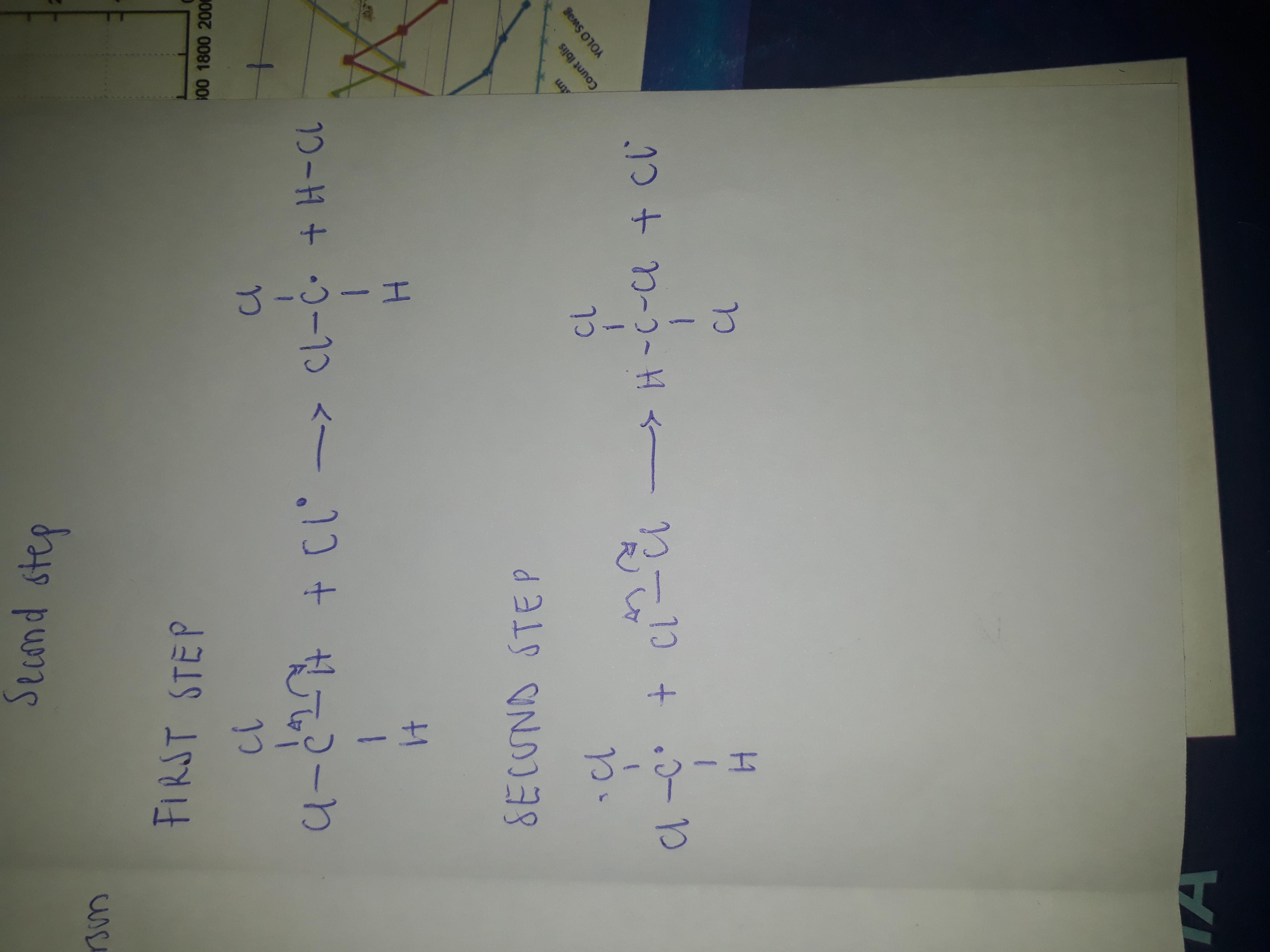
Which of the following represents a propagation step in the monochlorination of methylene chloride (CH2Cl2)?a. CHCl3 + Cl. Right
svetlana [45]

Answer:

B = CHCl2 + Cl2 --> CHCl3 + Cl

Explanation:

Free radical halogenation is a chlorination reaction on Alkane hydrocarbons. This involves the splitting of molecules into radicals/ unstable molecules in the presence of sunlight/ U.V light which ensures bonding of the molecules.

Free radical chlorination is divided into 3 steps which are:

The initiation step

The propagation step

The termination step

So in reference to the question, propagation step involves two steps.

The first step is where the molecule in this case the methylene chloride(CH2Cl2) loses a hydrogen atom and then bond with a chlorine atom radical to give a nethylwnw chloride radical and HCl.

The second step involves the reaction of this methylene chloride got in the first step with chlorine molecule to form trichloride methane and a chlorine radical.

You would find in the attachment the 2 step mechanism.

3 0
2 years ago
Consider the balanced equation below. 4NH3 + 3O2 --> 2N2 + 6H2O What is the mole ratio of NH3 to N2?
AURORKA [14]
The balanced equation given is:
4NH3 + 3O2 .....> 2N2 + 6H2O

From this equation, we can note that 4 moles of NH3 are required to produce 2 moles of N2.

Therefore, the mole ratio of NH3 to N2 is 4:2 which can be simplified into 2:1
4 0
2 years ago
Read 2 more answers
Cyclohexane has a freezing point of 6.50 ∘C and a Kf of 20.0 ∘C/m. What is the freezing point of a solution made by dissolving 0
ExtremeBDS [4]

Answer:

The freezing point will be 2.9^{0}C

Explanation:

The depression in freezing point is a colligative property.

It is related to molality as:

Depressioninfreezing point=K_{f}Xmolality

Where

Kf= 20\frac{^{0}C}{m}

the molality is calculated as:

molality=\frac{moles_{solute}}{mass_{solvent}}

moles=\frac{mass}{molarmass}=\frac{0.694}{154}=0.0045mol

massofcyclohexane=25g=0.025Kg

molarity=\frac{0.0045}{0.025}=0.18m

Depression in freezing point = 20X0.18=3.6^{0}C

The new freezing point = 6.5^{0}C-3.6^{0}C=2.9^{0}C

5 0
2 years ago
Room temperature is about 20 degrees Celsius. Explain how you could convert this temperature to kelvin. Use evidence from the fi
Taya2010 [7]

Answer:

293.15 K.

Explanation:

It is given that, the room temperature is 20 degrees Celsius.

We need to convert this temperature into kelvin.

The conversion from degrees Celsius to Kelvin is as follows :

T_k=T_c+273.15

We have, T_c=20^{\circ} C

So,

T_k=20+273.15\\\\T_k=293.15\ K

So, the room temperature is 293.15 kelvin.

8 0
2 years ago
A 5.0 g sample of calcium nitrate (Ca(NO3)2, M = 164) contaminated with silica (SiO2, M = 60.1) is found to contain 1.0 g calciu
zhenek [66]

Answer:

= 82%

Explanation:

Percentage purity is calculated by the formula;

% purity = (mass of pure chemical/total mass of sample) × 100

In this case;

1 mole of Ca(NO3)2 = 164 g

but; 164 g of Ca(NO3)2 = 40 g Ca

Therefore; mass of Ca(NO3)2 = 164 /40

                                                  = 4.1 g

Thus;

% purity of Ca(NO3)2 = (Mass of Ca(NO3)2/ mass of the sample)× 100

                                    = (4.1 g/ 5 g) × 100

                                    = 82%

4 0
2 years ago
Other questions:
  • Pyridine rings can also under electrophilic aromatic substitution. given 2-methoxypyridine below, draw the expected major produc
    7·1 answer
  • Based on a kc value of 0.200 and the given data table, what are the equilibrium concentrations of xy, x, and y, respectively? ex
    5·1 answer
  • Name the complex ion [cu(cn)6]4−. the oxidation number of copper is +2.enter the name.
    12·1 answer
  • What is the formal charge on the nitrogen in hydroxylamine, h2noh?
    8·1 answer
  • What occurs when an optically active alcohol reacts with HBr to give an alkyl halide? Multiple Choice the chirality center retai
    8·2 answers
  • The enthalpy change for the explosion of ammonium nitrate with fuel oil is –7198 kJ for every 3 moles of NH4NO3. What is the ent
    13·1 answer
  • How many liters of a 0.225 M solution of KI are needed to contain 0.935 moles of KI?
    5·1 answer
  • Write chemical equations and corresponding equilibrium expressions for each of the two ionization steps of carbonic acid. Part A
    11·1 answer
  • How much 2 M HBr is needed to neutralize 380 mL of 0.1 M NH4OH?
    14·1 answer
  • A laboratory utilizes a mixture of 10% dimethyl sulfoxide (DMSO) in the freezing and long-term storage of embryonic stem cells.
    5·1 answer
Add answer
Login
Not registered? Fast signup
Signup
Login Signup
Ask question!