answer.
Ask question
Login Signup
Ask question
All categories
  • English
  • Mathematics
  • Social Studies
  • Business
  • History
  • Health
  • Geography
  • Biology
  • Physics
  • Chemistry
  • Computers and Technology
  • Arts
  • World Languages
  • Spanish
  • French
  • German
  • Advanced Placement (AP)
  • SAT
  • Medicine
  • Law
  • Engineering
sladkih [1.3K]
2 years ago
11

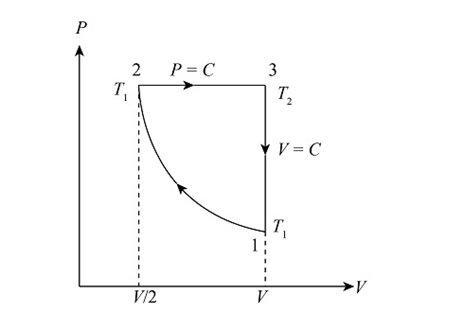
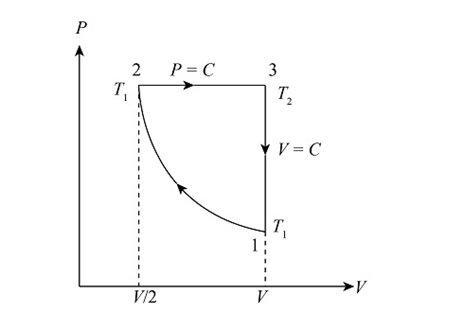
A heat engine using a diatomic ideal gas goes through the following closed cycle: ∙ Isothermal compression until the volume is h

alved. ∙ Isobaric expansion until the volume is restored to its initial value. ∙ Isochoric cooling until the pressure is restored to its initial value.

Physics
1 answer:
Alona [7]2 years ago
6 0

Answer:

a)η = 0.088

b) η = 0.5

Explanation:

a) The attached figure shows the P-V diagram for the process described in the exercise. According to that figure, the work during process 1-2 is equal to:

W(1-2) = -n*R*T1*ln(vi/vf) = -n*R*T1*ln(V/(V/2)) = -n*R*T1*ln(2)

the work during process 2-3 is equal to:

W(2-3) = nR*(T2-T1)

The work done during the 3-1 process equals zero, because the volume is constant. The specific heat for the molar specific heat equals:

cp = 7*R/2, where R is gas constant.

Qin = n*cp*(T2-T1) = 7*n*R/2*(T2-T1)

the efficiency of the cycle is equal to:

η = (W(1-2) + W(2,3))/Qin = (-n*R*T1*ln2 + n*R*(T2-T1))/(7*n*R/2*(T2-T1) = (2/7)*(1-(ln2/((T2/T1)-1)))

if we write the expression between volume and temperature, we have:

T2/T1 = v1/v2

T2/T1 = v/(v/2))

T2/T1 = 2

η = (2/7)*(1-(ln2/(2-1))) = 0.088

b)

The equation for efficiency of Carnot will be equal to:

η = 1-(T1/T2) = 1 - (1/2) = 0.5
You might be interested in
Two speakers, A and B, produce identical sound waves. A listener is 3.2 m away from speaker A. The listener finds the lowest fre
earnstyle [38]

Answer:

  0.83 m or 5.57 m

Explanation:

Destructive interference will occur when the distances from the speakers differ by 1/2 wavelength.

The length of 1 cycle of 72.4 Hz is ...

  λ = v/f = (343 m/s)/(72.4 Hz) ≈ 4.738 m

So, the distance of the listener from speaker B is ...

  3.2 m ± (4.738 m)/2 = {0.83 m, 5.57 m} . . . either of these distances

_____

The location could be at additional multiples of 4.738 m, but we think not. The sound intensity drops off with the square of the distance from the speaker, so identical sound waves from the speakers will sound quite different at different distances from the speakers. For best interference, the distances need to be as close to the same as possible. That will be at 3.2 m and 5.57 m.

_____

<em>Comment on the speed of sound</em>

We don't know what speed you are to use for the speed of sound. We have used 343 m/s. Some sources use 340 m/s, which will give a result different by 2 or 3 cm.

8 0
2 years ago
Technician a says that using a pressure transducer and lab scope is a similar process to using a vacuum gauge. technician b says
Phantasy [73]

Answer: Both Technician A and B

Explanation:

There is a similar process in using a pressure transducer and lab scope to using a vacuum gauge.

And also, the pressure transducer can be used to tie any issues to individual cylinders if paired with a second trace consisting of the ignition pattern. Therefore, both Technician A and B are correct.

7 0
2 years ago
you want to compare brands of paper towels to see which holds the most liquid. the independent variable in your experiment would
Kazeer [188]

Answer: the brand of paper towel

Explanation: the independent variable is the one you control in an experiment. the dependent variable would be the amount of water in the paper towel

5 0
2 years ago
The pupil of the human eye can vary in diameter from 2.00 mm in bright light to 8.00 mm in dim light. The eye has a focal length
Zarrin [17]

The indicated data are of clear understanding for the development of Airy's theory. In optics this phenomenon is described as an optical phenomenon in which The Light, due to its undulatory nature, tends to diffract when it passes through a circular opening.

The formula used for the radius of the Airy disk is given by,

y_r=1.22\frac{\lambda f}{d}

Where,

y_r = Range of the radius

\lambda = wavelength

f= focal length

Our values are given by,

State 1:

d=2.00mm = 2*10^{-3}m

f= 25mm = 25*10^{-3}m

\lambda = 750nm = 750*10^{-9}m

State 2:

d=8.00mm = 8*10^{-3}m

f= 25mm = 25*10^{-3}m

\lambda = 390nm = 390*10^{-9}

Replacing in the first equation we have:

y_{r1} = 1.22\frac{(750*10^{-9})(25*10^{-3})}{2*10^{-3}}

y_{r1}= 11.4\mu m

And also for,

y_{r2} =1.22\frac{(390*10^{-9})(25*10^{-3})}{8*10^{-3}}

y_{r2} = 1.49\mu m

Therefor, the airy disk radius ranges from 1.49\mu m to 11.4\mu m

7 0
2 years ago
A 0.20-kg object attached to the end of a string swings in a vertical circle (radius = 80 cm). at the top of the circle the spee
gayaneshka [121]

Answer:

Tension in the string at this position: 3.1 N.

Explanation:

Convert the radius of the circle to meters:

r = 80\;\text{cm} = 0.80\;\text{m}.

What's the net force on the object?

The object is in a circular motion. As a result,

\displaystyle \Sigma F = \frac{m\cdot v^{2}}{r},

where

  • \Sigma F is the net force on the object,
  • m is the mass of the object,
  • v is the velocity of the object, and
  • r is the radius of the circular motion.

For this object,

\displaystyle \Sigma F = \frac{0.20\times {4.5}^{2}}{0.80} = 5.0625\;\text{N}.

The output unit of net force should be standard if the unit for mass, velocity, and radius are all standard. The net force shall always point towards the center. In this case the net force points downwards.

What are the forces on this object?

There are two forces on the object at this moment:

  • Weight, W, which points downwards. W = m\cdot g = 0.20\times 9.81 = 1.962\;\text{N}.
  • Tension, T, which also points downwards. The size of the tension force needs to be found.

What's the size of the tension force?

Gravity and tension points in the same direction. The size of their resultant force is the sum of the two forces. In other words,

\Sigma F = T + W.

T = \Sigma F - W = 5.0625 - 1.962 = 3.1.

All three values in this question are given with two sig. fig. Round the value of T to the same number of significant figures.

4 0
2 years ago
Other questions:
  • Scientists in a test lab are testing the hardness of a surface before constructing a building. Calculations indicate that the en
    10·1 answer
  • What factors affect attractive force
    14·2 answers
  • Let A be the last two digits and let B be the sum of the last three digits of your 8-digit student ID. (Example: For 20245347, A
    6·1 answer
  • To determine the height of a flagpole, Abby throws a ball straight up and times it. She sees that the ball goes by the top of th
    10·1 answer
  • How do some businesses believe VR is affecting their training for employees?
    5·1 answer
  • A glider is gliding through the air at a height of 416 meters with a speed of 45.2 m/s. The glider dives to a height of 278 mete
    15·1 answer
  • A composite wall separates combustion gases at 2400°C from a liquid coolant at 100°C, with gas and liquid-side convection coeffi
    9·1 answer
  • A man in a strength competition pulls an 18-wheel truck 3.10 m in 20.5 s. There is a cable that is attached to his body that exe
    7·1 answer
  • A box sits on a table. A short arrow labeled F subscript N points up. A short arrow labeled F subscript g points down. A long ar
    6·1 answer
  • Lizette works in her school’s vegetable garden. Every Tuesday, she pulls weeds for 15 minutes. Weeding seems like a never-ending
    15·2 answers
Add answer
Login
Not registered? Fast signup
Signup
Login Signup
Ask question!