answer.
Ask question
Login Signup
Ask question
All categories
  • English
  • Mathematics
  • Social Studies
  • Business
  • History
  • Health
  • Geography
  • Biology
  • Physics
  • Chemistry
  • Computers and Technology
  • Arts
  • World Languages
  • Spanish
  • French
  • German
  • Advanced Placement (AP)
  • SAT
  • Medicine
  • Law
  • Engineering
Vikki [24]
2 years ago
13

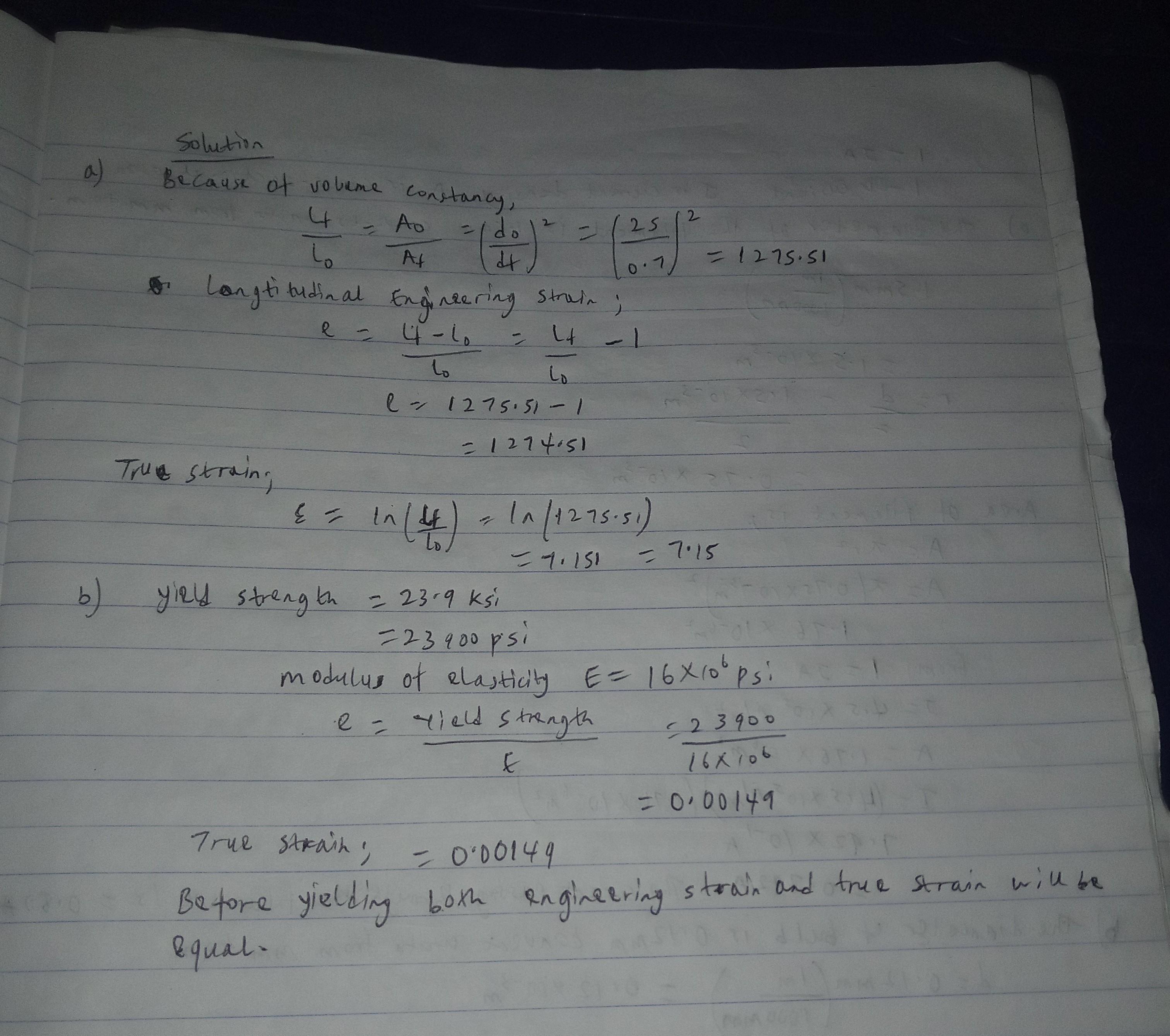
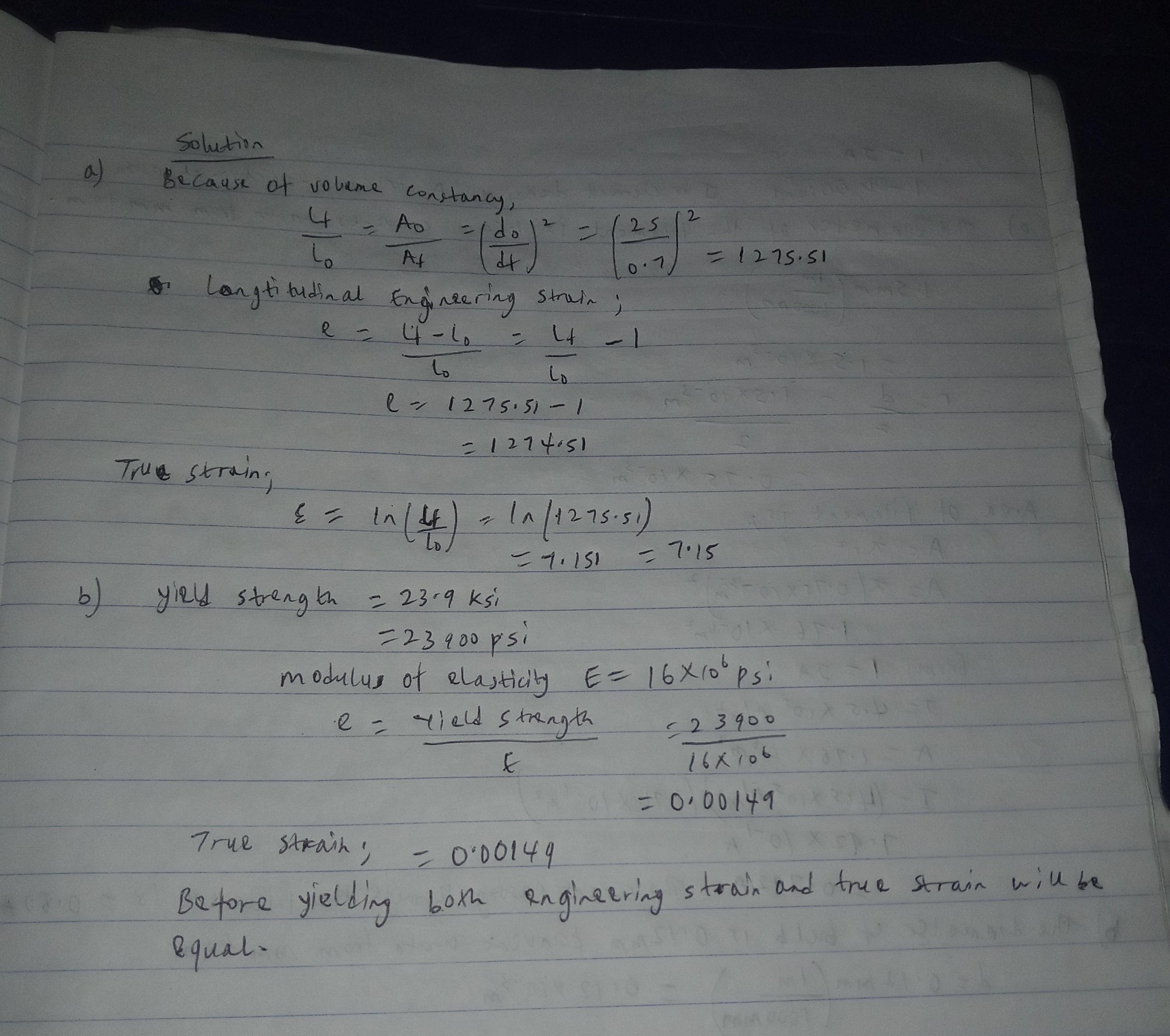
A paper clip is made of wire 0.7 mm in diameter. If the original material from which the wire is made is a rod 25 mm in diameter

, calculate the longitudinal engineering and true strains that the wire has undergone during processing.
(b) The engineering yield strength of a copper alloy is 23.9 ksi and the modulus of elasticity is 16x106 psi. Estimate the engineering strain just before yield and the corresponding true strain. Are you surprised with the result in (b)

Physics
1 answer:
blondinia [14]2 years ago
3 0

Answer:

The solution is attached in the picture below

Explanation:

You might be interested in
A certain alarm clock ticks four times each second, with each tick representing half a period. The balance wheel consists of a t
Semenov [28]

Answer:

a. I=2.77x10^{-8} kg*m^2

b. K=4.37 x10^{-6} N*m

Explanation:

The inertia can be find using

a.

I = m*r^2

m = 0.95 g * \frac{1 kg}{1000g}=9.5x10^{-4} kg

r=0.54 cm * \frac{1m}{100cm} =5.4x10^{-3}m

I = 9.5x10^{-4}kg*(5.4x10^{-3}m)^2

I=2.77x10^{-8} kg*m^2

now to find the torsion constant can use knowing the period of the balance

b.

T=0.5 s

T=2\pi *\sqrt{\frac{I}{K}}

Solve to K'

K = \frac{4\pi^2* I}{T^2}=\frac{4\pi^2*2.7702 kg*m^2}{(0.5s)^2}

K=4.37 x10^{-6} N*m

3 0
2 years ago
An object travels 50 m in 4 s. It had no initial velocity and experiences constant acceleration. What is the magnitude of the ac
Allisa [31]

Answer:

The formula to calculate velocity in this case:

v = v0 + at

=> a = (v - v0)/t

       = (50 - 0)/4

       = 50/4 = 12.5 (m/s2)

Hope this helps!

:)

3 0
2 years ago
The process of changing a property of a wave to transmit information is called .
BARSIC [14]

Answer : The process of changing a property of a wave to transmit information is called Modulation.

Explanation :

Modulation is the process of changing the property of wave to transmit information. This is done with the help of modulator.

In modulation, the message signal is superimposed on a high frequency signal. A sine wave ( usually high frequency ) is used as a high frequency carrier wave.

Modulation can be done in many ways like :

(1) Frequency modulation

(2) Amplitude modulation

(3) Pulse modulation

8 0
2 years ago
Read 2 more answers
A 12.0-kg shell is launched at an angle of 55.0 ∘ above the horizontal with an initial speed of 150 m/s. when it is at its highe
Stolb23 [73]
Hey there! Congratulations on posting your first question! I just want to thank you for taking the initiative to check out Brainly. With Brainly, students combine their strengths and talents to tackle problems together and by answering questions, you’ve helped several students learn even more, both quickly and effectively. If you ever have any questions or concerns feel free to PM me or check out our help center (faq.brainly.com). Thanks! 
7 0
2 years ago
An electron and a proton are held on an x axis, with the electron at x = + 1.000 m and the proton at x = - 1.000 m. Part A How m
r-ruslan [8.4K]

PART A)

Electrostatic potential at the position of origin is given by

V = \frac{kq_1}{r_1} + \frac{kq_2}{r_2}

here we have

q_1 = 1.6 \times 10^{-19} C

q_2 = -1.6 \times 10^{-19} C

r_1 = r_2 = 1 m

now we have

V = \frac{Ke}{r} - \frac{Ke}{r}

V = 0

Now work done to move another charge from infinite to origin is given by

W = q(V_f - V_i)

here we will have

W = e(0 - 0) = 0

so there is no work required to move an electron from infinite to origin

PART B)

Initial potential energy of electron

U = \frac{Kq_1e}{r_1} + \frac{kq_2e}{r_2}

U = \frac{9\times 10^9(-1.6\times 10^{-19}(-1.6 \times 10^{-19})}{19} + \frac{9\times 10^9(1.6\times 10^{-19}(-1.6 \times 10^{-19})}{21}

U = (2.3\times 10^{-28})(\frac{1}{19} - \frac{1}{21})

U = 1.15\times 10^{-30}

Now we know

KE = \frac{1}{2}mv^2

KE = \frac{1}{2}(9.1\times 10^{-31}(100)^2

KE = 4.55 \times 10^{-27} kg

now by energy conservation we will have

So here initial total energy is sufficient high to reach the origin

PART C)

It will reach the origin
4 0
2 years ago
Other questions:
  • Which type of listening response includes the use of head nods, facial expressions, and short utterances such as "uh-huh" that s
    8·1 answer
  • Rod A and rod B are cylindrical rods made of the same metal. amd they differ only in size. Rod B has double the length and doubl
    14·2 answers
  • In a power plant, pipes transporting superheated vapor are very common. Superheated vapor flows at a rate of 0.3 kg/s inside a p
    6·1 answer
  • While traveling from Boston to Hartford, Person A drives at a constant speed of 55 mph for the entire trip. Person B drives at 6
    13·1 answer
  • If 1.00 mol of argon is placed in a 0.500-L container at 28.0 ∘C , what is the difference between the ideal pressure (as predict
    7·1 answer
  • A crate is lifted vertically 1.5 m and then held at rest. The crate has weight 100 N (i.e., it is reese (enr647) – HS OnRamps 04
    5·2 answers
  • Kathmandu lies at high altitude than biratnagar from sea level.Where does an object has more weight between two places?Give reas
    6·1 answer
  • Sharks are generally negatively buoyant; the upward buoyant force is less than the weight force. This is one reason sharks tend
    6·1 answer
  • Stu wanted to calculate the resistance of a light bulb
    11·2 answers
  • The Lyman series comprises a set of spectral lines. All of these lines involve a hydrogen atom whose electron undergoes a change
    9·1 answer
Add answer
Login
Not registered? Fast signup
Signup
Login Signup
Ask question!