answer.
Ask question
Login Signup
Ask question
All categories
  • English
  • Mathematics
  • Social Studies
  • Business
  • History
  • Health
  • Geography
  • Biology
  • Physics
  • Chemistry
  • Computers and Technology
  • Arts
  • World Languages
  • Spanish
  • French
  • German
  • Advanced Placement (AP)
  • SAT
  • Medicine
  • Law
  • Engineering
tensa zangetsu [6.8K]
2 years ago
11

Classify each process according to direction of heat flow.

Chemistry
2 answers:
GenaCL600 [577]2 years ago
8 0

Answer:

heat flows in

heat flows out

heat flows put

Explanation:

cluponka [151]2 years ago
5 0

Answer:

heat flows in

heat flows out

heat flows put

Explanation:

You might be interested in
The pKs of succinic acid are 4.21 and 5.64. How many grams of monosodium succinate (FW = 140 g/mol) and disodium succinate (FW =
Varvara68 [4.7K]

Answer:

9.744g of monosodium succinate.

4.925g of disodium succinate.

Explanation:

To find pH of the buffer produced by the mixture of monosodium succinate-Disodium succinate is obtained from H-H equation:

pH = pKa + log ([Na₂Suc] / [NaHSuc])

As you want a pH of 5.28 and pKa is 5.64:

5.28 = 5.64 + log ([Na₂Suc] / [NaHSuc])

-0.36 = log ([Na₂Suc] / [NaHSuc])

0.4365 = ([Na₂Suc] / [NaHSuc]) <em>(1)</em>

<em />

As total concentration of the buffer is 100mM = 0.100M:

0.100M = [Na₂Suc] + [NaHSuc] <em>(2)</em>

Replacing (2) in (1):

0.4365 = (0.100M - [NaHSuc] / [NaHSuc])

0.4365 = (0.100M - [NaHSuc] / [NaHSuc])

0.4365 [NaHSuc] = 0.100M - [NaHSuc]

1.4365 [NaHSuc] = 0.100M

[NaHSuc] = 0.0696M

And:

[Na₂Suc] = 0.0304M

As volume of the buffer is 1L:

[NaHSuc] = 0.0696 moles

[Na₂Suc] = 0.0304 moles

Using molar mass of both substances:

Mass of monosodium succinate:

0.0696moles * (140g / 1mol) =<em> 9.744g of monosodium succinate.</em>

Mass of disodium succinate:

0.0304moles * (162g / 1mol) =<em> 4.925g of disodium succinate.</em>

<em></em>

5 0
2 years ago
El cuerpo humano tiene unos 6 billones de células (6,0x10¹²) y la población de la Tierra es de unos 8 000 millones de personas.
zloy xaker [14]

Answer:

En toda la población del mundo hay <u>0.0797 moles de células</u>

Explanation:

1.0 mol of cells = 6.022 * 10∧23 cells

X mol of cells  = 6.0 * 10∧12 cells

- X is cleared to find out how many moles of cells are in a human body:

  • X = 6.0 * 10∧12 cells / 6.022 * 10∧23 cells
  • X = 9,963 * 10∧-12 moles of cells per person

In the world there are 8 * 10∧9 people, how many moles in total will there be?

8 * 10∧9 people * 9,963 * 10∧-12 moles of cells per person  =

<u>0.0797 moles of molecules in the entire population of the earth.</u>

4 0
2 years ago
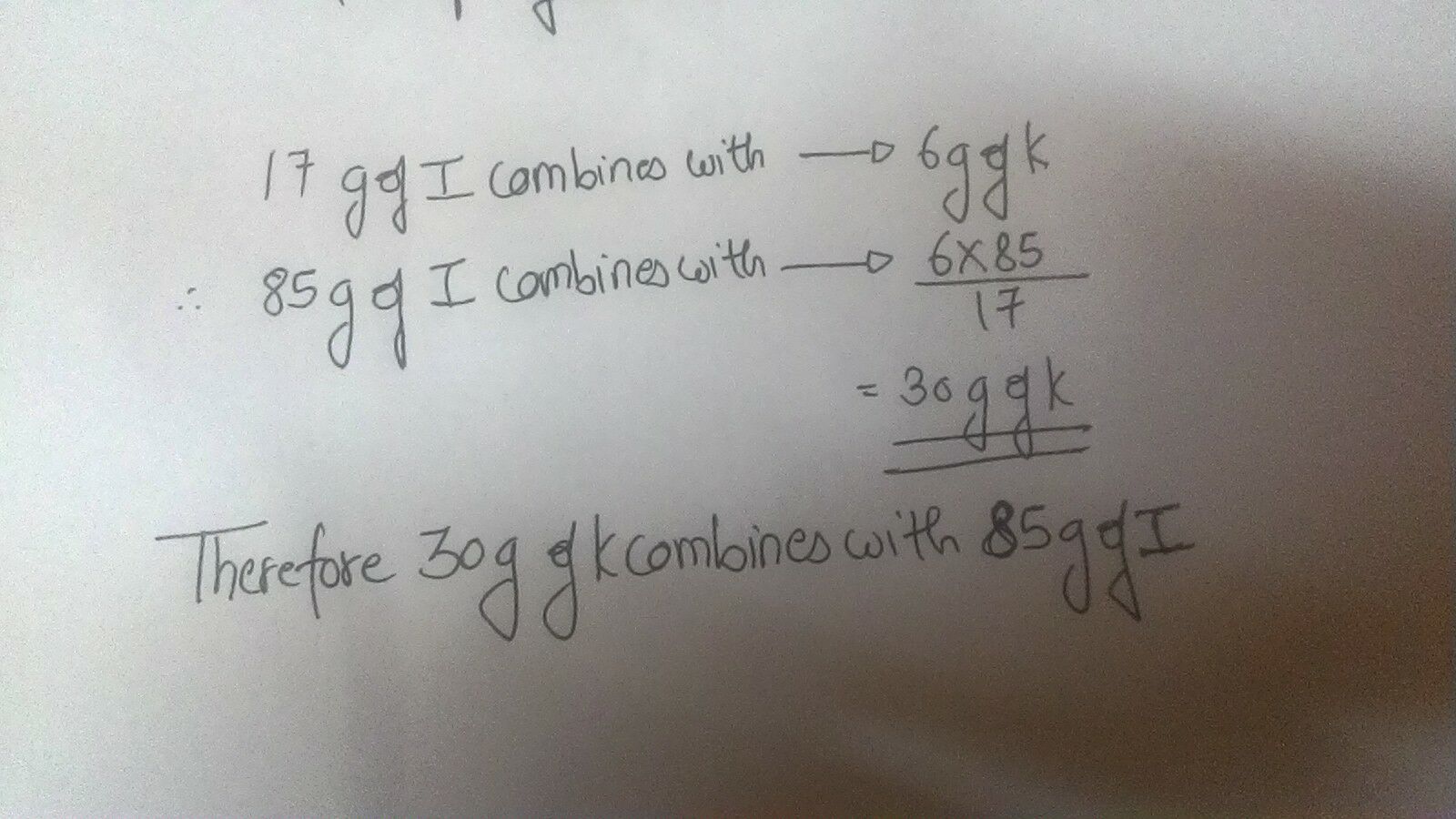
If 6 g of element k combine with 17 g of element l, how many grams of element k combine with 85 g of element l?
Ede4ka [16]
Hope this helps you.

5 0
2 years ago
11. If there are 8.24 x 10²² molecules of NaCl in a salt shaker, what is the mass of the salt?
vlada-n [284]

Answer: 8.12 g NaCl

Explanation: Use Avogadro's number to find the number of m

moles of NaCl:

8.24x10²² molecules NaCl / 1 mole NaCl/ 6.022x10²³ molecules NaCl

= 0.14 mole NaCl

Next convert moles to grams NaCl using its molar mass;

0.14 mole NaCl x 58g NaCl / 1 mole NaCl

= 8.12 g NaCl

6 0
2 years ago
Which element would you expect to form an ionic compound when combined with bromine (Br)?
daser333 [38]
Ionic bond is formed due to the transfer of electrons from one atom to another so that all atoms involved in the bond would become stable (with 8 electrons in the outermost level)

Now, for bromine, it has 35 electrons. This means that bromine has 7 valence electrons in the outermost level. Therefore, bromine needs to gain one electron in order to become stable.

Bromine can react with elements from:
group 1: each element in group 1 needs to lose one electron to become stable. Therefore, one bromine atom can form an ionic bond when combined with an atom of an element from group 1 (element in group 1 loses its electron for bromine atom).
group 2: each element in group 2 needs to lose two electrons to become stable. Therefore, two bromine atoms can form ionic bonds when combined with an atom of an element from group 2 (element in group 2 loses two electrons, one for each bromine atom).
group 3: each element in group 3 needs to lose three electrons to become stable. Therefore, three bromine atoms can form ionic bonds when combined with an atom of an element from group 1 (element in group 3 loses three electrons, one for each bromine atom).

Since no choices are given , I cannot tell the exact choice. But the correct one would be the element from either group 1 , 2 or 3.
3 0
2 years ago
Read 2 more answers
Other questions:
  • Which compound most likely contains polar covalent bonds?. The choices are the following: NaCl. AlF3. Br2. NF3
    13·2 answers
  • How many grams of o2 are required to produce 358.5 grams of zno??
    10·2 answers
  • When a small piece of white marble rock is carefully placed in a beaker of hydrochloric acid, bubbles form on the surface of the
    13·2 answers
  • The acid-dissociation constant, ka, for gallic acid is 4.57 ⋅ 10-3. what is the base-dissociation constant, kb, for the gallate
    8·2 answers
  • Identify the conjugate acid base pair <br> H3PO4(ag)+CO32=HCO3-(ag)+HPO42-(ag)
    8·1 answer
  • Assume the following substances are soluble in water.
    11·1 answer
  • An airplane cabin is pressurized to 5.80x10^2.What is the pressure inside the cabin in atmospheres?
    14·1 answer
  • For a hydrogen atom, which electronic transition would result in the emission of a photon with the highest energy?
    11·1 answer
  • A fossil is found to have a 14 C 14C level of 70.0 70.0 % compared to living organisms. How old is the fossil?
    12·1 answer
  • QUESTION 2
    15·1 answer
Add answer
Login
Not registered? Fast signup
Signup
Login Signup
Ask question!