answer.
Ask question
Login Signup
Ask question
All categories
  • English
  • Mathematics
  • Social Studies
  • Business
  • History
  • Health
  • Geography
  • Biology
  • Physics
  • Chemistry
  • Computers and Technology
  • Arts
  • World Languages
  • Spanish
  • French
  • German
  • Advanced Placement (AP)
  • SAT
  • Medicine
  • Law
  • Engineering
spin [16.1K]
2 years ago
4

During 4 hours one winter afternoon, when the outside temperature was 10° C, a house heated by electricity was kept at 19° C wit

h the expenditure of 58 kwh (kilowatt·hours) of electric energy. (a) What was the average energy leakage in joules per second (watts) through the walls of the house to the environment (the outside air and ground)? watts (b) The rate at which energy is transferred between two systems due to a temperature difference is often proportional to their temperature difference. Assuming this to hold in this case, if the house temperature had been kept at 22° C (71.6° F), how many kwh of electricity would have been consumed? kwh

Physics
2 answers:
bekas [8.4K]2 years ago
5 0

Answer:

a

The average energy leakage is  A= 14500J/s

b

The KWh of electricity consumed is  E_1=70.43Kwh

Explanation:

From the question we are told that

      The temperature outside T_o = 10^oC

       The The duration is  t =4 hours = 4 *3600 =14400s

       The Annual energy expenditure is  E = 58kwh = 58*1000*3600 = 2088*10^5J

        The temperature of the house is T_h = 24^oC

The average energy leakage(A) can be mathematically obtained by this formula

                            A = \frac{E}{t}

                               = \frac{2088*10^5}{14400}

                               A= 14500J/s    

Given that the house temperature T_h =27^oC

  The electrical energy consumed at T_h_1 =24^oC is E = 58Kwh

   The electrical energy consumed at T_h_2 = 27^0C is E_1 = ?

Since energy is proportional to (T-T_{ambient})

Where T_{ambient } is the temperature of outside (T_0)

The expression of the relationship between E and E_1 is mathematically represented as

               \frac{E}{E_1} = \frac{T_h_1 -T_{ambiant}}{T_h_2 - T_{ambiant}}

Substituting values

                \frac{E}{E_1} = \frac{24-11}{27-11}

                      =0.8235

 Now making E_1 the subject of the equation

        E_1 = \frac{E}{0.8235}

             = \frac{58}{0.8235}

             E_1=70.43Kwh


Wewaii [24]2 years ago
4 0

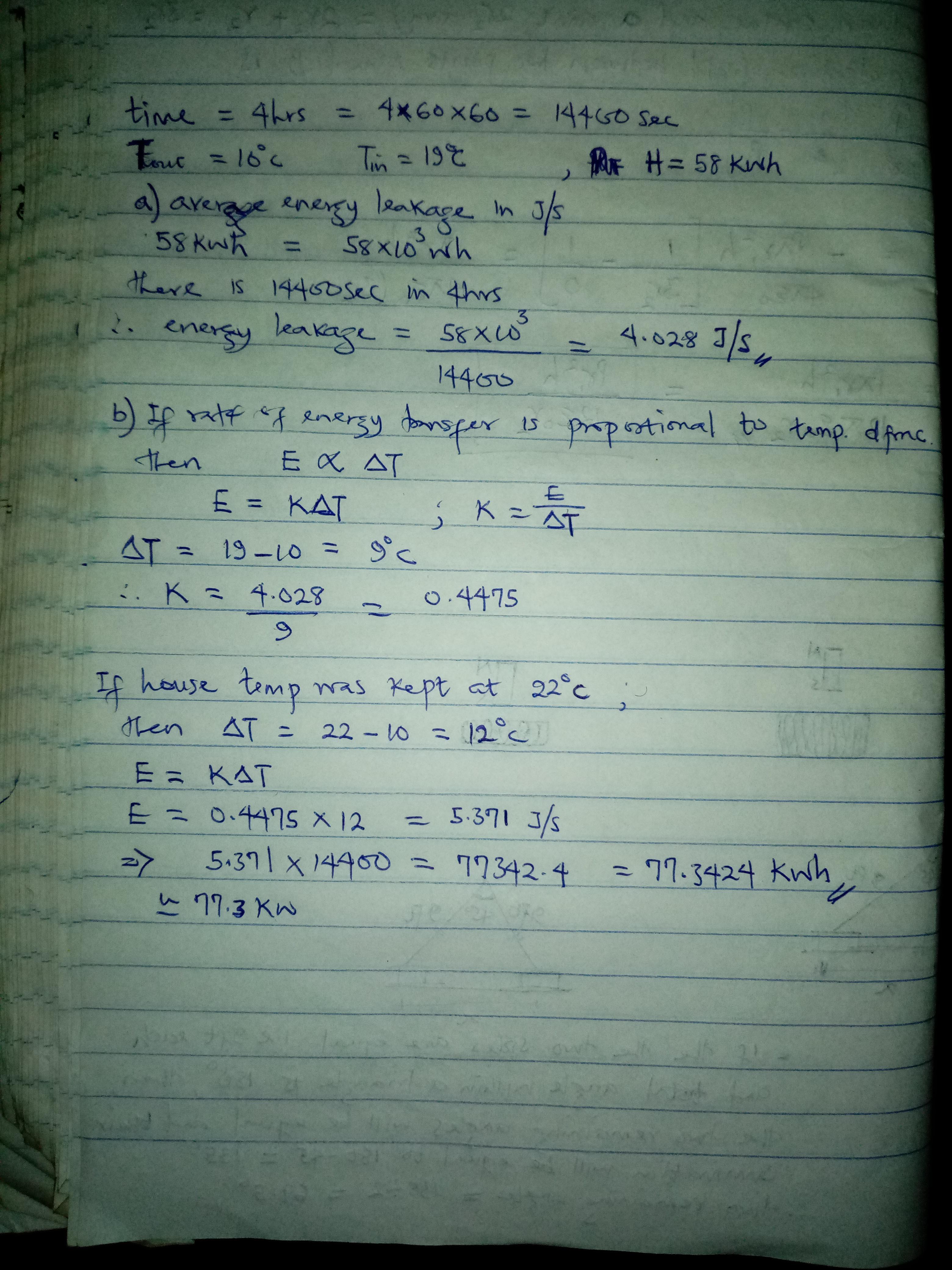
Answer: a) 4.028J/s

b) 77.3kW

Explanation:

Detailed explanation and calculation is shown in the image below.

You might be interested in
A girl is shown at position A on a swing when the seat is directly below the support bar. The seat is then at height A as shown
MrRa [10]

Answer:

<u></u>

  • <u>1. The potential energy of the swing is the greatest at the position B.</u>

  • <u>2. As the swing moves from point B to point A, the kinetic energy is increasing.</u>

Explanation:

Even though the syntax of the text is not completely clear, likely because it accompanies a drawing that is not included, it results clear that the posittion A is where the seat is at the lowest position, and the position B is upper.

The gravitational <em>potential energy </em>is directly proportional to the height of the objects with respect to some reference altitude. Thus, when the seat is at the position A the swing has the smallest potential energy and when the seat is at the <em>position B the swing has the greatest potential energy.</em>

Regarding the forms of energy, as the swing moves from point B to point A, it is going downward, gaining kinetic energy (speed) at the expense of the potential energy (losing altitude). When the seat passes by the position A, the kinetic energy is maximum and the potential energy is miminum. Then the seat starts to gain altitude again, losing the kinetic energy and gaining potential energy, up to it gets to the other end,

7 0
2 years ago
Read 2 more answers
two negative charge of -2.0 c and a positive charge of 3.0 c are separated by 80 m what is the force between two charges
kozerog [31]
The Coulomb force is equal to the constant k times the product of charge one and charge two over radius.

F=k((q1q2)/r)
6 0
2 years ago
What is the mass of an object that creates 33,750 joules of energy by traveling at 30 m/sec?
nikklg [1K]
The Energy is Kinetic Energy.

Kinetic Energy = 1/2*mv²,  Where m is mass in kg, v is velocity in m/s

Energy is 33750 Juoles,  v = 30m/s

1/2*mv² = E

1/2*m*30² = 33750

m = (2*33750) / (30²)     Using a calculator

m = 75 kg

Mass of object is 75 kg.
5 0
2 years ago
Read 2 more answers
A radioactive isotope has a half-life of 2 hours. If a sample of the element contains 600,000 radioactive nuclei at 12 noon, how
storchak [24]

Answer: There will be 75258 nuclei left at 6 pm.

Explanation:

a) half-life of the radioactive substance:

Half life is the amount of time taken by a radioactive material to decay to half of its original value.

t_{\frac{1}{2}}=\frac{0.69}{k}

k=\frac{0.69}{t_{\frac{1}{2}}}=\frac{0.693}{2hours}=0.346hours^{-1}

b) Expression for rate law for first order kinetics is given by:

A=A_0e^{-kt}

where,

k = rate constant  

t = time for decomposition = 6 hours ( from 12 noon to 6 pm)

A = activity at time t = ?

A_0 = initial activity  = 600, 000

A=600000\times e^{-0.346\times 6}

A=75258

Thus there will be 75258 nuclei left at 6 pm.

7 0
2 years ago
An electric drill transfers 200 J of energy into a useful kinetic energy store. It also transfers 44 J of energy by sound and 48
kramer

Answer:

Er = 108 [J]

Explanation:

To solve this problem we must understand that the total energy is 200 [J]. Of this energy 44 [J] are lost in sound and 48 [J] are lost in heat. In such a way that these energy values must be subtracted from the total of the kinetic energy.

200 - 44 - 48 = Er

Where:

Er = remaining energy [J]

Er = 108 [J]

3 0
2 years ago
Other questions:
  • A double slit apparatus is held 1.2 m from a screen. [___/4] (a) When red light (λ = 600 nm) is sent through the double slit, th
    13·1 answer
  • Use the formula h = −16t2 + v0t. (if an answer does not exist, enter dne.) a ball is thrown straight upward at an initial speed
    11·1 answer
  • Which factors could be potential sources of error in the experiment? check all that apply.
    11·2 answers
  • A dog is chasing a cat towards a tree. The cat has a 10-yard lead and runs at 6 yards per second. The dog runs at a speed of 8 y
    15·1 answer
  • Charlie is playing with his daughter Torrey in the snow. She sits on a sled and asks him to slide her across a flat, horizontal
    10·2 answers
  • An object is attached to a hanging unstretched ideal and massless spring and slowly lowered to its equilibrium position, a dista
    14·1 answer
  • Krista is playing tennis at the park. When the tennis ball flies toward her, Krista hits the ball with her racket, which causes
    8·1 answer
  • A skateboarder travels on a horizontal surface with an initial velocity of 3.2 m/s toward the south and a constant acceleration
    8·1 answer
  • Consider the specific example of a positive charge qqq moving in the +x direction with the local magnetic field in the +y direct
    12·2 answers
  • A group of students prepare for a robotic competition and build a robot that can launch large spheres of mass M in the horizonta
    9·1 answer
Add answer
Login
Not registered? Fast signup
Signup
Login Signup
Ask question!