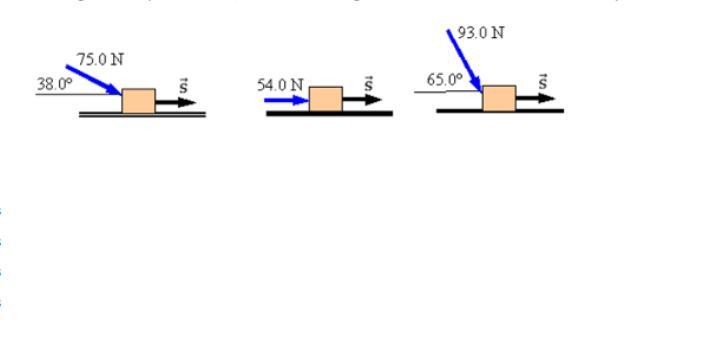
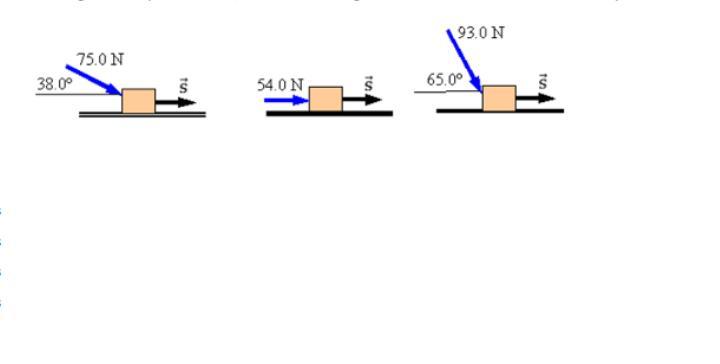
The image depicting the 3 forces is missing, so I've attached the image.
Answer:
v = 27.09 m/s
Explanation:
If we assume that no friction exists, we can solve as follows;
From the images we see that;
First image: F=75N acting at angle of 38°
Second Image: F = 54N acting Horizontally
Third Image: F=93N acting at 65°
Thus,
Sum of forces about the x - axis
ΣFx = 75cos(38) + 54cos(0) + 93cos(65)
ΣFx = (75 x 0.7880) + (54 x 1) + (93 x 0.4226)
ΣFx = 152.4 N
Now,
Sum of the forces =mass x acceleration,
Thus,
ΣFx = ma
Mass is given as 2.7kg
Thus,
152.4 = 2.7a
a = 152.4/2.7
a = 56.44 m/s²
Using Newton's equation of motion;
v² = u² + 2as
Where;
v is final velocity
u is initial velocity
a is acceleration
s is distance traveled in the x direction
Now, it starts from rest, thus, u = 0m/s
a =56.44 m/s²
s = 6.5m
Thus;
v² = 0 + 2(56.44)(6.5)
v² = 733.72
v = √733.72
v = 27.09 m/s