answer.
Ask question
Login Signup
Ask question
All categories
  • English
  • Mathematics
  • Social Studies
  • Business
  • History
  • Health
  • Geography
  • Biology
  • Physics
  • Chemistry
  • Computers and Technology
  • Arts
  • World Languages
  • Spanish
  • French
  • German
  • Advanced Placement (AP)
  • SAT
  • Medicine
  • Law
  • Engineering
mylen [45]
2 years ago
14

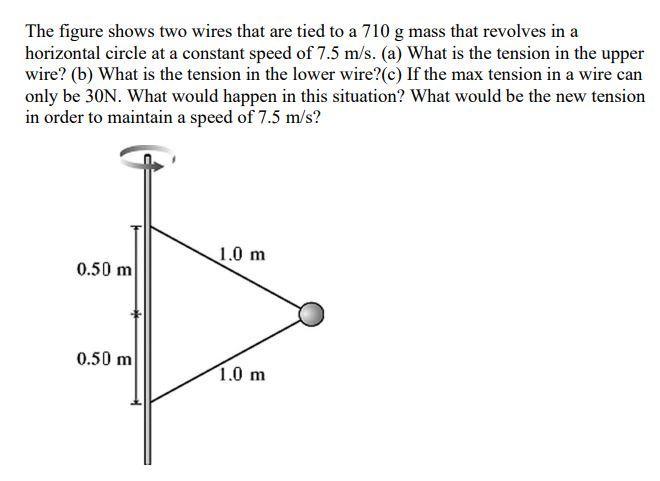
The figure shows two wires that are tied to a 710 g mass that revolves in a horizontal circle at a constant speed of 7.5 m/s. (a

) What is the tension in the upper wire? (b) What is the tension in the lower wire?(c) If the max tension in a wire can only be 30N. What would happen in this situation? What would be the new tension in order to maintain a speed of 7.5 m/s?

Physics
1 answer:
rodikova [14]2 years ago
4 0

Answer:

(a). Upper wire = 33.59 N

(b). downward wire = 19.67 N

(c). The upper wire would break.

Explanation:

The centripetal force  that keeps the mass moving in a circular path is directed towards the center and has the magnitude

F =\dfrac{M*v^2}{R}

Since

R = \sqrt{1.0m^2-0.5m^2} = \dfrac{\sqrt{3} }{2}

m= 0.710kg,

and v= 7.5m/s

the centripetal force is

F =\dfrac{0.710(7.5)^2}{\dfrac{\sqrt{3} }{2} }

F= 46.12N

The two wires are supporting this force; therefore,

T_1 cos(\theta)+T_2 cos(\theta)=46.12N.

(1).\:\: (T_u+T_d)cos(\theta)=46.12N

Also, gravity is pulling down on the mass, and the wires must also support that; therefore,

T_usin(\theta)= mg+T_dsin(\theta)

(2).\: \: (T_1-T_2)sin(\theta)= mg

Now,

\theta = sin^{-1}(\dfrac{0.5m}{1.0m} )= 30^o;

therefore, equations (1) and (2) give

(T_1+T_2)=\dfrac{46.12N }{cos(30^o)}

\boxed{(3). \:(T_1+T_2)=53.25N}

and

(T_1-T_2)= \dfrac{mg}{sin(\theta)}

\boxed{(4). \: T_1-T_2 = 13.916}

Solving equations (3) and (4) gives

\boxed{T_1= 33.59N}\\\\\boxed{T_2 = 19.67N}}

Thus, the tension in the upper wire is 33.59 N and in the bottom wire 19.67 N.

(c).

If the maximum tension in a wire can only be 30 N, then the upper wire would break because we see that its tension of 33.59 N exceeds 30 N.
You might be interested in
A brick is resting on a rough incline as shown in the figure. The friction force acting on the brick, along the incline, is
Tasya [4]
B) equal to the gravitational force of the brick
6 0
2 years ago
Read 2 more answers
The energy stored in oil come from the sun. Describe how energy from the sun became stored in oil
nirvana33 [79]

Crude oil has parts of decomposed dinosaurs and plants from millions of years ago. When the sun gave energy to the plants for their growth, the dinasours ate them which is now is stored in the oil today. So the sun gave energy to plants, dinosaurs ate them, pasted away and decomposed, then we drill and use it as oil.  

4 0
2 years ago
Read 2 more answers
Draw the vector C⃗ =1.5A⃗ −3B⃗ . The length and orientation of the vector will be graded. The location of the vector is not impo
Nutka1998 [239]
I made the drawing in the attached file.

I included two figures.

The upper figure shows the effect of:

- multiplying vector A times 1.5.
 It is drawn in red with dotted line.

- multiplying vector B times - 3 .
It is drawn in purple with dotted line.

In the lower figure you have the resultant vector: C = 1.5A - 3B.

The method is that you translate the tail of the vector -3B unitl the point of the vector 1,5A, preserving the angles.

Then you draw the arrow that joins the tail of 1,5A with the point of -3B after translation.

The resultant arrow is the vector C and it is drawn in black dotted line.
 
Download pdf
7 0
2 years ago
Read 2 more answers
A baseball pitcher throws a ball at 90.0 mi/h in the horizontal direction. How far does the ball fall vertically by the time it
Lisa [10]

Answer:

Vertical distance=  3.3803ft

Explanation:

First with the speed of the ball and the distance traveled horizontally we can determine the flight time to reach the plate:

Velocity= (90 mi/h) × (1 mile/5280ft) = 475200ft/h

Distance= Velocity × time⇒ time= 60.5ft / (475200ft/h) = 0.00012731h

time=  0.00012731h × (3600s/h)= 0.458316s

With this time we can determine the distance traveled vertically taking into account that its initial vertical velocity is zero and its acceleration is that of gravity, 9.81m/s²:

Vertical distance= (1/2) × 9.81 (m/s²) × (0.458316s)²=1.0303m

Vertical distance= 1.0303m × (1ft/0.3048m) = 3.3803ft

This is the vertical distance traveled by the ball from the time it is thrown by the pitcher until it reaches the plate, regardless of air resistance.

3 0
2 years ago
A large container, 120 cm deep is filled with water. If a small hole is punched in its side 77.0 cm from the top, at what initia
prisoha [69]

Answer:

The water will flow at a speed of 3,884 m/s

Explanation:

Torricelli's equation

v = \sqrt{2gh}

*v = liquid velocity at the exit of the hole

g = gravity acceleration

h = distance from the surface of the liquid to the center of the hole.

v = \sqrt{2*9,8m/s^2*0,77m} = 3,884 m/s

6 0
2 years ago
Other questions:
  • Charlie is playing with his daughter Torrey in the snow. She sits on a sled and asks him to slide her across a flat, horizontal
    10·2 answers
  • A floating ice block is pushed through a displacement d = (14 m) i hat - (11 m) j along a straight embankment by rushing water,
    15·1 answer
  • A typical jet airliner has a cruise airspeed of 900 km/h , which is its speed relative to the air through which it is flying. If
    9·1 answer
  • A government agency estimated that air bags have saved over 14,000 lives as of April 2004 in the United States. (They also state
    13·1 answer
  • In Hooke's law, Fspring=kΔx , what does the Fspring stand for?
    8·2 answers
  • Three +3.0-μC point charges are at the three corners of a square of side 0.50 m. The last corner is occupied by a −3.0-μC charge
    12·1 answer
  • Hiran is standing beside the road when he hears a bird flying away from hip and chirping. The bird’s chirp has a frequency of 18
    11·1 answer
  • A ball is dropped from the top of an eleven-story building to a balcony on the ninth floor. In which case is the change in the p
    6·1 answer
  • Q1: A runner is jogging in a straight line at a steady vr= 6.8 km/hr. When the runner is L= 2.4 km from the finish line, a bird
    9·1 answer
  • Physics professor Antonia Moreno is pushed up a ramp inclined upward at an angle 31.0 ∘ above the horizontal as she sits in her
    13·1 answer
Add answer
Login
Not registered? Fast signup
Signup
Login Signup
Ask question!
