answer.
Ask question
Login Signup
Ask question
All categories
  • English
  • Mathematics
  • Social Studies
  • Business
  • History
  • Health
  • Geography
  • Biology
  • Physics
  • Chemistry
  • Computers and Technology
  • Arts
  • World Languages
  • Spanish
  • French
  • German
  • Advanced Placement (AP)
  • SAT
  • Medicine
  • Law
  • Engineering
mario62 [17]
2 years ago
3

If half the kinetic energy of the initially moving object (m1m1) is transferred to the other object (m2m2), what is the ratio of

their masses? Express your answers using three significant figures separated by a comma.
Physics
1 answer:
Trava [24]2 years ago
7 0

Answer:

0.25( m1m1) , 0.75( m2m2)

Explanation:

Noted the formula for kinetic energy is 1/2(Mass × Velocity).

Therefore the original value of the mass is 0.5, giving half away makes it 0.25 to another mass which is primarily 0.5. This now makes the new mass 0.25+0.5=0.75.

Thank you.

You might be interested in
What is the momentum of a 533 kg blimp moving east at +75 m/s
mylen [45]

Answer:

39975kgm/s due east

Explanation:

Given parameters:

Mass of the blimp  = 533kg

Velocity  = +75m/s due east

Unknown:

Momentum of the body  = ?

Solution:

The momentum of a body is the amount of motion it posses.

 Momentum is the product of mass and velocity;


  Momentum = mass x velocity

  Insert the parameters and solve;

    Momentum  = 533 x 75  = 39975kgm/s

The momentum of the body is 39975kgm/s due east

7 0
1 year ago
What is the mass of an object that weighs 686N on Earth?
Oxana [17]

Answer:

70 kg is the mass of the object

Explanation:

This question can be solved with this simple formula:

Weight force = mass . gravity

686 N = mass . 9.8 m/s²

686 N /  9.8 m/s² = mass → 70 kg

Note → 1N = 1 kg . m / s²

8 0
2 years ago
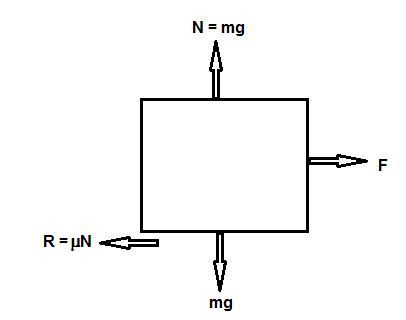
An object has a mass of 15 kg and is accelerating to the right at 16.3 m/s2. The free-body diagram shows the horizontal forces a
marshall27 [118]
Refer to the free body diagram shown melow.

F =  applied force
R =  frictional force
m = 15 kg, the mass of the object

The acceleration (to the right) is 16.3 m/s², therefore
F - R = (15 kg)*(16.3 m/s²) = 244.5 N

The normal reaction is
N = mg = (15 kg)*(9.8 m/s²)  = 147 N
The frictional force is
R = μN = 147μ N,  where μ =  coefficient of kinetic friction.

Let us check possible answers:
If R = 5.5 N, then μ = 5.5/147 = 0.0374 (very likely)
If R = 15 N, then μ = 15/147 = 0.102 (possible)
If R = 244.5 N,   (Highly unlikely, exceed mg)
If R = 494.5 N, (highly unlikely, exceeds mg)

Answer:
The most reasonable answer is R = 5.5 N

8 0
2 years ago
Read 2 more answers
An object weighs 200 newtons at a distance of 100 kilometers above the center of a small uniform planet. how much will the objec
disa [49]

Since the law of gravitation is an inverse square law if you quadruple the radius the f will drop by a factor of 16 SO the object would weigh 200/16 = 12.5N

In other words, as the distance, or radius, quadruples the weight becomes 1/16 of the original weight. Just plug in 4 for r and when you square it you get 16. The numerator is 1 so that is how the weight becomes 1/16.

7 0
2 years ago
What unit is used to measure energy when calculating specific heat capacity? Give the abbreviation, not the full name.
Svet_ta [14]
Energy is in Joules ( J )
specific heat capacity is in ( Joules per Kilogram per degree Celsius) ( J/kg C )
3 0
2 years ago
Other questions:
  • An 80-g particle moving with an initial speed of 50 m/s in the positive x direction strikes and sticks to a 60-g particle moving
    12·1 answer
  • You have a pumpkin of mass m and radius r. the pumpkin has the shape of a sphere, but it is not uniform inside so you do not kno
    8·1 answer
  • Which statements describe the characteristics of asteroids? Check all that apply. formed 4.6 billion years ago orbit the Sun bey
    7·2 answers
  • When astronomers discuss the apertures of their telescopes, they say bigger is better. Explain why.
    11·1 answer
  • Pions have a half-life of 1.8 x 10^-8 s. A pion beam leaves an accelerator at a speed of 0.8c. What is the expected distance ove
    10·1 answer
  • Two red blood cells each have a mass of 9.05×10⁻¹⁴ kg and carry a negative charge spread uniformly over their surfaces. The repu
    9·1 answer
  • A very long wire carries a uniform linear charge density of 5 nC/m. What is the electric field strength 13 m from the center of
    15·1 answer
  • A truck is using a hook to tow a car whose mass is one quarter that of the truck. If the force exerted by the truck on the car i
    12·1 answer
  • If you pull a resistant puppy with its leash in a horizontal direction, it takes 80 N to get it going. You can then keep it movi
    9·1 answer
  • A rabbit is trying to cross the street. Its velocity v as a function of time t is given in the graph below where
    7·1 answer
Add answer
Login
Not registered? Fast signup
Signup
Login Signup
Ask question!