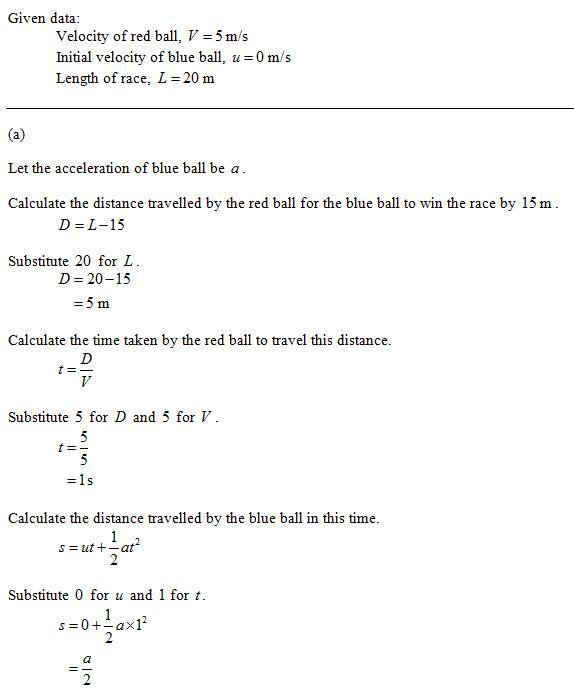
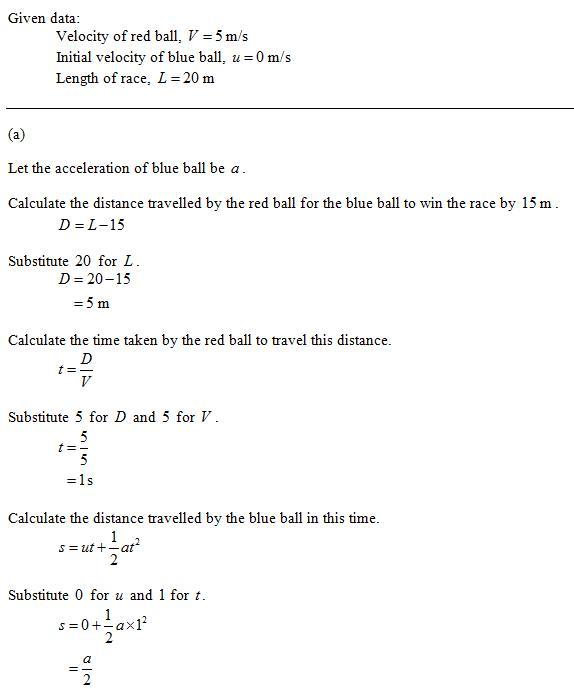
answer.
Ask question
Login Signup
Ask question
All categories
  • English
  • Mathematics
  • Social Studies
  • Business
  • History
  • Health
  • Geography
  • Biology
  • Physics
  • Chemistry
  • Computers and Technology
  • Arts
  • World Languages
  • Spanish
  • French
  • German
  • Advanced Placement (AP)
  • SAT
  • Medicine
  • Law
  • Engineering
kirill [66]
2 years ago
4

In the simulation above the red ball's motion is always the same (5.00 m/s) while the blue ball's motion can be modified by chan

ging the value of its acceleration (that is set by the slider). Note that for each part of this question you can use the simulation to help guide you, and in some cases to check your answer, but you should calculate numerical answers based on principles of physics rather than taking numbers directly from the simulation.
(a) What would the blue ball's acceleration have to be for the blue ball to win the race by a distance of 15.0 meters?

For the remaining questions set the acceleration of the blue ball to be 5.70 m/s2.

(b) How far is the second ball from the finish line when the first ball reaches the line?
(c) If the motion continues for both balls until the second ball reaches the finish line, what is the distance between the two balls at that time?

Physics
1 answer:
erastovalidia [21]2 years ago
3 0

Find the attachments

You might be interested in
7. A local sign company needs to install a new billboard. The signpost is 30 m tall, and the ladder truck is parked 24 m away fr
wolverine [178]
<h2>Solution :</h2>

Here ,

• Height of sign post = 30 m

• Distance between signpost and truck = 24 m

Let the

• Top of signpost = A

• Bottom of signpost = B

• The end of truck facing sign post be = C

Now as we can clearly imagine that the ladder will act as an hypotenuse to the Triangle ABC .

Where

• AB = Height of signpost = 30 m

• BC = distance between both = 24 m

• AC = Minimum length of ladder

→ AC² = AB² + BC² ( As we can see AB is perpendicular to BC )

→ AC² = (30)² + (24)²

→ AC² = 900 + 576

→ AC² = 1476

→ AC = 38.41875

or AC apx = 38.42

So minimum height of ladder = 38.42

6 0
2 years ago
Consider two circular metal wire loops each carrying the same current I as shown below. In what r... Consider two circular metal
NeX [460]

Answer:

1) The magnetic field outside the loop is zero.

In region III the magnetic fields due to the two wire loops point in the opposite direction andhence cancel each other. Therefore the magnetic field is zero in region I, III and V

The diagram is attached

6 0
2 years ago
To what potential should you charge a 2.0 μF capacitor to store 1.0 J of energy?
Bess [88]
E = (1/2)CV²
1 = (1/2)*(2*10⁻⁶)V²
10⁶ = V²
1000 = V

You should charge it to 1000 volts to store 1.0 J of energy.
6 0
2 years ago
The wavelength of green light is 550 nm.
SIZIF [17.4K]

Answer:

(a) momentum of photon is 1.205 x 10⁻²⁷ kgm/s

    velocity of electron is 1323.88 m/s

   momentum of the electron is 1.205 x 10⁻²⁷ kgm/s

(b) momentum of photon is 1.506 x 10⁻²⁷ kgm/s

  velocity of electron is 1654.85 m/s

  momentum of the electron is 1.506 x 10⁻²⁷ kgm/s

(c) The momentum of the photon is equal to the momentum of the electron

Explanation:

(a)

wavelength of green light, λ = 550 nm

momentum of photon is given by;

p = \frac{h}{\lambda}\\\\ p = \frac{6.626 *10^{-34}}{550*10^{-9}}\\\\p = 1.205 *10^{-27} \ kg.m/s

velocity of electron is given by;

P = \frac{h}{\lambda} \\\\mv = \frac{h}{\lambda}\\\\v = \frac{h}{m \lambda}\\\\v =   \frac{6.626 *10^{-34}}{(9.1*10^{-31} )(550*10^{-9})}\\\\v = 1323.88 \ m/s

momentum of the electron is given by;

p = mv

p = (9.1 x 10⁻³¹) (1323.88)

p = 1.205 x 10⁻²⁷ kgm/s

(b)

wavelength of red light, λ = 440 nm

momentum of photon is given by;

p = \frac{h}{\lambda}\\\\ p = \frac{6.626 *10^{-34}}{440*10^{-9}}\\\\p = 1.506 *10^{-27} \ kg.m/s

velocity of electron is given by;

v =   \frac{6.626 *10^{-34}}{(9.1*10^{-31} )(440*10^{-9})}\\\\v = 1654.85 \ m/s

momentum of the electron is given by;

p = mv

p =  (9.1 x 10⁻³¹) (1654.85)

p = 1.506 x 10⁻²⁷ kgm/s

(c) The momentum of the photon is equal to the momentum of the electron.
7 0
2 years ago
Convert the volume 8.06 in.3 to m3, recalling that1in. =2.54cmand100cm=1m. Answer in units of m3.
galina1969 [7]
1 in=2.54 cm=(2.54 cm)(1 m/100 cm)=0.0254 m
Therefore:
1 in=0.0254 m
1 in³=(0.0254 m)³=1.6387064 x 10⁻⁵ m³

Therefore:

8.06 in³=(8.06 in³)(1.6387064 x 10⁻⁵ m³ / 1 in³)≈1.321 x 10⁻⁴ m³.

Answer: 8.06 in³=1.321 x 10⁻⁴ m³
8 0
2 years ago
Other questions:
  • Describe a well-known hypothesis that was discarded because it was found to be untrue.earth-centered model of the universe. the
    6·1 answer
  • Jane is a team leader. Match her leadership and teamwork skills to the appropriate descriptions.making her team understand the r
    6·1 answer
  • A varying force is given by F=Ae ^-kx, where x is the position;A and I are constants that have units of N and m^-1 , respectivel
    11·1 answer
  • If Pete ( mass=90.0kg) weights himself and finds that he weighs 30.0 pounds, how far away from the surface of the earth is he
    9·1 answer
  • 1. Two identical bowling balls of mass M and radius R roll side by side at speed v0 along a flat surface. Ball 1 encounters a ra
    11·1 answer
  • Reset the PhET simulation (using the button in the lower right) and set it up in the following manner: select Oscillate, select
    15·1 answer
  • (4%) Problem 10: The standard frequency of the musical pitch called "middle C" is 261.6 Hz. show answer No Attempt How fast, in
    6·1 answer
  • Four kilograms of carbon monoxide (CO) is contained in a rigid tank with a volume of 1 m^3. The tank is fitted with a paddle whe
    11·1 answer
  • Which of these has the most kinetic energy
    5·2 answers
  • Things that are moving out of phase create an interference pattern<br> TURE or False??
    15·1 answer
Add answer
Login
Not registered? Fast signup
Signup
Login Signup
Ask question!